


















Lesson 12 of 49 · Airfoils and Lift
Pressure and lift
Learn the pressure coefficient Cp, how Cp curves reveal lift, the Kutta condition and Kutta-Joukowski theorem, with a numeric check on a spinning cylinder.
To go from "the wing lifts" to "how much", we need a measure of pressure that does not depend on speed or air density. That measure is the pressure coefficient. Plotted along the airfoil, it shows exactly where the lift is generated, and its area is the lift itself. In this lesson you will compute Cp, read a Cp curve, and then see the circulation picture of lift confirmed by a short numerical experiment.
What you will learn
- The definition of the pressure coefficient and its link to local speed.
- How to read a Cp plot: stagnation point, suction peak, recovery.
- How lift comes from integrating pressure around the section.
- What the Kutta condition and the Kutta–Joukowski theorem say.
Key terms
Pressure coefficient (Cp): Cp = (p − p∞) / q∞, the local pressure relative to the free stream, divided by the free-stream dynamic pressure.
Suction peak: the most negative Cp, usually near the leading edge of the upper surface.
Kutta condition: the flow leaves a sharp trailing edge smoothly, fixing the circulation.
Circulation (Γ): the line integral of velocity around a closed loop enclosing the body, in m²/s.
Section lift coefficient (cl): lift per unit span divided by q∞ c.
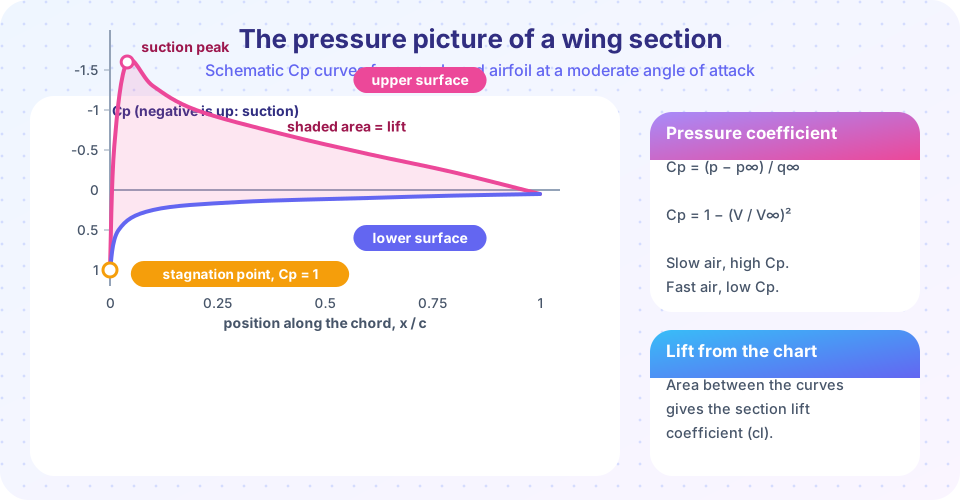
The pressure coefficient
The pressure on an airfoil depends on the free-stream pressure, so we subtract p∞ and divide by the free-stream dynamic pressure:
Cp = (p − p∞) / (½ ρ∞ V∞²)
For low-speed (incompressible) flow, Bernoulli's equation p + ½ρV² = p∞ + ½ρV∞² turns this into a statement about speed alone:
Cp = 1 − (V / V∞)²
Three cases cover most of what you need.
| Local speed | Cp | Meaning |
|---|---|---|
| V = 0 (stagnation point) | +1 | maximum possible pressure, at the leading edge |
| V = V∞ | 0 | pressure equals the free stream |
| V = 1.5 V∞ | −1.25 | strong suction on the upper surface |
Reading a Cp curve is routine for aerodynamicists. Starting at the leading edge: the flow stagnates (Cp = 1), then splits. The upper-surface flow accelerates around the nose to a suction peak, then slows as it moves back, so Cp climbs back toward zero and slightly positive at the trailing edge. That rising pressure is an adverse pressure gradient, which will matter for stall. The lower surface sees a smaller deviation from Cp = 0.
From Cp to lift
Pressure acts perpendicular to the surface, so for a thin airfoil at a small angle the normal-force coefficient is the difference between lower and upper Cp, integrated along the chord:
cn = ∫₀¹ (Cp,lower − Cp,upper) d(x/c)
and cl ≈ cn cos α. The shaded area between the two curves on the Cp plot is the lift. Notice what this means for design: the area is mostly the strip near the leading edge, where the suction peak lives. That is why leading-edge shape matters so much for maximum lift.
Circulation, the Kutta condition and the Kutta–Joukowski theorem
Circulation Γ is a way to measure the net swirl of the flow around the airfoil. Add a swirl around a body in a uniform stream and the flow speeds up on one side and slows on the other. For any body in 2D, incompressible, inviscid flow, the Kutta–Joukowski theorem states
L' = ρ V∞ Γ
where L' is lift per unit span. A fast stream with a small circulation gives the same lift as a slow stream with a large one.
But what decides Γ for an airfoil? Theory alone allows any value, and the physics adds a rule: the Kutta condition. At a sharp trailing edge the real flow, with a little viscosity, leaves smoothly with the upper and lower streams meeting there. Only one value of Γ satisfies this at each angle of attack. The condition explains how a wing "starts" its lift: when an airplane begins to move, the flow tries to go around the trailing edge, a starting vortex is shed with opposite circulation, and the wing is left with the matching bound circulation. The starting vortex is left behind on the runway.
Checking the theorem on a spinning cylinder
A circular cylinder with circulation is the simplest lifting body, and we can check Kutta–Joukowski numerically. For a cylinder of radius R in a stream V∞, with a circulation parameter κ = Γ / (2π R V∞), the surface speed at angle θ is 2 V∞ sin θ + κ V∞. Using Bernoulli we get
Cp(θ) = 1 − (2 sin θ + κ)²
and the vertical force per unit span is found by integrating pressure around the surface. The code below does this numerically and compares with ρ V Γ. It also finds the horizontal force (drag). For an ideal, frictionless flow it comes out at zero: this is d'Alembert's paradox, which Prandtl's boundary-layer idea resolved by showing that drag comes from viscosity.
Common misconceptions
"Pressure below the wing is much higher than ambient." For a typical wing at cruise, most of the lift comes from the upper surface suction. On a typical airfoil at moderate angles, the upper surface carries well over half of the lift.
"Circulation means the air goes round and round the wing." The air flows past the wing in a stream. The circulation is a mathematical measure of the net difference between speeds on the two sides.
"Cp is a pressure." It is a dimensionless ratio. Multiply by q∞ and add p∞ to recover the pressure in pascals.
Try it
Press Run (or Ctrl + Enter) to see the result here.
Program input · what you'd type while the program runs
Type the answers before you press Run, one per line. Each time the program reads a line (with input()), it gets the next line from this box.
Press Run (or Ctrl + Enter) to see the result here.
Program input · what you'd type while the program runs
Type the answers before you press Run, one per line. Each time the program reads a line (with input()), it gets the next line from this box.
Check your understanding
Quick check · 5 questions
of 5 answered You scored / 5 · perfect!
-
1. What is Cp at a stagnation point in incompressible flow?
V = 0, so Cp = 1 − 0 = 1: the maximum possible pressure coefficient. -
2. A point on the upper surface has Cp = −1.25. How fast is the air there compared with V∞?
V/V∞ = sqrt(1 − Cp) = sqrt(2.25) = 1.5. -
3. In the Kutta–Joukowski theorem L' = ρ V∞ Γ, what does Γ represent?
Γ is the circulation, the net swirl of the flow around the body. -
4. What does the Kutta condition do?
Of all the possible values of Γ, only one makes the flow leave the sharp trailing edge smoothly. -
5. The area between the lower and upper Cp curves (plotted against x/c) represents:
Integrating the pressure difference over the chord gives the normal-force coefficient, which is close to cl at small angles.
Summary
Cp = (p − p∞)/q∞ = 1 − (V/V∞)²in incompressible flow; stagnation gives Cp = 1.- The area between the lower- and upper-surface Cp curves is the section lift.
- The Kutta condition fixes circulation; Kutta–Joukowski gives
L' = ρV∞Γ. - A frictionless flow predicts zero drag (d'Alembert's paradox); drag needs viscosity.
Next: Thin-airfoil theory
Track your progress
Create a free account to tick off lessons and pick up where you left off on any device.
of Aerodynamics lessons completed