


















Lesson 38 of 49 · Computational Aerodynamics
Panel methods and potential flow
Learn potential flow, sources, vortices, the Kutta condition and how a panel method turns a body into a small linear system, with a working source-panel code.
Long before computers could solve the full equations of motion, aerodynamicists discovered that a surprising amount of flow behavior comes from a much simpler idea: treat the air as an ideal fluid that is incompressible and has no viscosity and no rotation. Then the flow obeys a linear equation, which means you can build complicated flows by adding simple ones. Panel methods exploit this: cover the body surface with flat panels, put a simple flow element on each, and solve a small linear system. They remain a workhorse for fast low-speed design and for teaching how CFD works.
What you will learn
- The potential-flow model and why superposition works.
- The building blocks: uniform flow, source, vortex and doublet.
- How the Kutta condition fixes circulation and lift.
- How a source panel method works, with a code you can run.
Key terms
Velocity potential (φ): a scalar whose gradient is the velocity, V = ∇φ; it exists for irrotational flow.
Laplace's equation: ∇²φ = 0, the governing equation for incompressible irrotational flow.
Singularity: a source, vortex or doublet used as a building block.
Kutta condition: at a sharp trailing edge the flow leaves smoothly, with finite velocity.
The potential-flow model
If the flow is steady, incompressible and irrotational, mass conservation ∇·V = 0 combined with V = ∇φ gives Laplace's equation ∇²φ = 0. This equation is linear: if φ₁ and φ₂ are solutions, so is φ₁ + φ₂. That is the superposition principle, and it is why we can add a free stream to a source and a vortex and get the flow around something new.
The boundary conditions are simple: the velocity far away equals the free stream, and at the body surface the flow cannot pass through it, V · n = 0. Pressure follows from Bernoulli's equation, and the pressure coefficient is:
Cp = (p − p∞) / (½ ρ V∞²) = 1 − (V / V∞)²
Building blocks
- Uniform flow: a constant velocity everywhere.
- Source (strength
σ): fluid flows radially outward at speedσ/(2πr)in two dimensions; a sink has negative strength. - Vortex (circulation
Γ): fluid circles at speedΓ/(2πr); it carries no net volume flow. - Doublet: a source and sink of equal strength pushed together; it makes the flow around a circle when combined with a uniform stream.
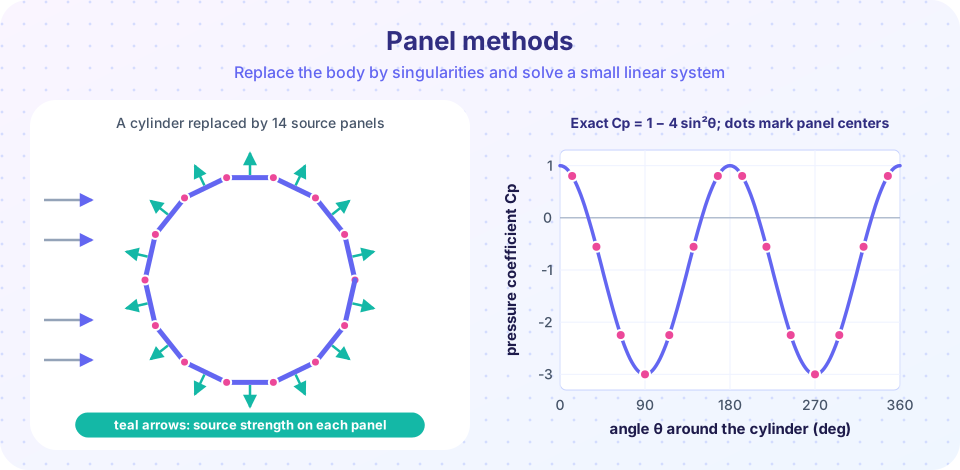
A uniform stream plus a doublet gives the flow around a circular cylinder, with surface speed V = 2V∞ |sin θ| and so Cp = 1 − 4 sin²θ. Add a vortex of circulation Γ and the flow becomes asymmetric, the surface speed is V = 2V∞ sin θ + Γ/(2πR) in magnitude (with the right sign convention), and the cylinder produces lift. The Kutta-Joukowski theorem says that the lift per unit span is L' = ρ V∞ Γ for any closed shape, which is the same relation you met in lifting-line theory.
Two famous results deserve a warning. D'Alembert's paradox: in steady, inviscid potential flow the drag of a body is exactly zero. The model has no friction and no separation, so it cannot predict drag. It can predict lift and pressure distributions where the real flow stays attached.
The Kutta condition
Potential flow around a lifting airfoil is not unique: you can add any amount of circulation and the boundary conditions remain satisfied. Nature picks one value. Experiments show that the flow leaves a sharp trailing edge smoothly, so we demand that the flow velocity there stays finite and the flow leaves along the bisector (or equal speed on both sides). This Kutta condition fixes the circulation and gives the lift. A panel method for a lifting airfoil places vortices on the panels and adds one equation for the Kutta condition.
How a source panel method works
For a non-lifting body (like a circular cylinder) a source panel method goes as follows:
- Approximate the body outline by
Nstraight panels, with control points at the middle of each panel. - Place a source of unknown constant strength
σⱼon each panelj. - Compute how much velocity panel
jinduces at control pointi: the influence coefficient, found from the analytical integral of a source distribution over a straight segment. - Demand no flow through the surface at every control point:
V∞ · nᵢ + Σⱼ σⱼ (Vⱼ→ᵢ · nᵢ) = 0. That is anN × Nlinear system for the strengths. - Compute tangential velocity at the panels, then
Cp = 1 − (V_t/V∞)².
Because the unknowns live only on the surface, no mesh fills the air. That is why panel methods are quick, even for a complete aircraft with a vortex-lattice or surface-panel variant. Their price is the potential-flow model: no viscosity, no shocks, no separation, so results become unreliable beyond moderate angles of attack and near stall.
Common misconceptions
"Potential flow is wrong, so it is useless." Outside the thin boundary layer, real attached flow is nearly irrotational, so potential flow predicts pressures and lift well before stall.
"Sources on the surface mean the body is leaking." The sources are mathematical stand-ins that arrange the exterior flow so that it is parallel to the surface; no fluid flows through the body.
"The Kutta condition is a law of nature." It is a model assumption based on viscous behavior at sharp edges; it works because viscosity sets the circulation.
Try it
First, a complete source panel code. It accepts any closed outline whose points run counter-clockwise. The circular cylinder is a special case where the discrete answer happens to be exact; the ellipse (axis ratio 1 : 2, flow along the long axis) shows the usual convergence toward the exact top-surface speed V (1 + b/a) = 1.5 V.
Press Run (or Ctrl + Enter) to see the result here.
Program input · what you'd type while the program runs
Type the answers before you press Run, one per line. Each time the program reads a line (with input()), it gets the next line from this box.
Second, add circulation to a cylinder and watch the stagnation points move together. This uses the analytic solution (uniform stream plus doublet plus vortex).
Press Run (or Ctrl + Enter) to see the result here.
Program input · what you'd type while the program runs
Type the answers before you press Run, one per line. Each time the program reads a line (with input()), it gets the next line from this box.
Check your understanding
Quick check · 5 questions
of 5 answered You scored / 5 · perfect!
-
1. Why can complicated potential flows be built from simple ones?
Linearity gives the superposition principle. -
2. What does the Kutta condition fix?
It selects the one circulation for which the flow leaves the trailing edge smoothly. -
3. In potential flow, what is the drag of a body in steady flow?
Without viscosity or separation the model predicts no drag. -
4. The surface Cp of a cylinder in potential flow at θ = 90° is
Cp = 1 − 4 sin²(90°) = −3. -
5. A panel method's unknowns live
That is why it needs no volume mesh and is so quick.
Summary
- Steady, incompressible, irrotational flow obeys the linear Laplace equation, so singularities can be superposed.
- The Kutta condition picks the circulation;
L' = ρ V Γ. - Panel methods solve for singularity strengths on the surface; they predict lift and pressure well in attached flow but no drag, separation or shocks.
Track your progress
Create a free account to tick off lessons and pick up where you left off on any device.
of Aerodynamics lessons completed