


















Lesson 3 of 49 · Getting Started
The four forces in flight
Understand lift, drag, thrust and weight, the lift and drag equations, steady climb, and how banking in a turn raises load factor and stall speed.
Four forces act on every aircraft in flight. Two of them, weight and thrust, come from gravity and the engine. The other two, lift and drag, come from the air, and they are the subject of this course. In this lesson you will see how the four fit together, meet the two equations you will use for the rest of the course, and learn why an aircraft that banks needs more lift than its own weight.
What you will learn
- How the four forces are defined and which direction each one acts.
- The lift and drag equations and what CL and CD mean.
- How forces balance in steady level flight and in a steady climb.
- How load factor and stall speed change in a banked turn.
Key terms
Lift (L): aerodynamic force perpendicular to the free-stream velocity.
Drag (D): aerodynamic force parallel to the free-stream velocity, opposing motion through the air.
Dynamic pressure (q): q = ½ ρ V², the pressure scale of the flow, in pascals.
Lift coefficient (CL): lift made dimensionless: CL = L / (q S).
Load factor (n): lift divided by weight, n = L / W. It equals the "g" a pilot feels.
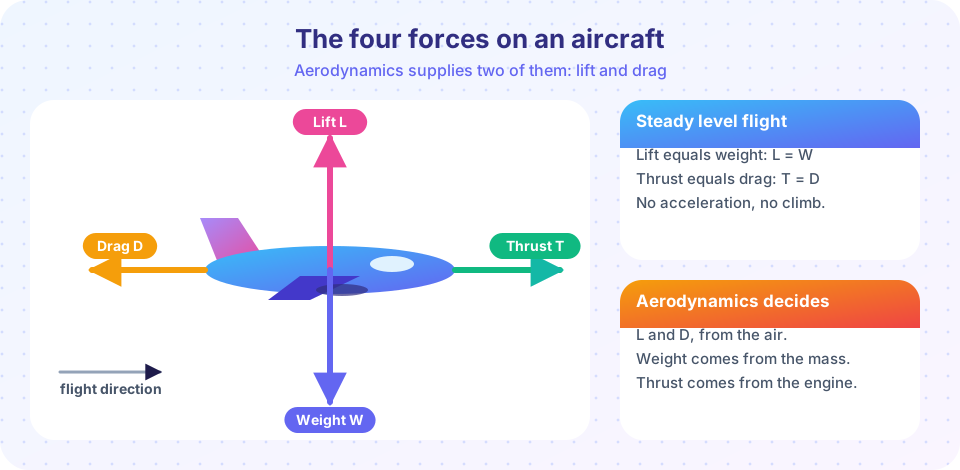
The four forces and their directions
- Weight W = m g points toward the Earth's center, always.
- Lift L is perpendicular to the direction the air is moving relative to the aircraft (the relative wind). In level flight that is up, but in a climb or glide the relative wind is tilted, so lift is tilted with it.
- Drag D is parallel to the relative wind and points backward.
- Thrust T is produced by the propeller or jet, usually along the aircraft's axis.
Notice what the definitions say: lift is not defined as "upward". It is defined relative to the air. This detail matters on every flight path that is not level.
The two equations
Dimensional analysis and experiment show that aerodynamic force scales with dynamic pressure and wing area:
L = ½ ρ V² S CL D = ½ ρ V² S CD
where ρ is air density (kg/m³), V is airspeed (m/s), S is wing reference area (m²), and CL and CD are dimensionless coefficients. The coefficients carry everything about the shape of the aircraft and its angle of attack. This is wonderful news: a wind-tunnel test of a small model gives coefficients that apply to the full-size aircraft (if Mach and Reynolds numbers are similar).
Worked example. A light aircraft of mass 1,100 kg has S = 16.2 m² and flies at 55 m/s near sea level (ρ = 1.225 kg/m³). Then q = ½ × 1.225 × 55² = 1,853 Pa. To hold level flight it needs L = W = 1,100 × 9.81 = 10,791 N, so CL = 10,791 / (1,853 × 16.2) = 0.36. If it slows to 40 m/s, q falls to 980 Pa and CL must rise to about 0.68. The pilot raises the angle of attack to get it.
Steady level flight
With no acceleration the forces balance both ways:
L = W T = D
The ratio L/D, the lift-to-drag ratio, then tells you how much thrust you need: T = D = W / (L/D). An aircraft with L/D = 10 weighing 10,791 N needs only 1,079 N of thrust, about one tenth of its weight. That is why flight is practical at all, and why Chapter 4 spends so much time on L/D.
Steady climb
In a steady climb at flight-path angle γ (gamma) above the horizontal, resolve forces along and perpendicular to the path:
T − D − W sin γ = 0 L − W cos γ = 0
Excess thrust T − D lets you climb: sin γ = (T − D) / W, and the rate of climb is V sin γ. For small γ, cos γ is almost 1, so lift stays close to weight.
Banked turns and load factor
To turn, the aircraft banks by angle φ (phi), tilting its lift vector. Only the vertical part L cos φ supports the weight; the horizontal part L sin φ provides the turning force. In a steady, level turn:
L cos φ = W → n = L / W = 1 / cos φ
| Bank φ | Load factor n | Stall speed multiplier √n |
|---|---|---|
| 0° | 1.00 | 1.00 |
| 30° | 1.15 | 1.07 |
| 45° | 1.41 | 1.19 |
| 60° | 2.00 | 1.41 |
| 75° | 3.86 | 1.97 |
The turn radius is r = V² / (g tan φ). Because lift is n W, stall speed rises by √n (see Chapter 3), which is why steep turns close to the ground are dangerous.
Common misconceptions
"Lift always points straight up." Lift is perpendicular to the relative wind. In a banked turn it tilts toward the center of the turn, and a gliding aircraft's lift tilts forward of vertical.
"Thrust must exceed weight to climb." An airplane climbs when thrust exceeds drag, not weight. A jet airliner's thrust is only a fraction of its weight (in cruise, a few percent) yet it climbs readily.
"CL is a property of the whole airplane at all speeds." CL depends mainly on angle of attack (and flap setting), not speed. Speed enters through q.
Try it
Press Run (or Ctrl + Enter) to see the result here.
Program input · what you'd type while the program runs
Type the answers before you press Run, one per line. Each time the program reads a line (with input()), it gets the next line from this box.
Check your understanding
Quick check · 5 questions
of 5 answered You scored / 5 · perfect!
-
1. In steady level flight, which pair of equations holds?
Vertical forces balance (lift against weight) and horizontal forces balance (thrust against drag). -
2. An aircraft flies at 55 m/s at sea level with S = 16.2 m² and needs lift 10,791 N. What is CL, roughly?
q = 0.5 x 1.225 x 55² = 1,853 Pa, and CL = L / (q S) = 10,791 / (1,853 x 16.2), about 0.36. -
3. In a 60° bank, level turn, what is the load factor?
n = 1 / cos 60° = 1 / 0.5 = 2, so the wings carry twice the aircraft's weight. -
4. What must be true for an aircraft to climb at constant speed?
Along the path, T − D = W sin γ, so a positive climb angle needs thrust above drag. -
5. By what factor does stall speed rise in a 2 g turn?
Stall speed scales with the square root of load factor: sqrt(2) = 1.41.
Summary
- Weight and thrust are not aerodynamic; lift and drag are, and they are defined relative to the oncoming air.
L = ½ρV²S·CLandD = ½ρV²S·CDhold for all flight speeds; the coefficients carry the shape information.- Level flight: L = W and T = D; climb: T − D = W sin γ.
- Banked turn: n = 1/cos φ, and stall speed rises by √n.
Next: Chapter 1 review
Track your progress
Create a free account to tick off lessons and pick up where you left off on any device.
of Aerodynamics lessons completed