


















Lesson 26 of 49 · Wings and Finite Span Effects
Chapter 5 review: wings and finite span effects
Review finite wings, induced drag, lifting-line theory, sweep and high-lift devices with a one-page summary, a recap table and a ten-question quiz.
You have now moved from the two-dimensional airfoil to the real, three-dimensional wing. This page gathers the chapter's main results in one picture and one table, lets you test them with a small calculator, and ends with a ten-question quiz that mixes all the lessons.
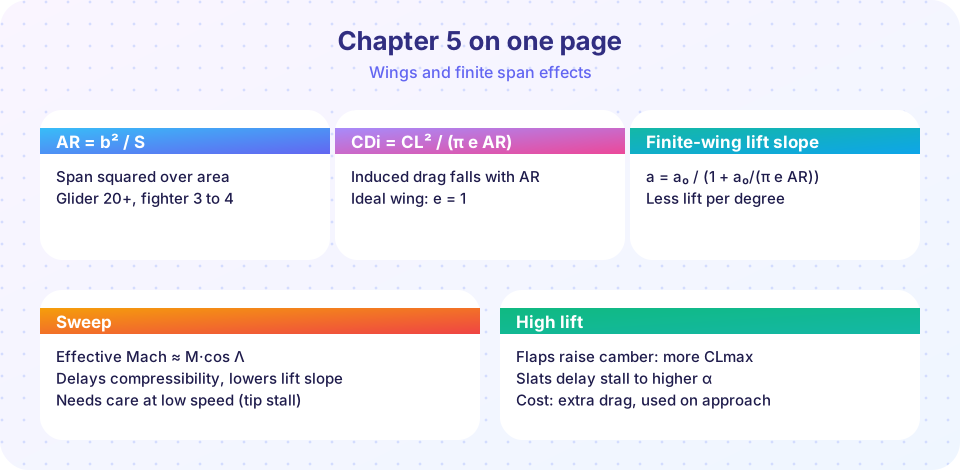
The chapter in a table
| Idea | Key result | Why it matters |
|---|---|---|
| Finite span | Tip vortices cause downwash | Lift tilts back, producing induced drag |
| Aspect ratio | AR = b² / S |
Long wings have less induced drag, higher lift slope |
| Induced drag | CDi = CL² / (π e AR) |
Grows with CL²; large at low speed |
| Lifting line | CL = π AR A₁, e = 1/(1+δ) |
Predicts span loading; elliptical is ideal |
| Sweep | Edge sees V cos Λ |
Delays compressibility; hurts low-speed behavior |
| High lift | Vs = √(2W/(ρ S CLmax)) |
Flaps and slats allow slow, short landings |
Try it
A one-stop calculator for the formulas of the chapter. Change the numbers and check them against your own hand calculations.
Press Run (or Ctrl + Enter) to see the result here.
Program input · what you'd type while the program runs
Type the answers before you press Run, one per line. Each time the program reads a line (with input()), it gets the next line from this box.
Check your understanding
Quick check · 10 questions
of 10 answered You scored / 10 · perfect!
-
1. What is the aspect ratio of a rectangular wing with chord 1.5 m and span 12 m?
For a rectangle AR = b / c = 12 / 1.5 = 8. -
2. What creates downwash at a finite wing?
The two counter-rotating tip vortices induce a downward velocity at the wing. -
3. An elliptically loaded wing has AR = 8 and CL = 0.6. Its induced drag coefficient is closest to
CDi = 0.36 / (π · 8) = 0.0143. -
4. Which loading gives the minimum induced drag for a given span and lift?
The elliptical loading has e = 1. -
5. Induced drag in level flight, as speed increases,
CL falls as speed rises, and CDi goes with CL², so induced drag falls. -
6. To reduce induced drag at constant lift most efficiently, you would
Dᵢ = L² / (π q b² e) depends on span squared. -
7. A wing is swept 30° and flies at M = 0.8. The effective Mach number at the leading edge is
0.8 × cos 30° = 0.693. -
8. Why do back-swept wings often have washout?
Tip stall on a swept wing causes pitch-up and loss of roll control. -
9. The weight of an airplane increases by 21% (factor 1.21) at the same CLmax and density. The stall speed rises by
Vs ∝ √W, and √1.21 = 1.1. -
10. Which pair of devices does an airliner use to raise CLmax for landing?
Flaps add camber and area; slats delay stall to higher angles.
Summary
- The finite wing sheds tip vortices; downwash tilts the lift vector and creates induced drag.
- Aspect ratio and span efficiency set induced drag and lift slope.
- Lifting-line theory predicts span loading; elliptical loading is the ideal.
- Sweep delays compressibility but needs washout; flaps and slats make low-speed flight possible.
Track your progress
Create a free account to tick off lessons and pick up where you left off on any device.
of Aerodynamics lessons completed