


















Lesson 33 of 49 · Stability and Control
Static longitudinal stability
Learn how the pitching-moment slope, the tail and the center of gravity decide static longitudinal stability, and compute the neutral point and static margin.
Flip a paper airplane with its nose a little high and it dips; throw one with its center of gravity too far back and it tumbles. The difference between those behaviors is static longitudinal stability: how the pitching moment changes when the angle of attack changes. This lesson shows why the sign of one slope, Cm,α, decides it, how the horizontal tail creates stability, and how to find the most aft center-of-gravity position that is still stable.
What you will learn
- How to read the pitching-moment curve and what "stable" means in terms of its slope.
- How wing and tail each contribute to
Cm. - How to compute the neutral point and the static margin.
- Why the tail often carries a download and what that costs.
Key terms
Pitching moment coefficient (Cm): nose-up moment about the center of gravity divided by q S c̄.
Aerodynamic center (AC): the point on a wing about which the moment coefficient does not change with angle of attack; about 25% chord for a subsonic thin airfoil.
Neutral point (h_n): the center-of-gravity position at which Cm,α = 0.
Static margin: h_n − h, the distance of the neutral point behind the center of gravity, as a fraction of the mean aerodynamic chord.
What stability means for the moment curve
Imagine a gust pitches the nose up by a small angle, so the angle of attack rises. For the airplane to be stable, the new aerodynamic moment must push the nose down. A nose-up disturbance (Δα > 0) must therefore produce a nose-down moment (ΔCm < 0):
Cm,α = dCm / dα < 0       (statically stable)
Cm,α = 0                  (neutral)
Cm,α > 0                  (unstable)
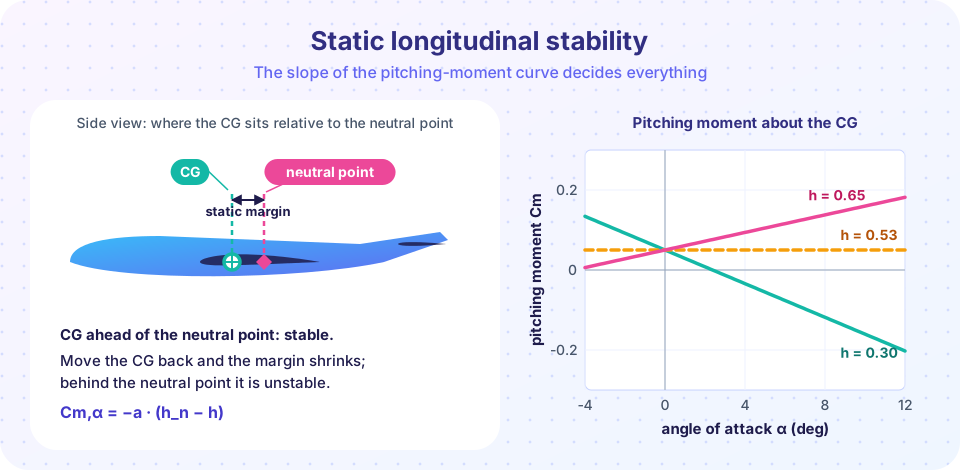
In the figure the stable curve slopes down. The airplane trims, flies steadily, where the curve crosses Cm = 0; a stable curve crosses it with a negative slope, so the equilibrium is restoring.
Contributions of wing and tail
Distances along the chord are measured as fractions of the mean aerodynamic chord c̄, from the leading edge: h for the center of gravity, h_ac for the wing's aerodynamic center (about 0.25).
Wing. The wing's lift acts at its aerodynamic center. Relative to the CG, a lift CL at distance (h − h_ac) produces ΔCm = CL (h − h_ac) on top of the constant Cm_ac. If the CG is behind the wing's aerodynamic center this is nose-up and destabilizing: more lift means more nose-up moment. A wing alone is stable only with the CG ahead of its AC.
Tail. The horizontal tail sits a distance l_t behind the wing AC. When the angle of attack rises, the tail's angle also rises, so it produces extra lift behind the CG, a nose-down moment. Its strength depends on its lift slope a_t, its area ratio S_t/S, how well it sits in the flow (η = q_t / q, often about 0.9) and the downwash from the wing, ε = ε₀ + (dε/dα) α, which reduces the tail's angle change to α(1 − dε/dα). Define the tail's effective lift slope per unit wing angle of attack:
a_t' = a_t · η · (S_t / S) · (1 − dε/dα)
The airplane's total lift slope is a = a_w + a_t'. The pitching-moment slope about the CG is the sum of wing and tail terms, and can be written very neatly:
Cm,α = a · (h − h_n)

h_n = [ a_w · h_ac + a_t' · h_t ] / a        where  h_t = h_ac + l_t / c̄
The neutral point h_n is the lift-slope-weighted average of the wing's and the tail's aerodynamic centers. It lies behind the wing's AC because the far-away tail pulls the average back. The static margin is K_n = h_n − h, and Cm,α = −a K_n. A static margin of 5% to 20% of the chord is typical of light aircraft and transports; some fighters fly with a margin near zero or even negative, with computers helping.
Worked example
An airplane has a_w = 4.8 per radian, a_t = 3.6, η = 0.95, S_t/S = 0.2, dε/dα = 0.35, l_t = 5.0 m, c̄ = 1.5 m, h_ac = 0.25.
a_t' = 3.6 · 0.95 · 0.2 · 0.65 = 0.445
a    = 4.8 + 0.445            = 5.245 per radian
h_t  = 0.25 + 5.0/1.5         = 3.583
h_n  = (4.8·0.25 + 0.445·3.583) / 5.245 ≈ 0.533
With the CG at h = 0.30, the static margin is 0.233 (23% of the chord) and Cm,α = −5.245 · 0.233 ≈ −1.22 per radian, about −0.021 per degree. Move the CG back to h = 0.45 and the margin falls to 8%: the airplane is still stable but "twitchy" and sensitive. At h = 0.60 it is unstable.
Trim and the tail's download
At a forward CG the wing's Cm_ac (negative for cambered airfoils) plus the lift's moment about the CG may demand a nose-up tail moment. The tail then pushes down. Since the tail's down-force adds to the total lift the wing must supply, it adds induced and trim drag. Pilots and designers therefore prefer the CG not too far forward. The trade-off between stability, trim drag and control authority is the subject of the next lesson.
Common misconceptions
"The neutral point is where the wing's lift acts." The wing's lift acts at its aerodynamic center. The neutral point is further back because the tail adds to the stability.
"A more forward CG is always better." It increases stability but also trim drag, stick force and the elevator needed to flare for landing.
"The tail always pushes up." On many aircraft the tail carries a downward force in cruise.
Try it
First, a calculator and a plot of Cm against α for several CG positions. Try changing the tail area or tail arm and see how the neutral point moves.
Press Run (or Ctrl + Enter) to see the result here.
Program input · what you'd type while the program runs
Type the answers before you press Run, one per line. Each time the program reads a line (with input()), it gets the next line from this box.
Second, an interactive explorer. Drag the center of gravity and watch the static margin and the verdict change.
Check your understanding
Quick check · 5 questions
of 5 answered You scored / 5 · perfect!
-
1. What sign must Cm,α have for static longitudinal stability?
A nose-up change in α must produce a nose-down moment change. -
2. The static margin is the distance between
K_n = h_n − h, positive when the CG is ahead of the neutral point. -
3. The neutral point lies behind the wing's aerodynamic center because
h_n is the lift-slope-weighted average of the wing AC and tail AC, so the tail pulls it back. -
4. With a_w = 5, a_t' = 1, h_ac = 0.25 and h_t = 2.5 (chords), what is the neutral point?
h_n = (5 · 0.25 + 1 · 2.5) / 6 = 3.75 / 6 = 0.625. -
5. Why is an extremely forward CG undesirable?
More stability means more nose-down moment to balance, hence more tail download and elevator authority.
Summary
- Static longitudinal stability means
Cm,α < 0: nose-up disturbances create nose-down moments. Cm,α = a (h − h_n); the static margin ish_n − h.- The neutral point is the lift-slope-weighted average of the wing and tail aerodynamic centers.
- Moving the CG aft cuts the margin and sensitivity grows; too far aft is unstable.
Track your progress
Create a free account to tick off lessons and pick up where you left off on any device.
of Aerodynamics lessons completed