


















Lesson 44 of 49 · Projects and Practice
Project 2: stability study of a light aircraft
Work through a stability study: compute the neutral point and CG envelope of a light airplane, check loading cases, and see how tail size changes the usable range.
Every airplane comes with a loading chart that tells the pilot where the center of gravity may be, and every one of those charts is the end product of a stability study like this one. In this project you take the example airplane from Chapter 7, compute its neutral point and its allowed CG range, check whether real loading cases fall inside it, and then ask how a bigger or smaller tail would change the answer. It ties together static stability, trim, and the control limits.
What you will learn
- How to compute the CG position from a loading table.
- How to derive forward and aft limits from elevator authority and static margin.
- How tail size changes the neutral point and the envelope width.
- Which simplifications make the result optimistic.
Key terms
Station: a position measured along the fuselage from a datum such as the nose.
Moment: weight multiplied by arm; the sum of moments divided by total weight gives the CG.
CG envelope: the permitted range of CG positions, usually plotted against weight.
Tail volume ratio (V_H): l_t S_t / (c̄ S), a measure of tail size and effectiveness.
Step 1: the airplane
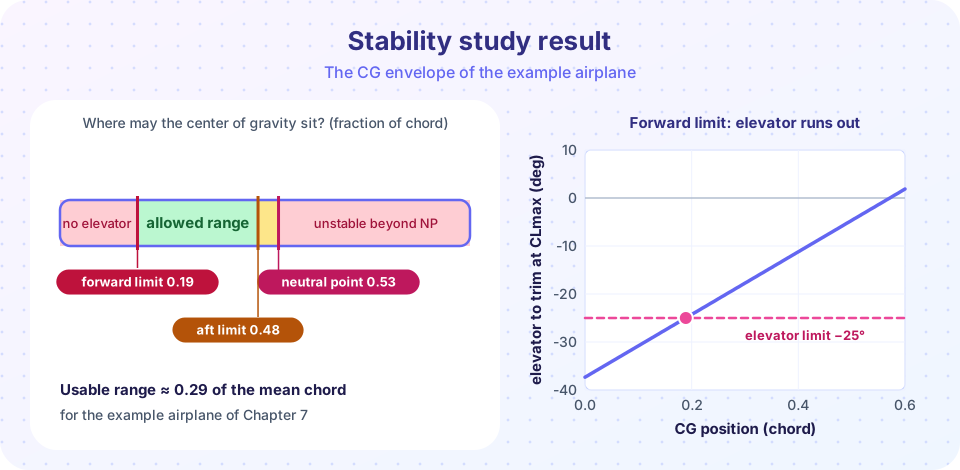
Use the same illustrative airplane as in the Chapter 7 lessons: wing lift slope a_w = 4.8 per radian, tail slope a_t = 3.6, tail efficiency η = 0.95, tail-to-wing area ratio S_t/S = 0.2, downwash gradient 0.35, tail arm l_t = 5.0 m, mean chord c̄ = 1.5 m, wing aerodynamic center at h_ac = 0.25. These give a neutral point at h_n = 0.533 of the chord and elevator effectiveness Cm,δe ≈ −1.14 per radian (τ = 0.5).
Step 2: the limits
- Aft limit. Keep a static margin of at least 5% of the chord:
h_aft = h_n − 0.05 = 0.483. - Forward limit. The elevator must be able to trim the airplane at maximum lift coefficient (
CLmax = 1.5) with flaps down. We assume flaps shiftCm0to−0.05and the elevator can go 25° up. Solving the trim equation for the CG givesh_fwd ≈ 0.19.
The usable range is therefore about 0.19 to 0.48 of the chord, a width of 0.29 c̄. This calculation uses a fixed Cm0: in a real airplane Cm0 also depends on the CG and on power, and the fuselage is destabilizing and moves the neutral point forward (typically by something like 5 to 10% of the chord). So the true aft limit would be further forward. Treat the answer as an educational estimate, not a certification calculation.
Step 3: loading cases
The CG position follows from a table of weights and arms. With a datum at the nose and the wing's mean-chord leading edge at x = 2.40 m (so h = (x_cg − 2.40)/1.5) the program below checks three illustrative cases: a normal four-occupant flight, a solo flight with full fuel and a deliberately aft-heavy case. The point is the method: find the moment, find the CG, check it against the envelope.
Step 4: tail size
A larger tail moves the neutral point aft and widens the margin, but weighs more and adds drag. The second program sweeps S_t/S from 0.10 to 0.30 and prints the neutral point and envelope width. Notice that a smaller tail narrows the envelope from both sides: the neutral point comes forward (aft limit) and elevator authority falls (forward limit).
Common misconceptions
"If the CG is inside the envelope the airplane is safe." The envelope depends on weight, flap setting, power and speed; the loading chart covers the certified cases only.
"A bigger tail is always better." It adds weight and drag and can make the airplane too stable to flare for landing.
"The neutral point is a property of the wing." It depends on the tail, fuselage and propulsion too.
Try it
First, a loading calculator. Edit the weights and arms to explore different cases.
Press Run (or Ctrl + Enter) to see the result here.
Program input · what you'd type while the program runs
Type the answers before you press Run, one per line. Each time the program reads a line (with input()), it gets the next line from this box.
Second, the tail-size trade study.
Press Run (or Ctrl + Enter) to see the result here.
Program input · what you'd type while the program runs
Type the answers before you press Run, one per line. Each time the program reads a line (with input()), it gets the next line from this box.
Check your understanding
Quick check · 4 questions
of 4 answered You scored / 4 · perfect!
-
1. A CG moves aft when you add baggage in the rear hold. What does this do to the static margin?
The CG moves toward the neutral point, so the margin h_n − h shrinks. -
2. What limits the forward CG position in this study?
With the CG far forward the elevator cannot produce enough nose-up moment at low speed. -
3. A pilot loads 80 kg at station 3.9 m. What is the moment (kg·m)?
Moment = weight × arm = 80 × 3.9 = 312 kg·m. -
4. What effect does the fuselage usually have on the neutral point?
The fuselage is destabilizing, so real aft limits are further forward than a wing-plus-tail model suggests.
Summary
- CG = total moment / total weight; express it as a fraction of the mean chord.
- Forward limit: elevator authority at
CLmax. Aft limit: neutral point minus a margin. - A larger tail moves the neutral point aft and widens the envelope, at a cost in weight and drag.
- Simple models ignore fuselage, power and stick-free effects, so real limits are tighter.
Track your progress
Create a free account to tick off lessons and pick up where you left off on any device.
of Aerodynamics lessons completed