


















Lesson 32 of 49 · Stability and Control
Chapter 7 overview: stability and control
See how static and dynamic stability, trim and control surfaces fit together, with a visual map of the chapter and a quick stability check you can run.
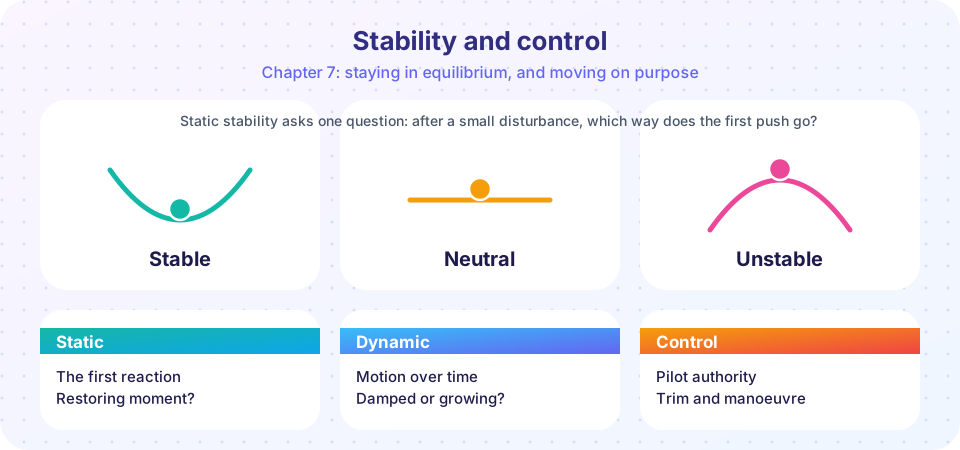
An airplane that makes plenty of lift and little drag is still useless if a pilot cannot hold it at a chosen attitude or steer it where they want. Stability and control are the two sides of the same problem. Stability is the airplane's own tendency to return to its equilibrium after a gust. Control is the pilot's ability to change that equilibrium on purpose. The two pull in opposite directions: a very stable airplane resists the pilot, a nearly unstable one responds instantly. Designing the balance is what this chapter is about.
What you will learn
- The difference between static and dynamic stability.
- How the position of the center of gravity relative to the neutral point sets longitudinal stability.
- How the elevator trims the airplane and why the center of gravity has limits.
- How the airplane's natural modes of motion (phugoid, short period) behave.
The chapter in slides
Disturb it and watch
Static first
Then dynamics
And control
What each lesson covers
- Static longitudinal stability: pitching moment, the tail's role, the neutral point and static margin, with a worked example.
- Trim, control surfaces and CG limits: how the elevator trims the airplane, what limits the center of gravity, and a quick look at lateral and directional stability.
- Dynamic stability: phugoid, short period and the lateral modes: the airplane's natural oscillations and a simulation of the phugoid.
- Chapter 7 review.
Key terms
Static stability: the initial tendency, after a disturbance, to develop forces and moments that restore equilibrium.
Dynamic stability: whether the resulting motion dies out over time.
Trim: a state with zero net moment (and force) so the airplane flies steadily with hands off.
Neutral point: the center-of-gravity position at which the airplane is neutrally stable.
Try it
Stability is a property you can see in a simple model. This oscillator is a stand-in for pitch motion: the stiffer the restoring moment, the faster the oscillation. Change the numbers and watch whether the motion dies out or grows.
Press Run (or Ctrl + Enter) to see the result here.
Program input · what you'd type while the program runs
Type the answers before you press Run, one per line. Each time the program reads a line (with input()), it gets the next line from this box.
Check your understanding
Quick check · 4 questions
of 4 answered You scored / 4 · perfect!
-
1. What does static stability describe?
Static stability concerns the first reaction: whether the moment restores or amplifies the disturbance. -
2. An airplane that is statically stable but whose oscillations grow over time is
It returns toward equilibrium initially but overshoots by growing amounts. -
3. Which is true of a very stable airplane?
High stability means a strong restoring tendency, so more control force is needed to maneuver. -
4. What is trim?
At trim the moments balance, so the airplane holds its attitude without pilot input.
Summary
- Static stability is the restoring tendency; dynamic stability is the motion that follows.
- Longitudinal stability comes from the center of gravity being ahead of the neutral point.
- Trim sets the equilibrium; control surfaces change it.
- Stability and maneuverability are competing demands.
Track your progress
Create a free account to tick off lessons and pick up where you left off on any device.
of Aerodynamics lessons completed