


















Lesson 24 of 49 · Wings and Finite Span Effects
Lifting-line theory
Understand Prandtl's lifting-line theory: horseshoe vortices, elliptical loading, the Fourier solution, and a runnable solver that finds lift and induced drag.
Around 1918, Ludwig Prandtl and his colleagues in Göttingen worked out the first practical theory of finite wings. It answers a question designers need every day: given a wing's shape and angle, how is lift spread along the span, and how much induced drag does it cost? The answer is surprisingly compact. You can solve it on a laptop in milliseconds, and the same ideas live on inside modern vortex-lattice programs.
What you will learn
- How a wing is modelled as a line of bound vortices with trailing horseshoe vortices.
- Why elliptical loading gives uniform downwash and the minimum induced drag.
- How the Fourier-series (Glauert) solution gives
CL,CDiandefor any straight wing. - When lifting-line theory is trustworthy and when it is not.
Key terms
Circulation (Γ): the net rotation of air around the wing section, in m²/s.
Kutta–Joukowski theorem: lift per unit span is L' = ρ V Γ.
Bound vortex: the vortex replacing the wing, fixed at the lifting line.
Span loading: how the circulation Γ(y) (and so lift per unit span) varies along the span.
Prandtl's picture
Replace the wing by a single straight vortex line along the span, the lifting line. By the Kutta–Joukowski theorem, a vortex of strength Γ in a stream of speed V and density ρ feels a force ρ V Γ per unit length, perpendicular to the flow. That is the lift. But a vortex line cannot end, so at the tips it must bend back and trail downstream as a long horseshoe vortex (bound segment plus two trailing legs).
A real wing's circulation changes along the span, so Prandtl used many horseshoes of different strengths and widths stacked together. Each trailing leg induces a downward velocity on the lifting line (the downwash) in proportion to its strength and inversely to its distance. Summing every leg gives the downwash at each spanwise point, and so each section's induced angle αᵢ(y).
The theory then closes the loop with a single statement: each section behaves like a two-dimensional airfoil working at its effective angle of attack:
Γ(y) = ½ · V · c(y) · a₀ · ( α(y) − α_L0 − αᵢ(y) )
Here c(y) is the chord, a₀ the section lift-curve slope and α_L0 the zero-lift angle. Because αᵢ(y) itself depends on Γ(y), this is an integro-differential equation for the unknown span loading.
The elliptical case
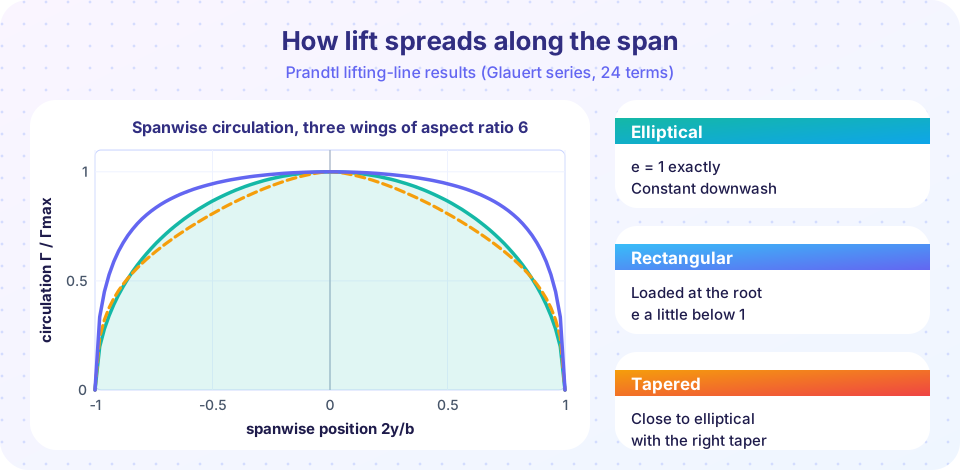
Try the elliptical loading Γ(y) = Γ₀ √(1 − (2y/b)²). Substituting into the downwash integral gives a remarkable result: the downwash is the same at every point along the span, w = −Γ₀ / (2b). The induced angle is therefore constant:
αᵢ = Γ₀ / (2 b V) and CL = π · AR · Γ₀ / (2 b V) so αᵢ = CL / (π AR)
and the induced drag coefficient is CDi = CL² / (π AR), the formula from the last lesson. Among all loadings with the same span and lift, the elliptical one has the lowest possible induced drag. That is why the Spitfire's elliptical wing became a symbol of elegance, although a tapered wing is easier to build and nearly as good.
A numerical example. An elliptical wing has b = 10 m, S = 12.5 m² (so AR = 8) and flies at V = 50 m/s at sea level, carrying L = 8,000 N:
q   = ½ · 1.225 · 50² = 1531 Pa
CL  = 8000 / (1531 · 12.5) = 0.418
CDi = 0.418² / (π · 8) = 0.00695
Dᵢ  = q · S · CDi ≈ 133 N
Γ₀  = 4 L / (π ρ V b) = 16.6 m²/s
αᵢ  = CL / (π AR) = 0.0166 rad ≈ 0.95°
There is an even neater form: Dᵢ = L² / (π q b² e). Induced drag depends on span b, not on area. To cut it, make the wing longer, not bigger.
The general solution: a Fourier series
For other planforms, Glauert expanded the circulation as a series in the angle θ defined by y = −(b/2) cos θ:
Γ(θ) = 2 b V · Σ Aₙ sin(nθ), n = 1, 3, 5, ...
(only odd terms for a symmetric wing). Substituting and demanding the equation hold at N stations gives N linear equations for the coefficients Aₙ. Then:
CL  = π · AR · A₁
CDi = π · AR · Σ n · Aₙ²   =   CL² / (π · AR · e)
e   = 1 / (1 + δ),    δ = Σ_(n≥3) n · (Aₙ / A₁)²
Because δ ≥ 0, e ≤ 1, with equality only if every Aₙ beyond A₁ is zero: that is the elliptical loading. The program below sets this up for a straight wing with linear taper.
When to trust it
Lifting-line theory works best for unswept wings with AR above about 4. It assumes each section behaves two-dimensionally and the lifting line is straight. It breaks down for low aspect ratios, for strongly swept wings and for stalled flow. For those, engineers move to vortex-lattice methods, panel methods and CFD, which the Computational Aerodynamics chapter introduces.
Common misconceptions
"The vortex is a real thread of air sitting on the wing." The bound vortex is a mathematical device that reproduces the lift; the wing is not literally a spinning rod.
"Elliptical loading needs an elliptical planform." An elliptical planform with no twist gives elliptical loading, but so can a tapered wing with the right twist. What matters is the loading, not the outline.
"Minimum induced drag means minimum total drag." A wing with perfect loading may be heavy and hard to build, and its profile drag and weight matter too.
Try it
First, solve a rectangular wing and a tapered wing of the same aspect ratio and compare their loading with the ideal ellipse. This is a real Glauert solution with 40 stations.
Press Run (or Ctrl + Enter) to see the result here.
Program input · what you'd type while the program runs
Type the answers before you press Run, one per line. Each time the program reads a line (with input()), it gets the next line from this box.
Second, search for the taper ratio that gives the best span efficiency at a chosen aspect ratio.
Press Run (or Ctrl + Enter) to see the result here.
Program input · what you'd type while the program runs
Type the answers before you press Run, one per line. Each time the program reads a line (with input()), it gets the next line from this box.
Check your understanding
Quick check · 5 questions
of 5 answered You scored / 5 · perfect!
-
1. In lifting-line theory, what does Kutta–Joukowski say about lift per unit span?
Lift per unit span equals density times velocity times circulation. -
2. What is special about the downwash of an elliptically loaded wing?
Elliptical loading gives a uniform downwash and so a constant induced angle w = Γ₀/(2b). -
3. An elliptical wing has AR = 10 and CL = 0.5. What is its induced angle of attack in degrees?
αᵢ = CL / (π AR) = 0.5 / 31.4 = 0.0159 rad ≈ 0.91°. -
4. What does a span efficiency factor e < 1 tell you?
e = 1 / (1 + δ) where δ measures the deviation from elliptical loading. -
5. For the same lift and speed, how do you reduce induced drag most effectively?
Dᵢ = L² / (π q b² e): span enters squared, area does not appear.
Summary
- Lifting-line theory models the wing as bound vortices with trailing horseshoe legs; each section works at
α − αᵢ. - Elliptical loading gives uniform downwash,
e = 1and the minimum induced drag. - The Glauert Fourier series gives
CL = π AR A₁,CDi = π AR Σ n Aₙ²ande = 1/(1+δ). - Induced drag is
Dᵢ = L² / (π q b² e): span matters, area does not.
Track your progress
Create a free account to tick off lessons and pick up where you left off on any device.
of Aerodynamics lessons completed