


















Lesson 4 of 49 · Getting Started
Chapter 1 review: Getting started
Review chapter 1 of the aerodynamics course: pressure and shear, the four forces, lift and drag equations, load factor, Mach and Reynolds numbers, with a practice quiz.
You now have the vocabulary for everything that follows. This review gathers the chapter's ideas into one picture, one table and a ten-question quiz. If you miss a question, jump back to the lesson in the last column.
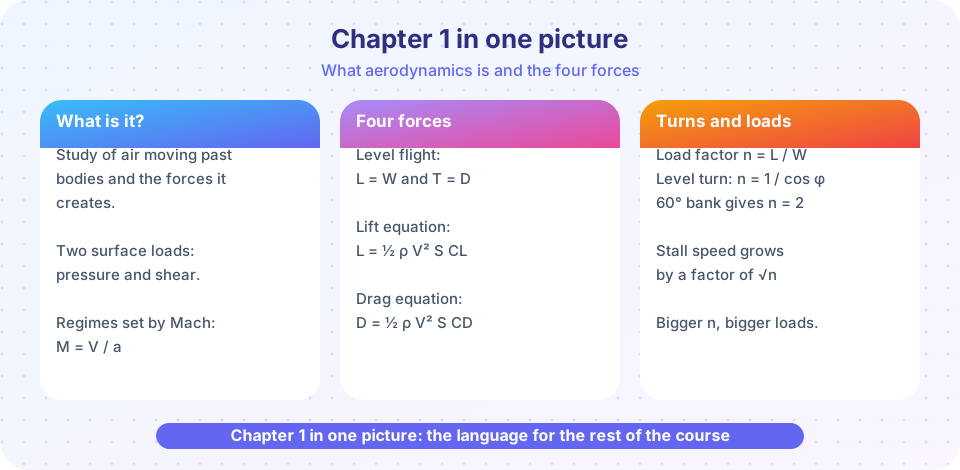
Recap table
| Idea | Key statement | Lesson |
|---|---|---|
| Loads on a body | Pressure acts perpendicular, shear along the surface | What is aerodynamics? |
| Regimes | M = V/a; subsonic below about 0.8, supersonic above 1.2 | What is aerodynamics? |
| Equivalence | Only relative motion matters, so tunnels work | What is aerodynamics? |
| Force equations | L = ½ρV²S·CL, D = ½ρV²S·CD | The four forces in flight |
| Level flight | L = W and T = D | The four forces in flight |
| Climb | sin γ = (T − D)/W | The four forces in flight |
| Turns | n = 1/cos φ, stall speed rises by √n | The four forces in flight |
Try it
Press Run (or Ctrl + Enter) to see the result here.
Program input · what you'd type while the program runs
Type the answers before you press Run, one per line. Each time the program reads a line (with input()), it gets the next line from this box.
Press Run (or Ctrl + Enter) to see the console output here.
No output.
Check your understanding
This chapter review has a longer quiz, mixing the whole chapter.
Quick check · 9 questions
of 9 answered You scored / 9 · perfect!
-
1. Which statement about pressure and shear is correct?
Pressure is a normal stress; shear stress is tangential and comes from viscosity. -
2. What does a wind tunnel rely on?
Forces depend on the speed of the air relative to the body, so a fixed model in moving air is equivalent. -
3. Which regime is the flow around an airliner cruising at Mach 0.85?
At Mach 0.85 parts of the flow over the wing reach the speed of sound, which is the definition of transonic flow. -
4. Lift is defined as the aerodynamic force:
Lift is perpendicular to the free-stream (relative wind) direction, which is not always vertical. -
5. In level flight at 1,853 Pa dynamic pressure with S = 16.2 m² and CL = 0.36, the lift is about:
L = q S CL = 1,853 x 16.2 x 0.36, about 10,800 N. -
6. An aircraft with L/D = 12 weighs 24,000 N. Level-flight thrust is:
T = D = W / (L/D) = 24,000 / 12 = 2,000 N. -
7. What is the load factor in a steady level turn at 60° bank?
n = 1/cos 60° = 2. -
8. Doubling airspeed with everything else equal multiplies lift by:
Lift is proportional to V², so doubling V gives four times the lift at the same CL. -
9. What does the Reynolds number compare?
Re = ρVL/μ. Mach number is the speed comparison with sound.
Summary
- Pressure and shear are the only loads; lift and drag are their components.
L = ½ρV²S·CL,D = ½ρV²S·CD; balance gives L = W, T = D in level flight.- Turns and climbs change the force balance: n = 1/cos φ, sin γ = (T − D)/W.
- Mach and Reynolds numbers classify flows.
Next: A tour of the atmosphere
Track your progress
Create a free account to tick off lessons and pick up where you left off on any device.
of Aerodynamics lessons completed