


















Lesson 43 of 49 · Projects and Practice
Project 1: design a glider wing
Design a model glider wing step by step: pick aspect ratio, compute the drag polar, find best glide and minimum sink, and test how the design changes.
A glider is the purest test of aerodynamic efficiency. It has no engine, so every meter it travels is paid for out of height. The ratio of distance traveled to height lost in still air equals the lift-to-drag ratio, so a glider designer lives and dies by L/D. In this project you will define a design, compute its drag polar, find its best-glide and minimum-sink conditions, and see how changing the wing changes the answer. It uses the finite-wing results of Chapter 5 and the performance ideas of the earlier chapters.
What you will learn
- How to turn a requirement into wing area, span and aspect ratio.
- How to build a parabolic drag polar
CD = CD0 + CL² / (π e AR). - How to find best-glide speed and minimum-sink speed, and why they differ.
- How aspect ratio and wing loading change performance.
Key terms
Drag polar: the relationship between CD and CL.
Best glide: the flight condition with maximum L/D; it gives the longest distance in still air.
Minimum sink: the condition with the smallest descent rate; it gives the longest time aloft.
Wing loading (W/S): weight divided by wing area; it sets the speeds.
Step 1: requirements and geometry
Our hypothetical design is a small hand-launched glider:
- mass
m = 2 kg, so weightW = m g = 19.6 N; - span
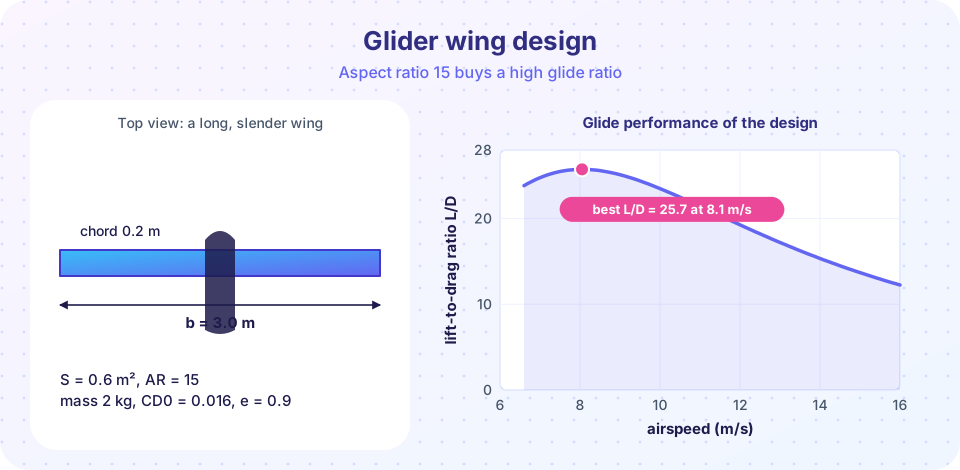
b = 3.0 mand areaS = 0.6 m², so mean chord0.2 mandAR = b²/S = 15; - sea-level air,
ρ = 1.225 kg/m³; - assumed maximum lift coefficient
CLmax = 1.3(a modest value for a small, low-Reynolds-number wing); - assumed zero-lift drag
CD0 = 0.016and span efficiencye = 0.9.
The last two are assumptions, not measurements: at the wing's Reynolds number (about 1 × 10⁵ at 8 m/s with a 0.2 m chord) the skin friction and drag of thin airfoils are hard to predict, so treat CD0 as a number to test, not to trust.
Step 2: the drag polar and best glide
With the lifting-line result from Chapter 5, the drag coefficient is the parasite drag plus the induced drag: CD = CD0 + CL² / (π e AR). The lift-to-drag ratio CL/CD is largest where parasite and induced drag are equal, which gives closed forms:
CL* = √( CD0 · π e AR )            (lift coefficient at best glide)
(L/D)max = ½ · √( π e AR / CD0 )
V_bg = √( 2 W / (ρ S CL*) )
For our numbers CL* = √(0.016 · π · 0.9 · 15) ≈ 0.82, (L/D)max ≈ 25.7, and V_bg ≈ 8.05 m/s. In still air from a launch height of 300 m the glider covers about 25.7 × 300 ≈ 7.7 km.
Because induced drag equals parasite drag at best glide, CDi = CD0 = 0.016 there, and the total is CD = 0.032.
Step 3: stall and minimum sink
Stall speed follows from CLmax: Vs = √(2W / (ρ S CLmax)) ≈ 6.4 m/s. The sink rate is w = V / (L/D) = V CD/CL. Minimizing it analytically gives the lift coefficient CL,ms = √(3 CD0 π e AR) ≈ 1.43. That is above CLmax = 1.3, so the minimum sink of this particular wing occurs at the edge of the stall, not at the theoretical optimum. A real pilot flies a little above the stall speed for safety, giving a slower, tighter circle in thermals but with a margin. The program below prints the whole picture, and you can try other values.
Step 4: trade studies
Once the model exists, answer "what if" questions at almost no cost:
- Longer wing, same area (higher
AR):(L/D)maxrises as√AR, but the wing gets heavier and more flexible. - More mass, same wing: heavier gliders fly faster at the same
L/D(best glide speed scales as√(W/S)), which helps in wind and between thermals. - Dirtier wing: raising
CD0cutsL/Das1/√CD0: a rough surface or a thick airfoil costs distance.
Common misconceptions
"Best glide speed and minimum sink speed are the same." They are different: minimum sink is slower.
"More aspect ratio is always better." Structural weight, bending and Reynolds-number effects grow with span; real designs balance them.
"The polar is a fixed property of the airfoil." It depends on Reynolds number, surface finish and the wing's planform.
Try it
First, compute the performance and plot L/D and sink rate against speed.
Press Run (or Ctrl + Enter) to see the result here.
Program input · what you'd type while the program runs
Type the answers before you press Run, one per line. Each time the program reads a line (with input()), it gets the next line from this box.
Second, a trade study over aspect ratio and mass. Which change helps most?
Press Run (or Ctrl + Enter) to see the result here.
Program input · what you'd type while the program runs
Type the answers before you press Run, one per line. Each time the program reads a line (with input()), it gets the next line from this box.
Check your understanding
Quick check · 4 questions
of 4 answered You scored / 4 · perfect!
-
1. At best glide, how are induced and parasite drag related?
L/D is maximal where CD0 = CL²/(π e AR). -
2. A glider has AR = 20, e = 0.9 and CD0 = 0.02. What is (L/D)max?
0.5 · √(π · 0.9 · 20 / 0.02) = 0.5 · √2827 ≈ 26.6. -
3. Doubling aspect ratio (everything else equal) multiplies (L/D)max by about
(L/D)max ∝ √AR, and √2 ≈ 1.41. -
4. Why does the glider's minimum-sink speed lie below the best-glide speed?
Sink rate depends on speed as well as L/D, so the minimum comes at a lower speed.
Summary
CD = CD0 + CL²/(π e AR); best glide atCL* = √(CD0 π e AR)with(L/D)max = ½√(π e AR / CD0).- Best-glide speed grows with wing loading as
√(W/S);L/Ddoes not depend on weight. - Minimum sink is slower than best glide, and for small gliders may sit at the stall limit.
- Aspect ratio and cleanliness are the strongest levers on glide ratio.
Track your progress
Create a free account to tick off lessons and pick up where you left off on any device.
of Aerodynamics lessons completed