


















Lesson 16 of 49 · Drag and Performance
Chapter 4 overview: Drag and performance
A clear overview of aerodynamic drag: form, skin-friction, interference, induced and wave drag, the drag-versus-speed curve, and a map of chapter 4.
Lift gets an aircraft off the ground, but drag decides how much fuel it burns. For a transport aircraft, a 1% saving in drag is worth millions of dollars of fuel over the fleet's life. This chapter looks at where drag comes from, how to estimate it, and how it determines the glide, climb and range performance of an aircraft.
What you will learn
- The main types of drag and what causes each.
- The shape of the drag-versus-speed curve and why it has a minimum.
- How chapter 4 is organized.
Key terms
Parasite drag: drag that does not depend on lift: form, skin friction and interference.
Induced drag: drag caused by producing lift on a finite wing; it falls as speed rises.
Profile drag: the sum of form drag and skin-friction drag of a section.
Zero-lift drag coefficient (CD0): the drag coefficient when the lift is zero.
Drag area (f): f = CD S, the equivalent flat plate area (m²) that would give the same drag.
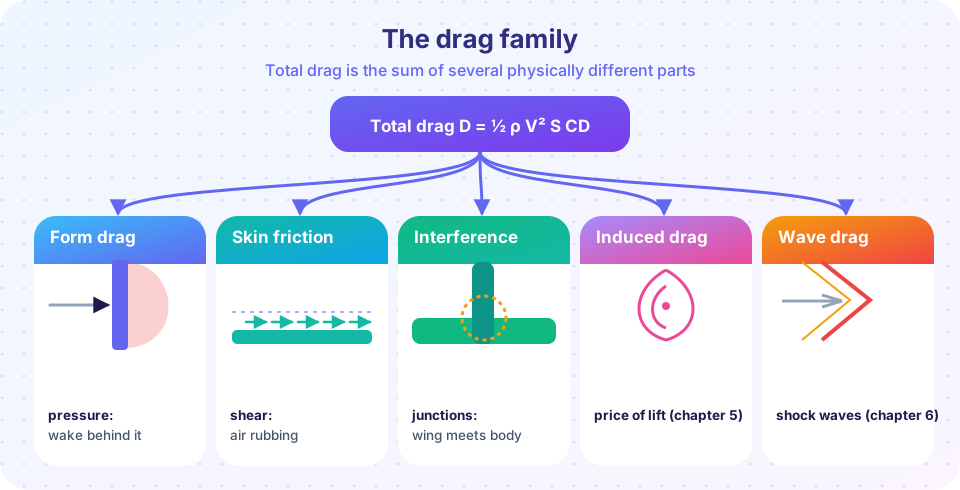
The drag family
Drag is the sum of several effects with very different physical origins.
Pressure (form) drag
Skin friction drag
Interference drag
Induced and wave drag
- Pressure (form) drag arises because the flow separates and leaves a wake of low pressure behind the body, so the pressure on the front exceeds the pressure on the rear. Bluff bodies (a cylinder, a flat plate facing the wind) have large form drag; streamlined bodies have little.
- Skin-friction drag is the sum of shear stress over the surface. It scales with the wetted area (the area touched by the air).
- Interference drag appears where components meet, such as a wing and a fuselage, because the boundary layers and pressure fields interact.
- Induced drag is the cost of lift on a wing of finite span. It is zero for a wing with no lift and falls with speed.
- Wave drag occurs at transonic and supersonic speeds, due to shock waves.
Form, skin-friction and interference drag add up to parasite drag, which does not depend on how much lift the wing makes. The drag coefficient is then CD = CD0 + CDi, where CDi is the induced part.
The drag curve
Parasite drag grows with the square of speed (D = ½ρV² S CD0). Induced drag falls with the square of speed, because a faster wing needs a smaller CL to hold the same weight and induced drag grows with CL². The sum is a U-shaped curve with a minimum at the speed where the two contributions are equal.
D = ½ ρ V² S CD0 + 2 K W² / (ρ V² S)
(Here K is the induced-drag factor of the drag polar introduced in The drag polar.) The minimum of this curve is the best glide speed and the speed for maximum endurance of a jet.
Common misconceptions
"Drag is always bad." Drag is also used: parachutes, spoilers, airbrakes and flaps on approach all add drag on purpose.
"A rough surface is always worse." Not always. A golf ball's dimples make the boundary layer turbulent, which delays separation and reduces the total drag of a bluff body at the right Reynolds numbers.
"Streamlined means thin." Streamlined means the flow stays attached. A thick, rounded teardrop can have far lower drag than a thin plate held square to the wind.
What the chapter covers
- The boundary layer and Reynolds number: the origin of friction drag.
- Types of drag: form drag, drag buildup and CD0.
- The drag polar:
CD = CD0 + K CL²and maximum L/D. - Glide, range and endurance: performance from L/D.
- Chapter 4 review.
Try it
Press Run (or Ctrl + Enter) to see the result here.
Program input · what you'd type while the program runs
Type the answers before you press Run, one per line. Each time the program reads a line (with input()), it gets the next line from this box.
Press Run (or Ctrl + Enter) to see the console output here.
No output.
Check your understanding
Quick check · 5 questions
of 5 answered You scored / 5 · perfect!
-
1. Which of these is part of parasite drag?
Parasite drag is form, skin-friction and interference drag, which do not depend on lift. -
2. As airspeed increases in level flight, induced drag:
A faster wing needs a smaller CL to hold the same weight, and induced drag falls with the square of that. -
3. At the speed of minimum drag, which statement holds?
Minimizing D = a V² + b/V² gives a V² = b/V², so the two parts are equal. -
4. Skin-friction drag scales mainly with:
More surface touching the air and a more turbulent layer both mean more skin friction. -
5. Why do golf balls have dimples?
A turbulent boundary layer clings longer to the ball, shrinking the wake and form drag.
Summary
- Drag is a family: form, friction, interference (parasite) plus induced and wave drag.
- Parasite drag rises as V²; induced drag falls as 1/V²; the total has a minimum.
- Drag area
f = CD Scompares different objects. - The rest of the chapter builds the tools to estimate drag and use it.
Track your progress
Create a free account to tick off lessons and pick up where you left off on any device.
of Aerodynamics lessons completed