


















Lesson 2 of 49 · Getting Started
What is aerodynamics?
Learn what aerodynamics studies: air as a continuum, pressure and shear, Mach and Reynolds regimes, and the three tools engineers use to predict airflow.
When you hold your hand out of a car window, you feel the air pushing it back and, if you tilt it, up or down. Nothing touched your hand but air, so the air must exert force. Aerodynamics asks how large that force is, where it acts and how to make it work for us: a big lift for a small drag on an airliner, or the opposite for a race car that wants to be pushed into the road.
What you will learn
- How aerodynamics is defined, and how it grew from a few key discoveries.
- Why we treat air as a continuous fluid, and what properties describe it.
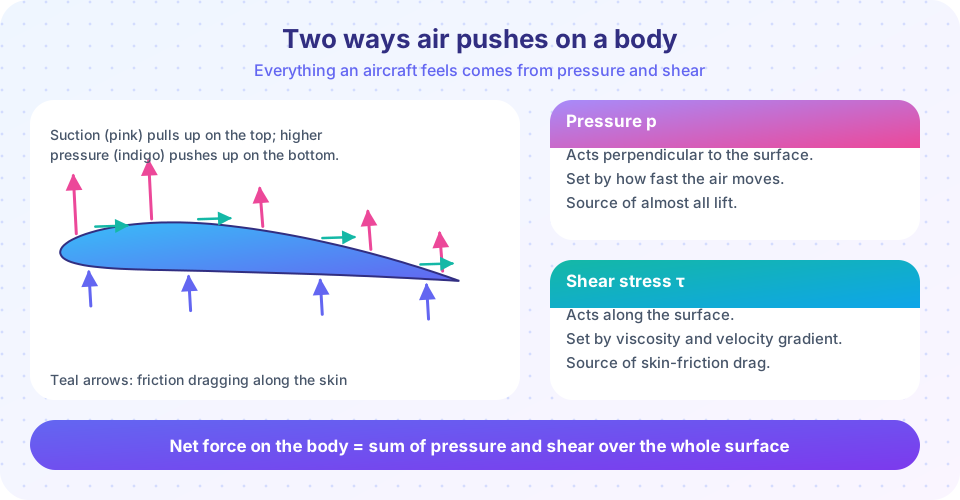
- The two ways air loads a surface: pressure and shear stress.
- How Mach number and Reynolds number sort flows into regimes.
- Why a wind tunnel and a moving aircraft are equivalent.
Key terms
Continuum: treating air as a smooth fluid with a pressure, density and velocity at every point, ignoring individual molecules.
Streamline: a curve that is everywhere tangent to the local flow velocity.
Free stream: the undisturbed air far from the body, with speed V∞, pressure p∞ and density ρ∞.
Pressure: normal force per unit area, in pascals (1 Pa = 1 N/m²).
Shear stress (τ): force per unit area acting along the surface, caused by viscosity.
A short history in five steps
- 1738: Daniel Bernoulli's Hydrodynamica links fluid speed and pressure.
- 1799: Sir George Cayley sketches a fixed-wing aircraft and separates the problems of lift, propulsion and control.
- 1891 onward: Otto Lilienthal flies gliders and publishes measurements showing that curved (cambered) wings give more lift than flat ones.
- 1901 to 1903: Wilbur and Orville Wright build a wind tunnel, test many wing shapes and fly the first powered, controlled aircraft in December 1903.
- 1904 and 1918: Ludwig Prandtl explains the thin boundary layer where friction acts, and later gives the lifting-line theory for finite wings.
The rest of the twentieth century added high-speed flow theory (Chapter 6) and, from the 1960s on, computer simulation (Chapter 8).
Air as a continuum
Air is billions of molecules, but between collisions a molecule travels only about 0.07 micrometers at sea level. A wing is meters wide. At that scale the molecular chaos averages out and we describe the air by smooth fields: pressure p, density ρ, temperature T and velocity V. This continuum assumption works for everything in this course. It fails only in the very thin air near space, where aerodynamics gives way to rarefied gas dynamics.
Pressure and shear: the only two loads
Everything an aircraft feels from the air comes from just two sources.
- Pressure acts perpendicular to the surface. Fast-moving air has lower pressure than slow air. A wing is shaped so that the pressure is lower on top and higher below, and the difference lifts the plane. Most of the lift and a good part of the drag come from pressure.
- Shear stress acts along the surface. Air sticks to the skin, so the layer next to the wall moves slowly while air farther out moves quickly. That steep velocity change creates friction. It gives skin-friction drag and almost no lift.
Add up pressure and shear over every square meter of the surface and you have the total aerodynamic force. Split it into a component perpendicular to the free stream (lift) and one parallel to it (drag). The moment about a chosen point (usually the quarter-chord point) is also found by summing these loads.
Flow regimes: Mach and Reynolds
Two dimensionless numbers decide how a flow behaves.
| Number | Formula | Meaning |
|---|---|---|
| Mach number M | V / a | speed relative to the speed of sound a |
| Reynolds number Re | ρ V L / μ | inertia relative to viscous forces |
The speed of sound is a = √(γ R T); at 15 °C it is about 340 m/s. Typical regimes by Mach number:
- Incompressible (M below about 0.3): density changes are under 5%, so we can treat air as having constant density.
- Subsonic (up to about 0.8): density changes matter but the flow stays smooth.
- Transonic (about 0.8 to 1.2): some regions of the flow go supersonic and shock waves appear.
- Supersonic (about 1.2 to 5): shock waves everywhere.
- Hypersonic (above about 5): extreme heating.
Reynolds number tells you whether the flow near the surface is smooth (laminar) or churning (turbulent), and it is introduced properly in Chapter 4. A model glider has Re of about 10⁵; an airliner wing has about 10⁷.
Three tools to predict flow
Engineers combine three approaches, and each checks the others.
- Theory: equations solved by hand, such as thin-airfoil theory (Chapter 3). Fast and insightful, but approximate.
- Experiment: wind-tunnel tests of models and flight tests of real aircraft. Realistic, but costly.
- Computation: computational fluid dynamics (CFD) solves the governing equations numerically on a grid (Chapter 8).
Common misconceptions
"A wind tunnel is only a rough substitute for flight." Not true in principle. What matters is the relative motion between body and air. A model held still in a 50 m/s airstream feels the same loads as the same model moving at 50 m/s through still air, provided Mach and Reynolds numbers match.
"Lift needs a strange trick." There is no magic. Lift is the net result of pressure acting on a curved or tilted surface, as the next lessons show.
Try it
The first plot shows the speed of sound against altitude. The widget below it shows why only airspeed matters for the forces, not ground speed.
Press Run (or Ctrl + Enter) to see the result here.
Program input · what you'd type while the program runs
Type the answers before you press Run, one per line. Each time the program reads a line (with input()), it gets the next line from this box.
Check your understanding
Quick check · 5 questions
of 5 answered You scored / 5 · perfect!
-
1. Which loads add up to the total aerodynamic force on a wing?
Pressure acts perpendicular to the skin and shear stress acts along it. Integrating both over the body gives lift, drag and moment. -
2. Why can we treat air as a continuum around a wing?
The mean free path at sea level is a tiny fraction of a micrometer, so smooth fields describe the air well. -
3. A wind tunnel test at 60 m/s is equivalent to flight at 60 m/s because:
Forces depend on airspeed relative to the body. The matching also needs similar Mach and Reynolds numbers. -
4. Which Mach range is called transonic?
In transonic flow part of the flow over the body is supersonic and part is subsonic, so shock waves form locally. -
5. What creates skin-friction drag?
Air sticks to the wall, so the layer next to it is slowed, and the steep velocity change produces shear stress along the surface.
Summary
- Aerodynamics studies how air flows around bodies and what forces and moments result.
- Air is modeled as a continuum described by p, ρ, T and V.
- Pressure (perpendicular) and shear stress (along the surface) are the only two loads.
- Mach number M = V/a and Reynolds number Re = ρVL/μ classify flows.
- Theory, experiment and CFD are complementary tools.
Track your progress
Create a free account to tick off lessons and pick up where you left off on any device.
of Aerodynamics lessons completed