


















Lesson 47 of 47 · Projects and Practice
Further Study: Where to Go Next
Plan your next steps after the course: related subjects such as organic, physical and analytical chemistry, materials science and strength of materials, with study tips.
You have covered a lot: how to characterize a polymer, how the major families behave, how functional materials are designed, how sustainability changes the questions we ask, and how to apply it all in a case study and a selection project. The natural next question is where to go from here.
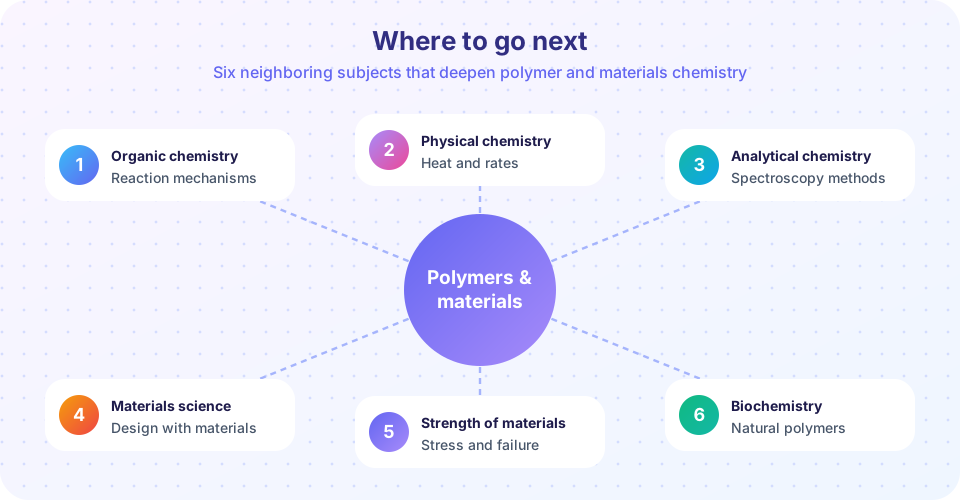
The answer depends on what attracted you. If it was the molecules, go deeper into organic and physical chemistry. If it was the measurements, study analytical chemistry. If it was the engineering, look at materials science and the mechanics of materials. And if it was the living side, biochemistry shows how nature makes and uses polymers.
What you will learn
- Choose a next subject that matches your interests.
- See how each neighboring subject connects to ideas from this course.
- Build a simple study plan with concrete projects.
Key terms
Prerequisite: knowledge you need before a subject makes sense.
Spaced practice: reviewing material at growing intervals so it sticks.
Project-based learning: learning by building something real, such as a calculator or a selection study.
Six directions
- Organic chemistry. Every polymerization is organic chemistry: radicals, ionic intermediates, condensation, ring-opening. Understanding mechanisms explains why a catalyst controls tacticity, why PVC loses HCl and why some polymers hydrolyze.
- Physical chemistry. Thermodynamics and kinetics are the engine behind LCST behavior, crystallization, rubber elasticity (entropy), Arrhenius degradation and reaction rates. This is where
ΔG = ΔH − TΔSbecomes a working tool. - Analytical chemistry. The characterization chapter was an overview; analytical chemistry teaches calibration, detection limits, uncertainty and how to design a measurement that you can trust.
- Materials science. The wider world of metals, ceramics and composites, with phase diagrams, microstructure, failure and selection. This is the natural home for the selection project.
- Strength of materials. Stress, strain, beams, torsion and failure: the mechanics behind the stress-strain curves, composite stiffness and the performance indices you derived.
- Biochemistry. Proteins, nucleic acids and polysaccharides are polymers; their folding, hydrogen bonding and enzymatic degradation illuminate biopolymers and biodegradation.
Ideas worth revisiting
Some of the course's ideas reward a second pass once you know more:
- Statistical mechanics of chains. The entropy of a random coil leads to rubber elasticity and to the solution behavior you met in hydrogels.
- Reaction kinetics of polymerization. Rates and mechanisms set the dispersity you measure by GPC.
- Phase behavior. Crystallization, LCST and block-copolymer morphologies are phase transitions.
- Statistics of measurement. Averages, distributions and uncertainty appear in every characterization method.
A study plan
A realistic plan for a few months might look like this:
- Weeks 1 to 2: review. Redo the practice problems without looking at solutions. Note which topics you missed.
- Weeks 3 to 6: one new subject. Pick one of the six directions, work through its first chapters and connect each new idea to a polymer example.
- Weeks 7 to 10: a project. Choose something you can build: a Python tool that calculates averages from GPC data, a selection study for a product you own, an LCA of two packages with real data sources.
- Week 11: write it up. A one-page summary with the question, method, result and limits teaches you more than another chapter would.
Common misconceptions
"Learning more means reading more." Practice, projects and explaining the ideas to someone else produce more lasting knowledge than rereading.
"I need to master one subject before touching another." Subjects reinforce each other: physical chemistry makes polymer physics clearer, and polymer examples make physical chemistry concrete.
Try it
A path chooser: tell it your main interest and it returns a suggested starting point and first project. Extend it with your own interests.
Press Run (or Ctrl + Enter) to see the console output here.
No output.
A second tool: a simple spaced-practice schedule. Give it a start day and it prints review days at growing intervals.
Press Run (or Ctrl + Enter) to see the result here.
Program input · what you'd type while the program runs
Type the answers before you press Run, one per line. Each time the program reads a line (with input()), it gets the next line from this box.
Check your understanding
Quick check · 3 questions
of 3 answered You scored / 3 · perfect!
-
1. Which subject would best explain why LCST behavior is driven by entropy?
Thermodynamics (ΔG = ΔH − TΔS) is the core of physical chemistry. -
2. Which subject covers stress, strain and beams?
Strength of materials is the mechanics of deformation and failure. -
3. Which study approach produces the most lasting learning?
Active use and spaced review strengthen recall far more than passive rereading.
Summary
- Choose a next subject by interest: organic and physical chemistry for molecules and energy, analytical chemistry for measurement, materials science and strength of materials for engineering, biochemistry for natural polymers.
- Revisit the course's main ideas (chain statistics, kinetics, phase behavior, measurement statistics) with deeper tools.
- A plan of review, one new subject, a project and a write-up beats passive reading.
Next: Back to the course home
Track your progress
Create a free account to tick off lessons and pick up where you left off on any device.
of Polymer and Materials Chemistry lessons completed