


















Lesson 15 of 47 · Polymerization Mechanisms
Coordination and ring-opening polymerization
See how Ziegler-Natta and metallocene catalysts build stereoregular polyolefins, how strained rings open into chains such as PLA and nylon 6, and how thermodynamics governs both.
Two of the most economically important families of polymers come from mechanisms that look very different from free radicals. Polyethylene and polypropylene, which together make up roughly half of all plastics, are mostly made with metal catalysts that grab each monomer and place it into a growing chain in a defined orientation. And a long list of polymers, from nylon 6 to the compostable poly(lactic acid) in a coffee cup lid, are made by opening rings. What links them is that the monomer is not simply "added": it is guided, either by a metal center or by the release of ring strain. This lesson shows both mechanisms and the thermodynamics that decides when they work.
What you will learn
- How Ziegler–Natta and metallocene catalysts polymerize alkenes by coordination-insertion
- How a catalyst controls tacticity and why single-site catalysts give narrower distributions
- Which rings polymerize and why ring strain matters
- The main ring-opening mechanisms and the products they give (PLA, nylon 6, PCL, PEG, silicones)
- How ring-opening metathesis polymerization (ROMP) differs
Key terms
Coordination-insertion: the monomer first binds to a metal center, then inserts into the metal–carbon bond of the growing chain.
Cocatalyst: a compound, such as an aluminium alkyl or methylaluminoxane (MAO), that activates the transition-metal catalyst.
Single-site catalyst: a catalyst with one kind of active site, producing uniform chains.
Ring strain: the extra energy of a ring compared with an open chain, which can drive ring-opening.
ROMP: ring-opening metathesis polymerization of strained cyclic alkenes with a metal-carbene catalyst.
Ziegler–Natta catalysts and the Cossee–Arlman mechanism
Ziegler's 1953 catalyst combined a titanium halide with an aluminium alkyl, such as TiCl₄ with Al(C₂H₅)₃. Modern industrial versions are supported on magnesium chloride, which raises activity so that tens of kilograms of polymer can form per gram of catalyst. They are heterogeneous: a solid with many surface sites, and they make most high-density polyethylene and isotactic polypropylene.
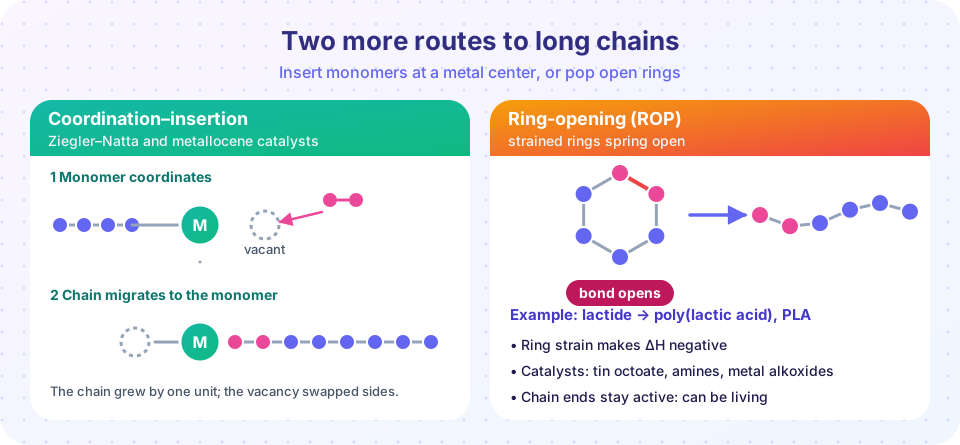
The accepted picture is the Cossee–Arlman mechanism. A titanium center on the surface carries a growing polymer chain bonded through a Ti–C bond, and a vacant coordination site next to it.
- A monomer, say propylene, coordinates to the vacant site through its double bond.
- The chain migrates from the metal onto the coordinated monomer: the monomer inserts into the Ti–C bond. The chain is now one unit longer, and the vacant site has moved to where the chain used to be.
- The cycle repeats, thousands of times per second at each active site.
Because the monomer must approach in a specific way at a chiral surface site, it can be placed with the same orientation each time. That is how Natta's catalysts made isotactic polypropylene, in which every methyl group points the same way. Added electron donors (external donors) improve stereoselectivity further, so modern catalysts produce more than 95 percent isotactic material.
Chain growth ends by chain transfer, most simply with hydrogen: H₂ cleaves the metal–chain bond and starts a new chain. Adding hydrogen is the industrial control knob for molar mass. Because a heterogeneous catalyst has many kinds of sites, each producing different chain lengths, the dispersity is broad, typically 4 to 8.
Another route to HDPE is the Phillips catalyst, chromium oxide on silica (developed at Phillips Petroleum in the early 1950s), which needs no cocatalyst and makes polyethylene with an extremely high molar mass and a broad distribution.
Metallocenes and single-site catalysts
In 1980 Walter Kaminsky and Hansjörg Sinn found that a soluble zirconocene dichloride, Cp₂ZrCl₂, becomes hugely active when treated with methylaluminoxane (MAO). Metallocenes are single-site catalysts: every metal center is the same, so every chain grows and ends in the same way. The result is a dispersity near 2 and a uniform incorporation of comonomers, ideal for linear low-density polyethylene made with 1-hexene or 1-octene.
The geometry of the ligands controls tacticity. Brintzinger's bridged (ansa) metallocenes with C₂ symmetry, developed by Kaminsky and Brintzinger in the 1980s, give isotactic polypropylene; Ewen showed in 1988 that metallocenes with a different symmetry (Cs) produce syndiotactic polypropylene. The metal center "reads" the shape of its ligands and passes that information to every monomer. Later generations include constrained-geometry catalysts and late-transition-metal catalysts (Brookhart's nickel and palladium diimines), which can make branched polyethylene from ethylene alone, and chain-shuttling systems that make block copolymers of ethylene with different comonomer content.
Ring-opening polymerization (ROP)
A ring can serve as a monomer if opening it lowers the Gibbs energy: ΔG = ΔH − TΔS < 0. For rings the entropy change is small and only slightly negative, since a ring already has restricted freedom, so the enthalpy, mostly ring strain, decides.
- Three- and four-membered rings (ethylene oxide, ~−94 kJ/mol; oxetane) are highly strained and polymerize readily.
- Five-membered rings have low strain. Tetrahydrofuran polymerizes only weakly and has a modest ceiling temperature of the order of 80 °C; γ-butyrolactone is difficult to polymerize.
- Six-membered rings like cyclohexane are nearly strain-free and do not polymerize, while δ-valerolactone and lactide (a six-membered cyclic diester) do, because the ester groups add strain.
- Seven- and eight-membered rings, such as ε-caprolactone and cyclic siloxane D4, polymerize well.
The mechanisms depend on the ring and the initiator.
| Type | Active center | Examples |
|---|---|---|
| Anionic | alkoxide or amide anion | ethylene oxide to PEG; ε-caprolactam to cast nylon 6 |
| Cationic | oxonium ion | THF to poly(THF); oxazolines |
| Coordination-insertion | metal alkoxide | lactide to PLA with tin(II) octoate; caprolactone to PCL |
| Organocatalytic | activated alcohol or monomer | DBU or TBD with an alcohol initiator |
| Enzymatic | lipase | caprolactone in mild conditions |
In the common coordination–insertion route to polylactide, a metal alkoxide (formed from tin octoate and an alcohol) opens the lactide ring by attacking the carbonyl and inserts it into the metal–oxygen bond, extending the chain by one lactide unit. The alcohol sets the number of chains, so Mn = M(lactide) × ([lactide]/[alcohol]) × p. With care, ROP is living-like, giving narrow distributions and block copolymers such as PLA-b-PEG.
Nylon 6 shows the industrial side. ε-Caprolactam (a seven-membered lactam) is polymerized with a little water at about 250 to 270 °C by a mix of ring opening and condensation. No small molecule is lost overall, yet the polymer is the same polyamide as a condensation product. Cast nylon 6 is made by anionic ROP of caprolactam directly in a mold, which allows big parts. Silicones come from ring opening of cyclic siloxanes (D3, D4) by acid or base, giving poly(dimethylsiloxane), PDMS. Poly(ethylene glycol) is made by anionic ROP of ethylene oxide and used in medicines and cosmetics.
Equilibrium monomer concentration
Because ΔH for ROP is modest, the polymerization is an equilibrium. Some monomer always remains at equilibrium:
[M]eq = exp(ΔG° / RT) = exp(ΔH°/RT − ΔS°/R).
At high temperature the equilibrium monomer concentration rises, and above a ceiling temperature polymer is not formed. For lactide this is why PLA melt-processing at high temperature leaves some monomer and why PLA can depolymerize on heating, a fact that matters for chemical recycling (chapter 8).
Ring-opening metathesis polymerization (ROMP)
A strained cyclic alkene such as norbornene or cyclooctene can be opened by a metal carbene catalyst (Grubbs' ruthenium catalysts, Schrock's molybdenum catalysts) in an olefin metathesis reaction. The product keeps a C=C double bond in every repeat unit. ROMP can be living, tolerates many functional groups, and makes materials such as polydicyclopentadiene for molded parts and block copolymers for research. Olefin metathesis was recognized by the 2005 Nobel Prize in Chemistry (Chauvin, Grubbs, Schrock).
Common misconceptions
"Any ring can be opened to make a polymer." Unstrained rings like cyclohexane do not polymerize; thermodynamics must be favorable.
"A catalyst only speeds up the reaction." In coordination polymerization the catalyst also controls tacticity, molar mass and comonomer placement.
"Ziegler–Natta and metallocene catalysts give the same distributions." Multisite Ziegler–Natta catalysts give Đ of 4 to 8; single-site metallocenes give about 2.
Try it
The first program calculates the equilibrium monomer concentration for ring-opening polymerizations at different temperatures, using illustrative thermodynamic values of the right order of magnitude; it shows why polymerization works at low temperature and weakens at high. The second simulates a stereoregular chain from the probability of a meso placement (Pm) and compares triad fractions with theory. Both are models, not measured data.
Press Run (or Ctrl + Enter) to see the result here.
Program input · what you'd type while the program runs
Type the answers before you press Run, one per line. Each time the program reads a line (with input()), it gets the next line from this box.
Press Run (or Ctrl + Enter) to see the result here.
Program input · what you'd type while the program runs
Type the answers before you press Run, one per line. Each time the program reads a line (with input()), it gets the next line from this box.
Check your understanding
Quick check · 5 questions
of 5 answered You scored / 5 · perfect!
-
1. In the Cossee–Arlman mechanism, what happens after the monomer coordinates?
Insertion extends the chain by one unit and moves the vacant site. -
2. Which catalyst type gives a dispersity of about 2 because all active sites are identical?
Single-site catalysts produce chains in the same way at every center. -
3. Why does cyclohexane not undergo ring-opening polymerization?
A strain-free six-membered ring gains almost no enthalpy on opening, so it does not polymerize. -
4. Which polymer is made by ROP of a cyclic diester with tin(II) octoate?
Lactide is the cyclic diester of lactic acid and gives PLA. -
5. How is molar mass most commonly controlled in industrial Ziegler–Natta polymerization?
Hydrogen cleaves the metal–polymer bond, ending one chain and starting another.
Summary
- Ziegler–Natta and metallocene catalysts polymerize alkenes by coordination-insertion at a metal center, controlling tacticity; Ziegler–Natta gives broad, metallocene narrow (about 2) distributions.
- Rings polymerize when strain makes ΔH favorable; ROP routes (anionic, cationic, coordination, organocatalytic) give PEG, PLA, PCL, nylon 6 and silicones.
- ROP and similar reactions are equilibria with an equilibrium monomer concentration and a ceiling temperature; ROMP opens strained cycloalkenes with metal carbenes.
Next: Chapter 3 review
Track your progress
Create a free account to tick off lessons and pick up where you left off on any device.
of Polymer and Materials Chemistry lessons completed