


















Lesson 4 of 47 · Getting Started
Materials families: metals, ceramics, polymers and composites
Compare the four main families of engineering materials by bonding, density, stiffness and failure, and learn where polymers win and where they do not.
Choosing a material is a matter of trade-offs. A bridge needs stiffness and strength at a price that a city can afford. A hip implant needs to survive millions of steps inside the body. A drinks bottle needs to be clear, light and cheap enough to throw away. No single material is best at everything, which is why engineers group materials into families with shared characteristics and then pick within the family. This lesson compares the four families, shows where polymers fit, and gives you a simple way to compare materials with numbers.
What you will learn
- How bonding separates metals, ceramics and polymers
- Typical ranges of density, stiffness and strength for each family
- Why composites combine families, and how fibers and matrix share the load
- How to compare materials with specific stiffness and an Ashby-style chart
Key terms
Density (ρ): mass per unit volume, here in g/cm³ (1 g/cm³ = 1000 kg/m³).
Young's modulus (E): stiffness; the stress needed per unit strain in the elastic range, measured in GPa for solids.
Specific stiffness: E divided by ρ; how stiff a material is for its weight.
Composite: a material made of two or more distinct phases, usually a strong reinforcement in a matrix.
Brittle: breaks with little plastic deformation; ductile: stretches and deforms before breaking.
Metals: a sea of electrons
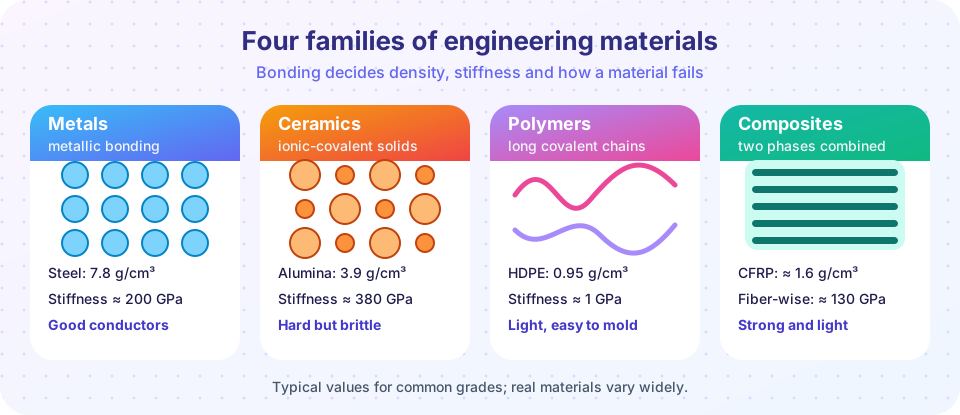
In a metal, atoms release outer electrons into a shared "sea" that holds the lattice together. Because the bonding is nondirectional, planes of atoms can slide, which makes metals ductile, tough and easy to form. The mobile electrons make them good conductors of heat and electricity. Steel is about 7.8 g/cm³ with a stiffness of roughly 200 GPa; aluminium is about 2.7 g/cm³ and 70 GPa. Metals are heavy compared with polymers, can corrode, and need high temperatures to melt and cast.
Ceramics: hard, stiff and brittle
Ceramics such as alumina, silica glass and silicon carbide are held by strong ionic or covalent bonds in rigid networks. The bonds are strong and directional, so ceramics are very stiff (alumina near 380 GPa), hard and heat resistant. For the same reason they cannot absorb energy by slipping, so a tiny flaw can start a crack that runs through the piece. They are brittle, and they are poor at handling sudden impacts or tension but excellent in compression and at high temperature. Glass, tiles, spark-plug insulators and cutting tools are all ceramics.
Polymers: long chains, weak forces
A polymer has strong covalent bonds along the chain and weak forces between chains. The result is low density (polyethylene is about 0.95 g/cm³), low stiffness (about 1 to 3 GPa for typical plastics, and far less for rubbers), good electrical insulation, resistance to many chemicals, and an easy path to making complicated shapes by molding at low temperature. The weak links are the cost: polymers soften with heat, creep under steady load and age with sunlight and oxygen.
The remarkable thing about polymers is how much their behavior can be tuned. The same ethylene unit gives a soft film, a stiff bottle crate or an ultra-strong fiber depending on chain length, branching and orientation. Later chapters show how.
Composites: the best of two worlds
A composite embeds one material in another. The classic design is fibers in a matrix. The fibers, such as glass or carbon, are stiff and strong along their length but cannot carry load alone. The polymer matrix, often epoxy, holds the fibers in place, transfers load between them and protects them from damage. Carbon-fiber reinforced polymer (CFRP) has a density near 1.6 g/cm³ and, along the fibers, a stiffness of the order of 130 GPa (more in some grades), so it competes with metals at a fraction of the weight. Fibers carry most of the load along their axis; across the fibers the matrix dominates, so composites are anisotropic, and designers place layers in the directions of the loads. Wood is nature's version: cellulose fibers in a lignin matrix.
Concrete (aggregate in cement) and reinforced concrete (steel bars in concrete) are composites on a different scale.
A comparison you can act on
| Property | Metals | Ceramics | Polymers | Composites |
|---|---|---|---|---|
| Bonding | metallic | ionic/covalent network | covalent chains + weak forces | two phases |
| Density (g/cm³) | 2.7 to 8 | 2.5 to 6 | 0.9 to 2 | 1.5 to 2.2 |
| Stiffness (GPa) | 70 to 210 | 70 to 400 | 0.001 to 4 | 20 to 150 (along fibers) |
| Failure | ductile | brittle | ductile to brittle, time-dependent | depends on layup |
| Melting or use limit | high | very high | low (80 to 300 °C) | limited by matrix |
| Processing | casting, machining | sintering | molding, extrusion | layup, molding |
Notice how specific stiffness, E/ρ, changes the picture. Steel, at 200 GPa and 7.8 g/cm³, scores about 26 GPa per g/cm³. A carbon-fiber composite at 130 GPa and 1.6 g/cm³ scores more than 80. A typical plastic scores around 1. For a pressure vessel, a car body or an aircraft wing, specific properties decide the choice; for a plastic bottle, cost and processing do.
An Ashby chart plots one property against another on logarithmic axes so that whole families appear as clouds. Reading these charts is a core skill in materials selection, and you can draw one yourself below.
Where polymers win, and where they do not
Polymers win when you need low weight, easy shaping into complex parts, corrosion resistance, electrical insulation, flexibility, transparency or low cost per piece. They lose when you need very high stiffness, temperature resistance, or dimensional stability under load. Many of the most successful products combine families: a metal circuit board with a polymer insulator, a ceramic filler in a polymer matrix, a polymer-coated steel can. You will see in chapters 6 and 7 how additives and fibers push polymers into new territory.
Selecting a material: a worked way of thinking
Materials selection is a method, not a lookup. An engineer writes down the function (what the part must do), the constraints (limits that must not be crossed) and the objective (what to minimize or maximize). Take a bicycle frame tube. The function is to carry bending loads. The constraints are a minimum stiffness so the bike does not flex, a minimum strength so it does not break, and a maximum cost. The objective is the lowest possible mass. Each choice of material and tube shape gives a mass, and the winner is the one with the best combination of specific stiffness and specific strength that fits the budget. That is why racing bikes use carbon fiber composites and titanium, touring bikes use steel and aluminium, and children's balance bikes may use molded polymer.
The same logic works for a disposable cup. The function is to hold a hot liquid; the constraints are food safety, a Tg or melting point above 90 °C or an insulating wall, and very low cost per piece; the objective is minimum cost. Foamed polystyrene or paper lined with a thin polyethylene film wins, because a polymer can be molded into a thin-walled shape in a fraction of a second and at a tiny cost. Strength and stiffness hardly matter.
Two further ideas help. First, processing is part of the choice. A ceramic with perfect properties may be impossible to make into a complex shape, while a thermoplastic can be injection molded into a part with clips, ribs and hinges in a single step. Second, properties depend on conditions: temperature, humidity, ultraviolet light, chemicals and the time under load. A polymer that is excellent at 20 °C may be unusable at 80 °C. Engineers therefore pair every number in a data sheet with the conditions under which it was measured.
Common misconceptions
"Stronger always means better." The best material is the one that meets the requirements at the lowest cost and weight. A stronger material that is heavier, costlier or harder to shape can be the worse choice.
"Polymers are weak." Compared with steel in bulk, ordinary plastics are less stiff. But oriented polymer fibers such as high-modulus polyethylene and aramid have tensile strengths that exceed that of steel on a weight basis.
"Ceramics are fragile because their bonds are weak." It is the opposite: the bonds are very strong, which prevents the slip that would let a metal deform. Brittleness comes from flaws and the lack of plastic flow.
Try it
Draw a small Ashby chart of stiffness against density, then rank materials by specific stiffness. The numbers are typical values for common grades, rounded; real grades vary.
Press Run (or Ctrl + Enter) to see the result here.
Program input · what you'd type while the program runs
Type the answers before you press Run, one per line. Each time the program reads a line (with input()), it gets the next line from this box.
Press Run (or Ctrl + Enter) to see the result here.
Program input · what you'd type while the program runs
Type the answers before you press Run, one per line. Each time the program reads a line (with input()), it gets the next line from this box.
Check your understanding
Quick check · 5 questions
of 5 answered You scored / 5 · perfect!
-
1. Why are metals generally ductile?
The electron sea allows layers of atoms to slip past each other without breaking the bonding. -
2. Which family is typically the stiffest and most brittle?
Strong directional bonds give ceramics high modulus but little capacity for plastic flow. -
3. What does specific stiffness measure?
Specific stiffness E/ρ shows how much stiffness you get per unit of weight. -
4. In a fiber-reinforced composite, the matrix mainly
Fibers are stiff and strong along their axis; the matrix binds and shares the load. -
5. Why do engineers not always choose the stiffest material?
Selection balances many requirements, so the best choice is rarely the extreme in one property.
Summary
- Bonding explains the families: metallic (ductile, dense), ionic/covalent networks (stiff, brittle), covalent chains with weak forces (light, soft, easily processed) and composites (combined phases).
- Specific stiffness E/ρ and Ashby charts compare materials fairly across families.
- Polymers win on weight, shaping and chemical resistance, and lose on stiffness and heat; composites push them into structural uses.
Next: Chapter 1 review
Track your progress
Create a free account to tick off lessons and pick up where you left off on any device.
of Polymer and Materials Chemistry lessons completed