


















Lesson 43 of 47 · Projects and Practice
Project: Select a Material for a Product
A guided design project: turn requirements into constraints and objectives, derive performance indices, screen and rank polymers, composites and metals, and decide.
Engineers rarely ask "what is the best material?" They ask "what is the best material for this job, given what the part must do, what it may not do, and what we are trying to minimize?" This project walks through that process in four steps and uses code to carry out the screening and ranking, so you can repeat it for your own products.
Your deliverable at the end is a short design note: the requirements, the performance index you derived, the shortlist with numbers and a recommendation with its caveats. The example is a light, stiff beam, but the method works for bottles, housings, films and gaskets alike.
What you will learn
- Translate a design brief into function, constraints, objective and free variables.
- Derive a performance index for a stiff light beam and for other loadings.
- Screen with hard limits and rank with an index, using a short script.
- Balance several criteria with a weighted decision matrix and state caveats.
Key terms
Function: what the part does (carry a bending load, contain a liquid, insulate).
Constraint: a limit that must be met (minimum stiffness, maximum temperature).
Objective: the quantity to minimize or maximize (mass, cost, impact).
Performance index: a combination of properties that measures how well a material meets the objective for a given function and shape.
Free variable: a quantity the designer can change, such as cross-section size.
Step 1: write the brief
Take this example: a drone arm, a beam of length L = 0.3 m, must not deflect more than a given amount under the motor load, must withstand 90 °C near the motor, and should be as light as possible.
| Element | Statement |
|---|---|
| Function | Support a bending load as a beam |
| Constraints | Stiffness S at least a given value; service temperature at least 90 °C; length fixed |
| Objective | Minimize mass |
| Free variable | Cross-section size (assume a solid square section of side b) |
Writing the brief in this form already prevents most mistakes, because it tells you what is fixed and what you can change.
Step 2: derive the performance index
For a square beam, bending stiffness scales as S ∝ E b⁴ / L³, where E is Young's modulus. Because stiffness must be met with the smallest section, solve for b:
b = (S L³ / E)^(1/4)
The mass is m = ρ b² L. Substitute:
m = ρ L (S L³ / E)^(1/2) = (S^(1/2) L^(5/2)) × (ρ / E^(1/2))
Everything in the first bracket is fixed by the brief. To minimize mass you must minimize ρ / E^(1/2), that is, maximize the index M = E^(1/2) / ρ.
Other loadings give other indices (the derivation is the same each time):
| Part | Index to maximize |
|---|---|
| Stiff tie (tension member) of minimum mass | E / ρ |
| Stiff beam (solid section) | E^(1/2) / ρ |
| Stiff panel (plate) | E^(1/3) / ρ |
| Strong beam (minimum mass for a strength limit) | σ^(2/3) / ρ |
The pattern is useful: the more the shape can redistribute material (thin panels, hollow beams), the more weight is placed on density.
Step 3: screen and rank
Screening removes anything that fails a constraint. Ranking sorts the rest by the index. The table below uses typical handbook-order values (they vary by grade, so always check a data sheet) for a short list that includes a composite measured along its fibers.
Press Run (or Ctrl + Enter) to see the result here.
Program input · what you'd type while the program runs
Type the answers before you press Run, one per line. Each time the program reads a line (with input()), it gets the next line from this box.
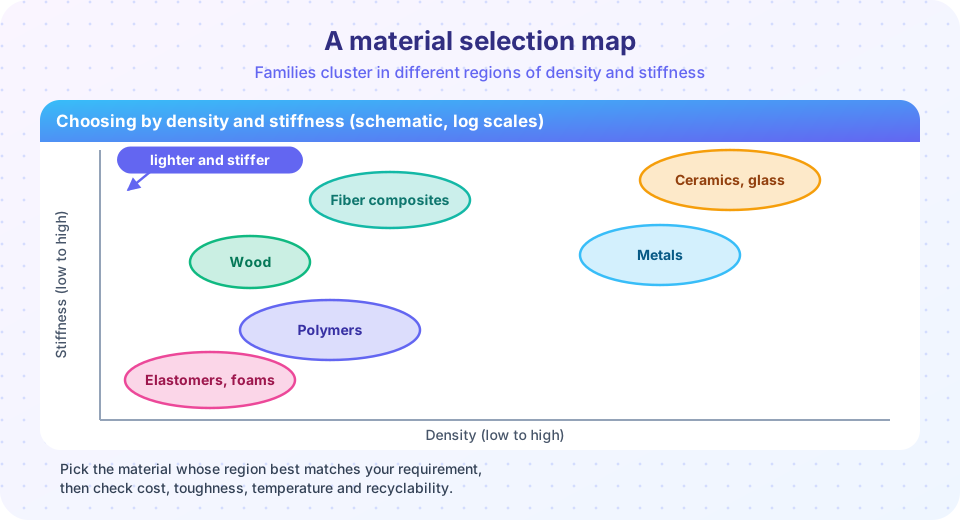
Read the result critically. The carbon-fiber composite wins by a wide margin, but only along its fibers: if the arm is loaded across them, the effective E is far lower (remember the Reuss bound). Glass-filled epoxy lands near aluminum on this index, and the unreinforced polymers cluster far below. Steel is stiff but heavy, so it does not rank well when mass is the objective. These are exactly the trade-offs you saw in the composites lesson.
Step 4: balance several criteria
Mass is only one objective. A weighted decision matrix scores each finalist on several criteria (say 1 to 5), multiplies by weights that reflect priorities, and adds up. The scores below are judgment calls for a drone arm, so treat them as an example of method, not as data.
Press Run (or Ctrl + Enter) to see the console output here.
No output.
The ranking depends on the weights, which is the point: write them down before you compute, so the decision reflects the brief and not the result you hoped for.
Your project deliverable
- Brief: function, constraints, objective, free variables (a short table).
- Index derivation: the formula, with the steps (use the beam example as a template).
- Screening and ranking: your own candidate list (at least six materials from different families) with data and sources.
- Decision matrix: at least four criteria with weights and a sensitivity check.
- Caveats: anisotropy, temperature, moisture, joints, manufacturing route, end of life (recycling or disposal).
- Recommendation: one primary and one fallback.
Try other briefs: a refillable water bottle (stiff panel, light, hot-fill temperature, recyclable), a cable insulation (flexible, electrically insulating, flame retardant) or a gasket (low modulus, high strain recovery, chemical resistance).
Pitfalls to watch for
Three mistakes account for most poor selections. The first is choosing an index for the wrong shape or loading: a tie, a beam and a panel each have different indices, so derive the one that matches your part. The second is ignoring the temperature, moisture or chemical environment: a polymer that passes on stiffness can lose a large share of it a few tens of degrees below its glass transition, and nylon stiffness changes with humidity. The third is forgetting the process. A material that wins on paper may be impossible to mold into the shape you need, or may need tooling that is too costly for the volume. Always add one line to your design note for each of these.
Common misconceptions
"Pick the material with the highest property." The best material depends on the combination: a high modulus is useless if the density kills the mass objective, which is why we use indices.
"A composite's numbers are material constants." They depend on fiber direction, volume fraction and layup.
"Cost is only the price per kilogram." Part cost includes processing, tooling, scrap and end of life.
Check your understanding
Quick check · 4 questions
of 4 answered You scored / 4 · perfect!
-
1. For a solid square beam that must meet a stiffness requirement with minimum mass, which index should be maximized?
Substituting b = (S L³/E)^(1/4) into m = ρ b² L gives m proportional to ρ / E^(1/2). -
2. What does screening do?
Screening applies limits such as a maximum service temperature before ranking. -
3. Why must a composite's index be quoted with its fiber direction?
The modulus along the fibers can be an order of magnitude greater than across them. -
4. In a weighted decision matrix, why write the weights before computing scores?
Pre-committed weights avoid reverse-engineering the answer.
Summary
- A selection problem has a function, constraints, an objective and free variables; writing them down is half the work.
- Performance indices (such as
E^(1/2)/ρfor a light stiff beam) combine properties in the way the shape and loading demand. - Screen with hard limits, then rank by the index, then balance criteria with a weighted matrix and test its sensitivity.
- Always state caveats: direction, temperature, moisture, process and end of life.
Next: Practice problems
Track your progress
Create a free account to tick off lessons and pick up where you left off on any device.
of Polymer and Materials Chemistry lessons completed