


















Lesson 24 of 47 · Characterization
Thermal Analysis: DSC and TGA
Read DSC traces for Tg, crystallization and melting, calculate percent crystallinity, and use TGA mass-loss curves to find decomposition steps and fillers.
Heat a polymer slowly and it tells you its life story. At one temperature the chains begin to wiggle, at another they snap into crystals, at a third the crystals melt, and far above that the bonds themselves break. Two instruments, differential scanning calorimetry (DSC) and thermogravimetric analysis (TGA), record that story in about an hour using a few milligrams of material.
These measurements decide how a plastic can be processed, how hot a product can safely get and how much of it is really polymer. They also reveal hidden history: how fast a part was cooled, or whether the pellet contains talc, glass or moisture.
What you will learn
- Explain how DSC measures heat flow and identify Tg, Tc and Tm on a trace.
- Calculate percent crystallinity from melting and crystallization enthalpies.
- Explain why the first and second heating scans differ.
- Read a TGA curve for decomposition steps, moisture and filler content.
Key terms
Glass transition temperature (Tg): the temperature range where an amorphous region changes from hard and glassy to soft and rubbery as chain segments start to move.
Melting temperature (Tm): where crystals melt. Reported as the peak of an endothermic DSC curve.
Enthalpy of fusion (ΔHm): the heat absorbed on melting, found from the peak area, in J/g.
Crystallinity (Xc): the mass fraction of the sample in crystalline form.
Residue: the mass left in TGA after the polymer has decomposed.
How DSC works
A DSC holds two small pans in a furnace: one with a few milligrams of sample, one empty as a reference. The instrument heats both at a constant rate, typically 10 °C per minute, and measures the extra heat flow needed to keep the sample at the same temperature as the reference. The signal, in milliwatts per milligram, is the heat flow.
Three kinds of event appear:
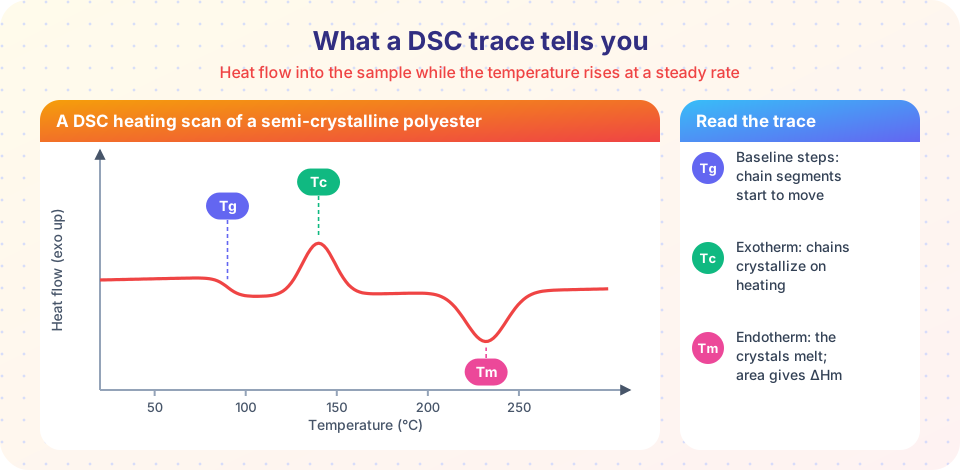
- A step in the baseline is the glass transition. Above Tg the heat capacity of the sample jumps because new motions become possible, so more heat is needed per degree. No heat is absorbed or released, which is why it is a step and not a peak. Tg is usually taken at the midpoint of the step.
- An exothermic peak (drawn upward in the "exo up" convention) is crystallization on heating, called cold crystallization. Chains that were frozen in a disordered state during fast cooling gain enough mobility above Tg to organize into crystals, releasing heat.
- An endothermic peak (drawn downward) is melting. The area under the peak is the enthalpy of fusion, and the peak top is the melting temperature. Polymer peaks are broad because crystals have a spread of thicknesses, and thin ones melt first.
Conventions differ: some instruments draw exotherms downward. Always check the axis label, as the figure above does ("exo up").
First heat, second heat
The first heating scan shows the sample as it arrived, including processing history, aging and absorbed moisture. A common routine is heat, cool, heat: heat above Tm to erase the history, cool at a controlled rate to record crystallization on cooling, then heat again. The second heat reflects the material itself rather than how it was molded. When comparing resins, compare second heats; when diagnosing a molded part, look at the first.
Crystallinity from DSC
The heat released or absorbed in a perfect crystal of the polymer is a literature constant, ΔHm°. If your sample absorbs a fraction of that, the same fraction of it must be crystalline:
Xc (%) = (ΔHm - ΔHcc) / (w × ΔHm°) × 100
ΔHcc is the heat of cold crystallization (crystals that formed during the scan were not there originally, so they must be subtracted), and w is the weight fraction of polymer if the sample contains filler. Commonly quoted values of ΔHm° are about 293 J/g for polyethylene, 207 J/g for polypropylene, 140 J/g for PET and 93 J/g for PLA. Different papers use slightly different values, so state the value you used.
Worked example. A PET bottle sample shows ΔHm = 38 J/g and ΔHcc = 20 J/g.
Xc = (38 - 20) / 140 × 100 = 12.9 %
A stretched bottle wall is typically more crystalline than that, but a quenched preform really is nearly amorphous, which is why it is clear. Crystallinity matters: more crystals give higher stiffness and chemical resistance but, if the crystals are large, haze and brittleness.
How TGA works
A TGA weighs a sample on a microbalance while heating it in a controlled gas. The output is mass (usually percent of the starting mass) against temperature. Often the derivative, the DTG curve, is plotted too, where each peak marks the temperature of fastest loss.
- Atmosphere matters. In nitrogen you see thermal decomposition alone. In air, oxygen adds oxidation and the carbon char burns away, so the residue differs.
- A small early step below about 150 °C is usually water or solvent.
- A big step is decomposition of the polymer. The onset temperature (where the curve leaves the baseline) is a practical measure of thermal stability.
- The residue at high temperature is what does not burn: glass, talc, calcium carbonate, carbon black (in nitrogen) or char.
Why PVC loses 58 % in step one
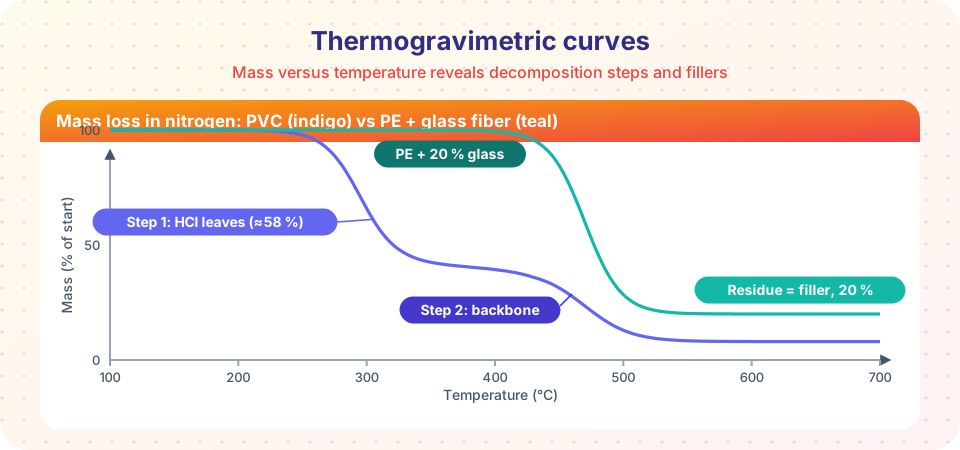
PVC repeat units are –CH2–CHCl–, with a molar mass of about 62.5 g/mol. When heated, each unit can lose HCl (36.46 g/mol). The fraction of mass that leaves is
36.46 / 62.50 = 0.583 → about 58 %
That is the first step in the figure, and it explains why PVC needs stabilizers: the HCl released catalyzes more loss, and the remaining conjugated polyene chain darkens. The second step, at higher temperature, is the breakdown of that carbon-rich backbone, leaving some char.
Using TGA to find fillers
If a sample of polypropylene with talc leaves 25 % residue at 700 °C in air, and the talc loses little mass itself, the filler content is about 25 % by weight. Corrections are needed if the filler itself loses mass, such as calcium carbonate, which gives off CO₂ near 700 to 800 °C and leaves calcium oxide. Knowing the chemistry of the filler is part of reading the curve.
Linking heat to stiffness: DMA
Dynamic mechanical analysis applies a small oscillating deformation and measures the storage modulus (stiffness) and the loss factor tan δ as temperature changes. The modulus drops by orders of magnitude at Tg, and the peak of tan δ is a more sensitive Tg marker than DSC for highly crystalline or cross-linked materials, where the DSC step is weak.
Common misconceptions
"The glass transition is a melting point for the amorphous part." It is not a first-order transition and has no latent heat. It is a gradual change in mobility, and its value depends on the heating or cooling rate.
"Higher crystallinity always means a stronger plastic." Stiffness and strength often rise, but impact toughness can fall, and large crystals scatter light so films turn hazy.
"TGA residue is always the filler." In nitrogen, many polymers leave carbonaceous char; in air, the char burns off. Compare the atmosphere to decide.
Try it
First, a crystallinity calculator. Edit the enthalpies and the filler fraction to see how the formula behaves, and notice that cold crystallization lowers the apparent original crystallinity.
Press Run (or Ctrl + Enter) to see the result here.
Program input · what you'd type while the program runs
Type the answers before you press Run, one per line. Each time the program reads a line (with input()), it gets the next line from this box.
Second, generate a model DSC curve from three events (a step, an exotherm and an endotherm). It is an illustration built from smooth functions, not an instrument recording.
Press Run (or Ctrl + Enter) to see the result here.
Program input · what you'd type while the program runs
Type the answers before you press Run, one per line. Each time the program reads a line (with input()), it gets the next line from this box.
Third, a TGA mass balance. The PVC number comes straight from the formula masses, and the second function turns a residue into a filler estimate.
Press Run (or Ctrl + Enter) to see the result here.
Program input · what you'd type while the program runs
Type the answers before you press Run, one per line. Each time the program reads a line (with input()), it gets the next line from this box.
Check your understanding
Quick check · 5 questions
of 5 answered You scored / 5 · perfect!
-
1. On a DSC trace, a step in the baseline with no peak indicates:
At Tg the heat capacity changes, which shifts the baseline as a step. No latent heat is exchanged, so there is no peak. -
2. Why is the 'second heat' often preferred when comparing two resins?
Heating above Tm and cooling under controlled conditions removes the effects of molding, storage and moisture. -
3. A PET sample has ΔHm = 38 J/g and ΔHcc = 20 J/g. With ΔHm° = 140 J/g, its crystallinity is about:
Xc = (38 - 20) / 140 × 100 = 12.9 %, about 13 %. -
4. In TGA, a polymer leaves 20 % residue at 700 °C in air and the filler does not lose mass. The most likely meaning is:
Organic polymer and char burn away in air, so what remains is inorganic material such as glass or talc. -
5. Why does PVC lose about 58 % of its mass in its first TGA step?
Dehydrochlorination removes HCl; 36.46 / 62.50 is about 0.58 of the repeat-unit mass.
Summary
- DSC records heat flow against temperature: a step is Tg, an exothermic peak is crystallization, an endothermic peak is melting, and its area gives ΔHm.
- Crystallinity is
Xc = (ΔHm − ΔHcc) / (w ΔHm°); the reference ΔHm° is a literature value you must state. - A heat-cool-heat routine removes thermal history, so compare second heats between materials.
- TGA records mass against temperature: decomposition onset shows stability, the residue shows fillers, and the atmosphere decides what counts as residue.
- DMA complements DSC by linking transitions to stiffness.
Track your progress
Create a free account to tick off lessons and pick up where you left off on any device.
of Polymer and Materials Chemistry lessons completed