


















Lesson 10 of 47 · Polymer Basics
Chapter 2 review: polymer basics
Review repeat units, degree of polymerization, molar mass averages, dispersity, architectures, copolymers and tacticity with a summary picture, recap table and a ten-question quiz.
This chapter gave you the language for describing any polymer: the repeat unit, the size of a chain, the spread of sizes in a sample, and the shape and sequence of the chain. These ideas are the grammar of the whole subject. When you read that a polymer is "a linear, high-density polyethylene with Mn = 30,000 g/mol and Đ = 4" you can now picture it and judge whether it will make a film, a pipe or a fiber. Use this review to check that the vocabulary and the calculations are secure.
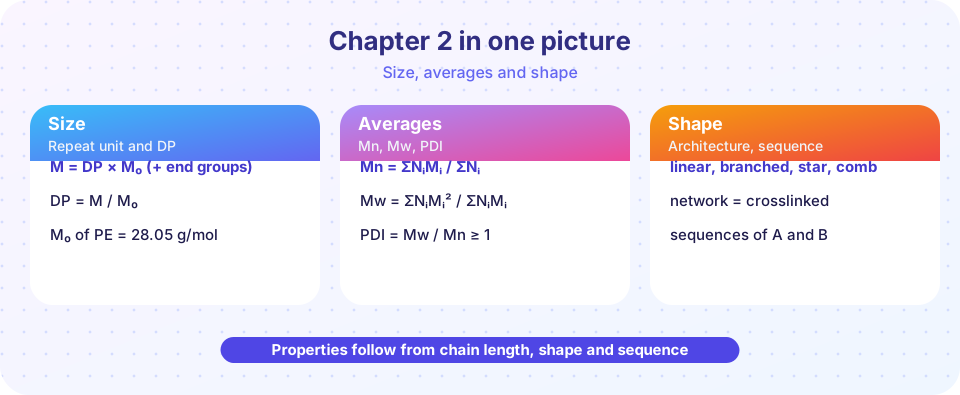
Recap table
| Concept | Key facts |
|---|---|
| Repeat unit | The smallest repeating group; for addition polymers it matches the monomer, for condensation polymers it does not (nylon 6,6: 226.3 g/mol, not 262.4). |
| Naming | Source-based (polyethylene) or structure-based IUPAC (poly(methylene)); standard abbreviations PE, PP, PS, PVC, PET. |
| DP and M | M = DP × M₀; polyethylene with M = 280,000 g/mol has DP of about 10,000. |
| Size of a chain | Contour length is micrometers; a random coil is tens of nanometers. |
| Averages | Mn = ΣNM/ΣN; Mw = ΣNM²/ΣNM; Mz = ΣNM³/ΣNM²; always Mn ≤ Mw ≤ Mz. |
| Dispersity | Đ = Mw/Mn; about 2 for step-growth, 1.5 to 3 for radical, 1.05 to 1.3 for controlled. |
| Why it matters | Strength rises with M; melt viscosity ∝ Mw^3.4 above entanglement. |
| Architecture | Linear, branched, star, comb, dendritic, network; branching lowers density and crystallinity. |
| Copolymers | Random, alternating, block, graft; reactivity ratios and the Mayo–Lewis equation set composition. |
| Tacticity | Isotactic, syndiotactic, atactic; regular chains crystallize. |
Worked example to rehearse
A sample has two fractions: 50 chains of 20,000 g/mol and 10 chains of 100,000 g/mol.
- Total mass: 50(20,000) + 10(100,000) = 2,000,000 g/mol (per 60 chains)
- Mn = 2,000,000 / 60 = 33,333 g/mol
- ΣNM² = 50(4 × 10⁸) + 10(10¹⁰) = 2 × 10¹⁰ + 10¹¹ = 1.2 × 10¹¹
- Mw = 1.2 × 10¹¹ / 2,000,000 = 60,000 g/mol
- Đ = 60,000 / 33,333 = 1.80
Notice that the large chains are only one sixth of the molecules but half of the mass. That asymmetry is exactly why Mw is larger than Mn.
Connecting the three ideas
A good way to consolidate the chapter is to run one polymer through all three lenses. Take LLDPE, the polyethylene used for stretch film and flexible packaging. Its repeat unit is –CH₂–CH₂–, with a small fraction of units that carry a short branch from a comonomer such as 1-hexene. That is the chemistry lens: mostly polyethylene, with a few butyl branches. Its molar mass, typically a number-average of 30,000 to 40,000 g/mol, and its dispersity of about 2 to 4 depending on the catalyst, are the size lens: chains of 1,000 or more repeat units with a modest spread. The shape lens says that the backbone is linear, with short branches placed along it at intervals, and that the sequence of comonomer units is random along each chain.
Now change one lens at a time. Keep the chemistry and size but remove the branches: you get HDPE, stiffer and more crystalline. Keep the chemistry and the architecture but raise the molar mass by a factor of 100: you get ultra-high-molecular-weight polyethylene, so viscous that it cannot be melt-processed in the ordinary way and so tough that it is used in artificial joints. Keep size and architecture but replace half the hydrogens on alternate carbons by methyl groups and place them randomly: you get an amorphous ethylene-propylene rubber. Each change is small on paper and large in the product.
A related exercise helps with the calculations. When you meet a new problem, write down which quantities you have (M, M₀, Nᵢ, Mᵢ) and which you need (DP, Mn, Mw, Đ), and choose the formula that links them. Most mistakes come from mixing up the number-weighted and mass-weighted averages, or from forgetting that a condensation polymer's repeat unit is lighter than the sum of its monomers.
Common misconceptions to double-check
"Mw can be smaller than Mn." Never: Mw ≥ Mn for any sample, with equality only for identical chains.
"Condensation polymers have the same repeat unit as the sum of their monomers." They lose a small molecule at each link.
"Branching and tacticity are the same idea." Branching is about the connectivity of chains; tacticity is about the three-dimensional orientation of side groups along an otherwise linear chain.
Try it
A practice-problem generator for the calculation you will use most. Press the button for a new problem, type the degree of polymerization, and check. It is a study aid, not a graded test.
Check your understanding
Quick check · 9 questions
of 9 answered You scored / 9 · perfect!
-
1. What is the repeat unit mass of PVC, –CH₂–CHCl–, in g/mol (C 12.011, H 1.008, Cl 35.45)?
2(12.011) + 3(1.008) + 35.45 = 62.50 g/mol. -
2. A polystyrene sample has M = 208,300 g/mol and M₀ = 104.15 g/mol. What is its degree of polymerization?
DP = 208,300 / 104.15 = 2,000. -
3. For the sample 2 chains of 10,000 and 2 chains of 30,000 g/mol, what is Mn?
Mn = (2 × 10,000 + 2 × 30,000) / 4 = 20,000 g/mol. -
4. For the same sample, Mw is
ΣNM² = 2(10⁸) + 2(9 × 10⁸) = 2 × 10⁹ and ΣNM = 80,000, so Mw = 2 × 10⁹ / 80,000 = 25,000 g/mol. -
5. Which statement about dispersity is correct?
Đ = Mw/Mn ≥ 1 with equality for identical chains. -
6. The contour length of a chain is much larger than the coil size because
Rotation about single bonds allows many conformations, and the most probable ones are coiled. -
7. SBS rubber is an example of which copolymer sequence?
Polystyrene–polybutadiene–polystyrene is a triblock copolymer. -
8. Isotactic polypropylene crystallizes more easily than atactic polypropylene because
Order along the chain permits ordered packing, and thus crystallinity. -
9. Doubling the weight-average molar mass of an entangled melt changes its zero-shear viscosity by roughly
With η₀ ∝ Mw^3.4, 2^3.4 ≈ 10.
Summary
- Describe a polymer by repeat unit, size distribution (DP, Mn, Mw, Đ) and shape (architecture, sequence, tacticity).
M = DP × M₀, andĐ = Mw/Mn ≥ 1; each average answers a different question.- Architecture, copolymer sequence and tacticity change properties without changing the repeat unit's chemistry.
Track your progress
Create a free account to tick off lessons and pick up where you left off on any device.
of Polymer and Materials Chemistry lessons completed