


















Lesson 35 of 47 · Advanced and Functional Materials
Smart Polymers and Hydrogels
Understand hydrogels, swelling ratio, PNIPAM's lower critical solution temperature, pH-responsive polyacids, shape-memory and self-healing polymers.
A soft contact lens is mostly water, yet it keeps its shape. A baby's diaper holds hundreds of times its own weight of liquid without leaking. A drug capsule releases its cargo only when it reaches a slightly acidic tissue. Behind all three are hydrogels and smart polymers: materials whose structure changes in response to their environment.
What makes these materials special is that their response comes from a delicate balance of forces at the molecular level, so a small change in temperature, pH or light can tip it and produce a large, visible effect. In this lesson you will learn how a hydrogel holds water, how to quantify swelling, why PNIPAM collapses on warming, and how pH, light and heat can be used as triggers.
What you will learn
- Define a hydrogel and calculate swelling ratio and water content.
- Explain the balance of forces that sets equilibrium swelling.
- Explain LCST behavior of PNIPAM in terms of entropy.
- Describe pH-responsive, light-responsive, shape-memory and self-healing polymers and their uses.
Key terms
Hydrogel: a cross-linked hydrophilic polymer network swollen with water.
Swelling ratio (Q): swollen mass divided by dry mass.
LCST: the lower critical solution temperature, above which a polymer solution or gel separates from water.
Polyelectrolyte: a polymer with ionizable groups, such as acrylic acid units.
Stimulus-responsive polymer: a polymer whose properties change sharply when a trigger such as temperature, pH or light changes.
What a hydrogel is
A hydrogel is a three-dimensional polymer network that absorbs water but does not dissolve, because its chains are held together by cross-links (covalent bonds or strong physical associations). The polymer is hydrophilic: it carries groups such as hydroxyl, amide, carboxylic acid or ether that bond to water. Water fills the spaces in the mesh, so a gel can be 90 % water or more and still behave as a soft solid.
The classic examples include:
- pHEMA (poly(2-hydroxyethyl methacrylate)), the polymer of the first soft contact lenses developed by Otto Wichterle and colleagues in Czechoslovakia in the 1950s and 1960s. Typical water content is about 38 %.
- Sodium polyacrylate, the superabsorbent in diapers, which can absorb hundreds of times its dry mass of pure water (much less in salty solutions such as urine, because ions weaken the swelling).
- Natural gels such as agarose, gelatin and alginate, used in labs, foods and wound dressings.
Quantifying swelling
Weigh the dry gel (Wd) and the fully swollen gel (Ws):
Q = Ws / Wd                          (swelling ratio)
water content (%) = (Ws − Wd) / Ws × 100
A gel that swells from 1.0 g to 20 g has Q = 20 and a water content of 95 %.
What sets the equilibrium
Swelling is a tug-of-war between three effects, summarized in the Flory–Rehner theory:
- Mixing: polymer and water prefer to mix when they interact favorably, which drives water in.
- Elasticity: the cross-linked chains stretch as the gel swells, and their entropic elasticity (see the rubber lesson) pulls back. A more densely cross-linked gel swells less.
- Ionic osmotic pressure: if the chains carry fixed charges, their counter-ions are trapped inside and draw in water to dilute themselves. This is why charged gels can swell enormously and why adding salt to the surrounding liquid shrinks them.
Equilibrium is reached when the three pressures balance. Anything that changes one of them, such as temperature, charge or solvent quality, changes the swelling, which is exactly what smart polymers exploit.
Temperature response: PNIPAM
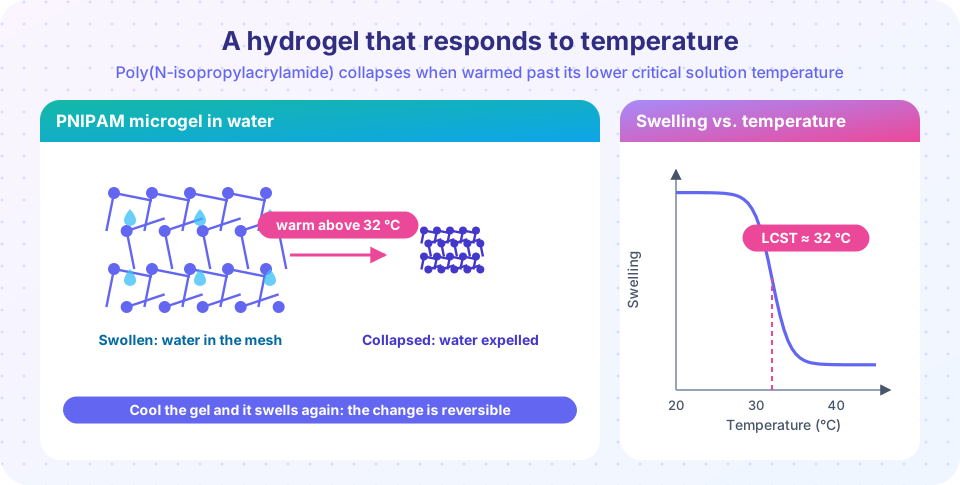
Poly(N-isopropylacrylamide), PNIPAM, has hydrophilic amide groups and hydrophobic isopropyl groups. Below about 32 °C the amide groups form hydrogen bonds with water and the chains are swollen. Above that temperature, called the lower critical solution temperature (LCST), the chains collapse and the gel expels most of its water, as in the figure.
The reason is entropy. Water molecules near the hydrophobic isopropyl groups are ordered into cage-like structures, which lowers the entropy of the water. Warming makes the free energy of mixing ΔG = ΔH − TΔS less favorable because the entropy term −TΔS grows with temperature; above the LCST it is more favorable for water to leave the polymer and regain its disorder. The effect is therefore reversible and counter-intuitive: the gel collapses on heating, the opposite of ordinary dissolution.
The LCST can be tuned by copolymerization. Hydrophilic comonomers raise it; hydrophobic ones lower it. Because 32 °C is close to body temperature, PNIPAM-based systems are attractive for injectable gels that solidify in the body, and for cell culture sheets from which cells detach when the dish is cooled.
pH response
Gels containing weak acid groups such as poly(acrylic acid) (pKa about 4.5) are neutral and compact at low pH but become charged and swollen at higher pH. The fraction of acid groups ionized follows the Henderson–Hasselbalch relation:
α = 1 / (1 + 10^(pKa − pH))
At pH 3, α ≈ 0.03, so there are few charges. At pH 7, α ≈ 0.997: nearly every group carries a negative charge, the mutual repulsion and trapped counter-ions swell the gel strongly. Gels with basic groups, such as amines, do the opposite. A pH-sensitive coating can protect a drug in the acidic stomach and release it in the more neutral intestine.
Other triggers and functions
- Light. Azobenzene groups switch between straight and bent forms when exposed to ultraviolet and visible light. In a polymer network the change can bend a film or release a payload.
- Electric and magnetic fields. Charged gels bend in an electric field; magnetic particles embedded in a gel let a field move it or heat it.
- Glucose and biomolecules. Gels carrying groups that bind glucose swell as glucose rises, a concept explored for sensors and insulin delivery.
- Shape-memory polymers. A material is molded into a permanent shape, heated above a switching temperature (often a Tg or Tm), deformed into a temporary shape and cooled to fix it. Heating again makes the chains relax back to the original shape. Medical stents and self-deploying structures use this idea.
- Self-healing polymers. Reversible bonds, such as hydrogen bonds or Diels–Alder adducts, can break and reform, so a cut surface can bond together again, sometimes at room temperature and sometimes after warming. Another approach embeds microcapsules of healing agent that release when a crack passes through.
Uses
Wound dressings that keep a damp environment, contact lenses, soft robotics, tissue-engineering scaffolds, cell sheets, drug delivery, smart windows and sensors. Mechanical weakness is a challenge: ordinary hydrogels are fragile, which is why tougher "double-network" gels, with a rigid first network and a stretchy second one, are an active research area.
Common misconceptions
"A hydrogel is a liquid." It is a solid network. Cross-links prevent it from flowing, even when it is 95 % water.
"Heating always helps things dissolve." LCST polymers do the reverse: they separate from water on heating because water's entropy gain wins.
"Smart polymers think." They are ordinary polymers with a built-in physical response; the "intelligence" is the thermodynamic balance of forces.
Try it
First, model the swelling curve of a PNIPAM gel and shift its LCST by adding a hydrophilic comonomer. The curve is a smooth sigmoid model with a plausible shape, not measured data.
Press Run (or Ctrl + Enter) to see the result here.
Program input · what you'd type while the program runs
Type the answers before you press Run, one per line. Each time the program reads a line (with input()), it gets the next line from this box.
Second, pH response. The ionized fraction of poly(acrylic acid) follows Henderson–Hasselbalch; the swelling below is modeled as proportional to the charge, a deliberate simplification.
Press Run (or Ctrl + Enter) to see the result here.
Program input · what you'd type while the program runs
Type the answers before you press Run, one per line. Each time the program reads a line (with input()), it gets the next line from this box.
Third, a swelling calculator for a lab notebook entry.
Press Run (or Ctrl + Enter) to see the console output here.
No output.
Check your understanding
Quick check · 5 questions
of 5 answered You scored / 5 · perfect!
-
1. A gel weighs 0.5 g dry and 10 g swollen. What is its swelling ratio Q?
Q = Ws / Wd = 10 / 0.5 = 20. -
2. Why does PNIPAM collapse when heated above about 32 °C?
The −TΔS term grows with temperature; above the LCST it favors water leaving the polymer. -
3. Why does a poly(acrylic acid) gel swell at pH 7 but not at pH 2?
With pKa about 4.5, most groups are charged at pH 7 and nearly all neutral at pH 2. -
4. Which pair describes a shape-memory polymer cycle?
The temporary shape is locked in by cooling; reheating lets the network return to its permanent shape. -
5. Adding salt to the solution around a charged hydrogel usually:
Ions outside reduce the osmotic driving force from trapped counter-ions inside, so swelling falls.
Summary
- Hydrogels are cross-linked hydrophilic networks that hold large amounts of water; swelling ratio
Q = Ws/Wd. - Equilibrium swelling balances mixing, elastic and ionic (osmotic) contributions; changing any one of them changes the swelling.
- PNIPAM has an LCST near 32 °C driven by the entropy of water; copolymerization shifts it.
- Polyacid gels respond to pH through ionization (
α = 1/(1 + 10^(pKa − pH))). - Light, electric fields, glucose, shape memory and self-healing broaden the toolbox for medicine, sensors and soft robots.
Track your progress
Create a free account to tick off lessons and pick up where you left off on any device.
of Polymer and Materials Chemistry lessons completed