


















Lesson 29 of 47 · Plastics, Rubbers and Fibers
Engineering Plastics and Thermosets
Compare high-performance thermoplastics such as nylon, polycarbonate and PEEK with cross-linked thermosets such as epoxy and phenolic, and calculate gel points.
Commodity plastics are good enough for a bottle but not for a gear, a helmet visor, a jet-engine bracket or a circuit board. When parts must carry load, survive heat, resist solvents and keep their shape for years, engineers turn to engineering plastics (stronger, stiffer thermoplastics) and thermosets (cross-linked networks that never melt).
These materials cost more per kilogram, but they replace metals, glass and ceramics where weight, corrosion or design freedom matter. In this lesson you will see what makes each of them special at the molecular level, and you will calculate when a liquid resin turns into a solid network.
What you will learn
- Link the structure of nylon, polycarbonate, PMMA, PEEK and PTFE to their properties.
- Explain how a thermoset cures and why it cannot be re-melted.
- Calculate a gel point with the Carothers and Flory–Stockmayer equations.
- Choose between a thermoplastic and a thermoset for a given application.
Key terms
Engineering plastic: a thermoplastic with enough strength, stiffness and heat resistance to be used for structural parts.
Curing: the chemical reaction that cross-links a thermoset resin into a network.
Gel point: the conversion at which an infinite network first appears and the liquid turns into a rubbery gel.
Functionality (f): the number of reactive groups on a monomer.
Hydrogen bonding: a strong dipole attraction (such as N–H···O=C) between chains, important in polyamides.
Engineering thermoplastics
Polyamides (nylons)
Nylon 6,6 is made from hexamethylenediamine and adipic acid; nylon 6 is made by ring-opening polymerization of caprolactam. The amide groups –CO–NH– form hydrogen bonds between neighboring chains, so nylons are strong, tough and abrasion-resistant, with melting points of about 220 °C (nylon 6) and 265 °C (nylon 6,6). That is why gears, bearings, cable ties and fuel lines use them.
The catch is water. Amide groups attract water molecules, and nylons absorb several percent of their weight in humid air. Water acts as a plasticizer: it lowers the glass transition, so a nylon part is stiffer and drier right after molding than after weeks in a damp environment, and its dimensions change a little. Designers account for this "conditioned" state.
Polycarbonate (PC)
Polycarbonate is made from bisphenol A and a carbonate source. The stiff aromatic units give a high Tg of about 147 °C, and the polymer is amorphous, so it is transparent. Its impact strength is exceptional for a clear material, which is why it is used in safety glazing, helmet visors, headlamp lenses and discs. It scratches easily, so it is often hard-coated, and its monomer bisphenol A has prompted regulatory scrutiny for food-contact uses.
PMMA (acrylic)
Poly(methyl methacrylate) is also amorphous and transparent (about 92 % light transmission), with a Tg around 105 °C. It is more scratch resistant than polycarbonate and far more weather resistant, so it is the choice for aquarium panels, signs and lighting covers, but it is more brittle.
POM, PEEK and PTFE
- POM (acetal, polyoxymethylene) is highly crystalline with a Tm of about 175 °C. It is slippery and dimensionally stable, so it is used in small gears and zippers.
- PEEK (polyether ether ketone) has a backbone of rigid aromatic rings linked by ether and ketone groups. Tg is about 143 °C and Tm about 343 °C. It keeps its stiffness at high temperatures, resists chemicals and is biocompatible, so it appears in aerospace parts and spinal implants.
- PTFE (
–CF₂–CF₂–) has the strongest bonds in organic chemistry and a smooth fluorine sheath. It is inert, extremely slippery and melts at about 327 °C, but its melt is so viscous that it cannot be molded like ordinary thermoplastics and is sintered like a powder instead. It was discovered by accident by Roy Plunkett at DuPont in 1938.
Thermosets: one big molecule
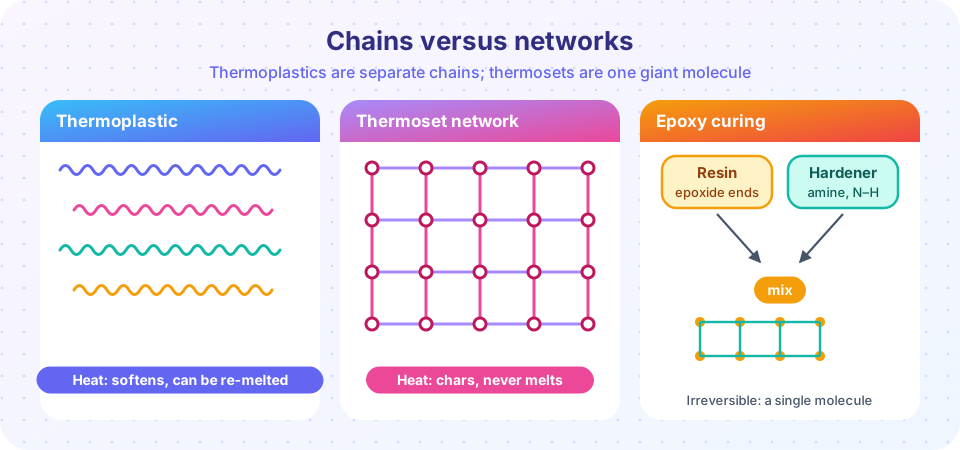
A thermoset starts as a low-viscosity liquid (or a soft solid) made of reactive molecules. On curing, covalent bonds connect them into a three-dimensional network. After that no chain can slide, so heating cannot melt the material; it only decomposes. This is why thermosets cannot be remolded, and why they are valued for heat and chemical resistance.
- Phenolic resins. Leo Baekeland's phenol–formaldehyde resin ("Bakelite", 1907) was the first fully synthetic commercial plastic. Phenolics resist heat and flame and still appear in electrical parts, brake pads and laminates.
- Epoxy resins. The most common resin, bisphenol A diglycidyl ether, has an epoxide (three-membered ring) at each end. An amine hardener opens those rings; because each N–H can open one ring, a diamine can link four. Epoxies bond strongly to nearly everything, so they are used in adhesives, coatings, the matrix of composites and printed circuit boards (the common FR-4 board is glass fabric in flame-retarded epoxy).
- Unsaturated polyesters cure by free-radical copolymerization with styrene and are used in boat hulls and bathtubs, usually reinforced with glass fiber.
- Polyurethane thermosets and melamine–formaldehyde (kitchen laminates) and silicones complete the family.
When does a liquid become a solid?
During cure, branched clusters grow until one spans the whole sample. That instant is the gel point. Before it, the material is soluble and flows; after it, part of it is an insoluble network. Carothers' equation gives the critical conversion for a mixture with an average functionality f_avg per monomer molecule:
p_c = 2 / f_avg
For equal amounts of reactive groups, Flory–Stockmayer theory for an A₂ + B_f system gives a lower and more realistic value:
p_c = 1 / √(f − 1)
where p_c is the conversion of the A groups. For an epoxy resin (A₂, two epoxide groups) with a diamine counted as B₄ (four N–H), p_c = 1/√3 = 0.577. Cure is more than half done before gelation, which matters for processing: you must finish molding, wetting a fiber mat or pouring before the gel point, because after it the resin cannot flow.
Carothers' equation overestimates the conversion needed, because it assumes every chain must be tied into the network. Flory–Stockmayer is closer to experiment, though real systems still gel a little later than it predicts because some bonds close into small rings that waste reactive groups instead of building the network.
Cure and glass transition
As cure proceeds, Tg rises. If the Tg climbs to the cure temperature, the network vitrifies: motion freezes and the reaction nearly stops, leaving unreacted groups. A post-cure at higher temperature lets them finish. This is why a cured epoxy's Tg tells you how complete its cure is, a use of DSC from the previous chapter.
Choosing: thermoplastic or thermoset?
| Question | Thermoplastic | Thermoset |
|---|---|---|
| Can it be re-melted and recycled by remelting? | Yes | No |
| Heat resistance | Limited by Tg or Tm | Stable until decomposition |
| Creep (slow flow under load) | Present | Greatly reduced |
| Cycle time in production | Fast, cool and eject | Slower, wait for cure |
| Toughness | Usually higher | Often brittle without modifiers |
| Typical use | Housings, gears, films | Adhesives, coatings, composites, circuit boards |
Common misconceptions
"Thermosets burn because they melt." A thermoset does not melt at all; it chars and decomposes. If a "plastic" flows in a flame it is a thermoplastic.
"Epoxy dries like paint." Epoxy cures by a chemical reaction with its hardener. Evaporation of a solvent has nothing to do with it, which is why the mixing ratio matters.
"Engineering plastics are always stronger than metals." They are lighter and corrosion-proof, but per unit cross-section they are usually weaker and less stiff; they win on weight, design freedom and cost of shaping.
Try it
First, calculate gel points. Use the calculator to see how raising the functionality of the hardener moves the gel point earlier, and how Carothers and Flory–Stockmayer compare.
Press Run (or Ctrl + Enter) to see the result here.
Program input · what you'd type while the program runs
Type the answers before you press Run, one per line. Each time the program reads a line (with input()), it gets the next line from this box.
Second, a thermal ceiling chart for the engineering plastics above. The marker shows the softening limit: Tm for semi-crystalline materials and Tg for amorphous ones. Real continuous-use temperatures are lower and depend on load and time.
Press Run (or Ctrl + Enter) to see the result here.
Program input · what you'd type while the program runs
Type the answers before you press Run, one per line. Each time the program reads a line (with input()), it gets the next line from this box.
Check your understanding
Quick check · 5 questions
of 5 answered You scored / 5 · perfect!
-
1. Why do nylons change properties in humid air?
Hydrogen bonding with water plasticizes the polymer, reducing stiffness and swelling the part slightly. -
2. Which engineering plastic is transparent with exceptional impact strength and a Tg of about 147 °C?
Polycarbonate is amorphous and clear, and it is used for visors and glazing because it resists impact. -
3. Why can a thermoset not be re-melted?
Covalent cross-links hold everything in place; heating leads to decomposition rather than flow. -
4. Using Flory–Stockmayer for an A2 + B4 system with balanced groups, the gel point is at what conversion?
p_c = 1/√(f − 1) = 1/√3 ≈ 0.577. -
5. What does a rising Tg during epoxy cure tell you?
More cross-links restrict motion and raise Tg; DSC can therefore measure the degree of cure.
Summary
- Engineering thermoplastics (nylon, PC, PMMA, POM, PEEK, PTFE) earn their place through hydrogen bonding, rigid aromatic backbones or very strong bonds.
- Thermosets cure into a single covalent network: phenolic, epoxy, unsaturated polyester, polyurethane, melamine and silicone. They do not melt.
- The gel point is where the network first spans the sample: Carothers
p_c = 2/f_avg; Flory–Stockmayerp_c = 1/√(f − 1)forA₂ + B_f. - Tg rises with cure; vitrification can stall the reaction, so a post-cure is often needed.
- Choose thermoplastics for recyclability and toughness, thermosets for heat resistance and dimensional stability.
Next: Rubbers and fibers
Track your progress
Create a free account to tick off lessons and pick up where you left off on any device.
of Polymer and Materials Chemistry lessons completed