


















Lesson 33 of 47 · Advanced and Functional Materials
Polymer Composites, Ceramics and Nanomaterials
Learn how fiber-reinforced polymer composites work, calculate stiffness with the rule of mixtures, and see how ceramics, sol-gel glass and nanofillers fit in.
No single material is stiff, strong, light, tough and cheap all at once. A composite gets around that by combining two or more materials so that each does what it is best at. Glass or carbon fibers are very stiff and strong but brittle and fragile as loose threads; a polymer matrix is tough and moldable but soft. Embed the fibers in the matrix and you get a material that is light, strong and shapeable.
Composites form the wings of airliners, wind-turbine blades, bicycle frames, boat hulls and the printed circuit board in your phone. In this lesson you will learn why the fiber does the work, how to estimate a composite's stiffness, why a composite is strongly anisotropic, and how ceramics, glass and nanofillers extend the idea.
What you will learn
- Explain the roles of fiber and matrix and name the common fiber types.
- Estimate composite stiffness with the rule of mixtures and understand its two bounds.
- Calculate the critical fiber length and the effect of fiber orientation.
- Describe sol-gel ceramics and how nanofillers such as clay change properties.
Key terms
Matrix: the continuous polymer phase that binds the fibers, protects them and transfers load.
Reinforcement: the stiff, strong phase, usually fibers, particles or platelets.
Volume fraction (Vf): the fraction of the composite's volume occupied by fiber.
Anisotropic: having different properties in different directions.
Laminate: a stack of thin layers (plies) with chosen fiber orientations.
The roles of fiber and matrix
Why are fibers so strong? A glass or carbon fiber has very few flaws, because it is thin and its structure is highly oriented. A bulk piece of the same glass breaks at a fraction of the strength, because any crack can run through it. The matrix has three jobs: it holds the fibers in place, transfers load into them by shear at the interface, and protects them from damage and moisture. Without a good interface, fibers just pull out.
| Fiber | Typical modulus (GPa) | Density (g/cm³) | Notes |
|---|---|---|---|
| E-glass | about 73 | about 2.55 | Cheap, the workhorse of boats and pipes |
| Carbon (standard, PAN-based) | about 230 | about 1.8 | Stiff, light, conductive, costly |
| Aramid | about 70 to 130 | about 1.44 | Tough, impact resistant, weak in compression |
| Natural (flax, hemp) | about 30 to 70 | about 1.4 to 1.5 | Renewable, variable quality |
Matrices are usually epoxy (for high performance), unsaturated polyester or vinyl ester (for large cheap parts such as boats), or thermoplastics such as PP, nylon and PEEK (for recyclability and fast cycles).
Estimating stiffness: the rule of mixtures
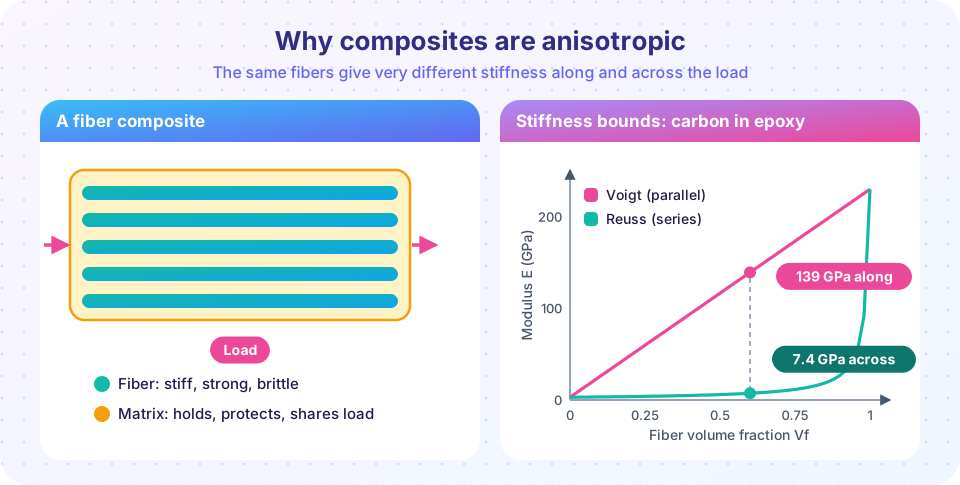
Take a composite with fiber volume fraction Vf, fiber modulus Ef and matrix modulus Em. Two limiting arrangements give bounds.
Loading along the fibers (parallel, equal strain). Fiber and matrix stretch together, so the loads add:
E∥ = Vf Ef + (1 − Vf) Em (Voigt, upper bound)
Loading across the fibers (series, equal stress). The same stress passes through both phases, so their compliances add:
1 / E⊥ = Vf / Ef + (1 − Vf) / Em (Reuss, lower bound)
Worked example. Carbon fiber (Ef = 230 GPa) in epoxy (Em = 3 GPa) at Vf = 0.60:
E∥ = 0.6 × 230 + 0.4 × 3 = 139.2 GPa
1 / E⊥ = 0.6 / 230 + 0.4 / 3 = 0.002609 + 0.13333 = 0.135942 → E⊥ = 7.4 GPa
Along the fibers the composite has about 46 times the stiffness of the matrix; across them only about 2.5 times. In practice the real transverse modulus is slightly higher than the Reuss estimate (more complex models such as Halpin–Tsai refine it), but the lesson stands: a unidirectional composite is not a plate of uniform material.
Light as well as stiff
The composite density is a mixture too: ρ = Vf ρf + (1 − Vf) ρm. With ρf = 1.8 and ρm = 1.2 g/cm³, ρ = 1.56 g/cm³. The specific stiffness along the fibers is 139 / 1.56 ≈ 89 GPa per g/cm³, more than three times that of steel (200 / 7.85 ≈ 25) or aluminum (70 / 2.7 ≈ 26). That is why aircraft designers value carbon composites.
Orientation, laminates and failure
Because properties depend on direction, designers stack thin plies with different orientations into a laminate. A common quasi-isotropic layup uses plies at 0°, +45°, −45° and 90°. Fibers at 0° carry the main load, those at ±45° resist shear and torsion, and those at 90° prevent transverse cracking. Tailoring the stack lets the designer put stiffness exactly where it is needed.
Short (chopped) fibers are cheaper and fit injection molding, but they only strengthen the matrix if they are longer than a critical length lc, the length over which the matrix can load the fiber up to its own strength:
lc = σf d / (2 τ)
with σf the fiber strength, d its diameter and τ the interfacial shear strength. For σf = 3.5 GPa, d = 10 µm and τ = 50 MPa, lc ≈ 0.35 mm, so molded glass-filled plastics need fibers longer than that.
Composites are strong but fail in their own ways. Delamination (layers separating) is the signature weakness of laminates, and impact can cause hidden damage that does not show on the surface. Manufacturing routes include hand lay-up, pre-impregnated sheets cured under heat and pressure in an autoclave, resin transfer molding, filament winding for pressure vessels, and pultrusion for constant-profile beams.
Ceramics, glass and sol-gel
Ceramics and glasses are inorganic networks held by strong covalent and ionic bonds. They are hard, stiff, heat resistant and chemically inert, but brittle, so they fail catastrophically from flaws. They meet polymers in several ways:
- Sol-gel processing builds glass from liquid precursors at low temperature. In the classic example, tetraethyl orthosilicate (TEOS) hydrolyzes in water-alcohol and condenses into a Si–O–Si network that gels, then dries and densifies. Because it works in solution, it makes coatings, fibers and hybrid organic-inorganic materials impossible by melting.
- Silicones (
–Si(CH₃)₂–O–) are polymers with an inorganic backbone: flexible, heat stable and water repellent. - Polymer-derived ceramics are made by shaping a preceramic polymer and pyrolyzing it; polycarbosilane fibers become silicon carbide fibers this way.
- Ceramic fibers and whiskers reinforce metals and ceramics when polymers would burn.
Nanofillers
When filler particles shrink to nanometers, the surface area per gram explodes, and a small amount can change a polymer dramatically.
- Layered clay (montmorillonite), when its platelets are separated (exfoliated) in the polymer, forces gas molecules to take a tortuous path, so a few percent of nanoclay can cut permeability of films. It also raises stiffness and flame resistance.
- Carbon black and silica reinforce rubber; silica in tire tread improves wet grip and rolling resistance.
- Carbon nanotubes and graphene are extremely stiff and conductive, but getting them dispersed and bonded to the matrix is the hard part, so property gains are usually far smaller than the ideal values.
The recurring challenge is the same: a nanofiller only helps if it is well dispersed and well bonded. Clumps act as defects.
Common misconceptions
"A composite is as strong in every direction." A unidirectional composite can be 15 or more times stiffer along the fibers than across them. Always ask which direction the load acts in.
"More fibers is always better." Above roughly 65 to 70 % by volume the matrix can no longer wet and bind the fibers, and properties drop.
"Carbon fiber is a polymer." Carbon fiber is almost pure carbon made from a polymer precursor. The composite is carbon fiber in a polymer matrix.
Try it
An interactive rule of mixtures. Drag the slider and watch the stiffness along and across the fibers, together with the density and the specific stiffness.
Second, the direction dependence of a single ply. The plot uses an illustrative set of ply properties (a model, not a data sheet) and the standard off-axis formula for a unidirectional lamina.
Press Run (or Ctrl + Enter) to see the result here.
Program input · what you'd type while the program runs
Type the answers before you press Run, one per line. Each time the program reads a line (with input()), it gets the next line from this box.
Third, the critical fiber length for different interfaces. A good bond (high τ) means shorter fibers suffice.
Press Run (or Ctrl + Enter) to see the result here.
Program input · what you'd type while the program runs
Type the answers before you press Run, one per line. Each time the program reads a line (with input()), it gets the next line from this box.
Check your understanding
Quick check · 5 questions
of 5 answered You scored / 5 · perfect!
-
1. In a composite loaded along the fibers, the stiffness follows approximately:
Equal strain in fiber and matrix means the loads add, which gives the Voigt (parallel) rule of mixtures. -
2. Carbon fiber (230 GPa) in epoxy (3 GPa) at Vf = 0.6 has a Voigt modulus of about:
0.6 × 230 + 0.4 × 3 = 139.2 GPa. -
3. What is the main job of the matrix?
Fibers carry most of the load, but only if the matrix binds them and shares stress into them. -
4. Why does nanoclay reduce gas permeability of a film?
Exfoliated platelets act as barriers; molecules must diffuse around them. -
5. Sol-gel processing of silica starts from:
TEOS hydrolysis and condensation builds a silica network at low temperature.
Summary
- Composites combine a stiff, strong reinforcement with a tough, moldable matrix; the matrix transfers load and protects.
- Along the fibers
E ≈ Vf Ef + (1 − Vf) Em; across them1/E = Vf/Ef + (1 − Vf)/Em. These are bounds, and the gap shows strong anisotropy. - Laminates mix ply angles to place stiffness where needed; short fibers must exceed the critical length
lc = σf d / (2τ). - Ceramics and glasses are hard but brittle; sol-gel builds them from liquids, and silicones and preceramic polymers bridge polymers and ceramics.
- Nanofillers can change barrier, stiffness and flame behavior, but only when well dispersed and bonded.
Next: Conducting polymers
Track your progress
Create a free account to tick off lessons and pick up where you left off on any device.
of Polymer and Materials Chemistry lessons completed