


















Lesson 2 of 47 · Getting Started
Why polymers matter: a short history
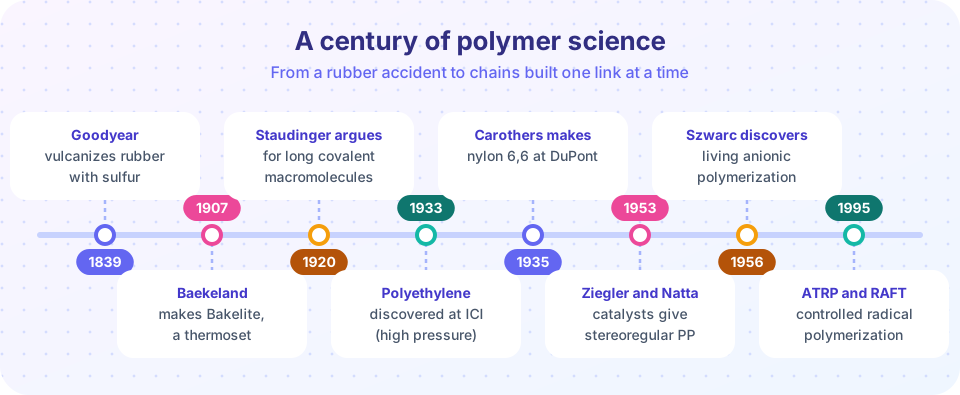
Follow the story of polymers from natural rubber and Bakelite to Staudinger's macromolecule, nylon, Ziegler-Natta catalysts and modern controlled polymerization.
People used polymers for thousands of years before anyone knew what they were. Wool, silk, leather, cotton, wood and natural rubber are all polymers, and craftspeople shaped them by trial and error: smoking, tanning, weaving, soaking. The science of polymers is much younger. It began as a dispute about whether giant molecules could exist at all, and it grew into one of the most productive fields of chemistry. This lesson tells that story, because the history explains why the subject is organized the way it is, and why a handful of discoveries still shape what you will learn.
What you will learn
- Why the macromolecule hypothesis was controversial and how it was settled
- The main milestones: vulcanization, Bakelite, nylon, polyethylene, Ziegler-Natta, living polymerization
- How each milestone introduced an idea you will use later in the course
- Why plastics became both indispensable and an environmental challenge
Key terms
Vulcanization: heating rubber with sulfur so that chains become linked into a network.
Thermoset: a polymer that cures into a permanent network and cannot be remelted.
Macromolecule hypothesis: Staudinger's claim that polymers are single molecules of very high molar mass held together by ordinary covalent bonds.
Catalyst: a substance that speeds up a reaction and is not used up; some catalysts also control the shape of the polymer they make.
Living polymerization: a chain-growth process in which chains keep growing as long as monomer is available, with no built-in stopping step.
Before the science: natural polymers
The word polymer comes from Greek roots meaning "many parts". The Swedish chemist Jöns Jacob Berzelius used it in 1833, but in a different sense from ours, for compounds that had the same elemental composition but different molar masses. The modern meaning took another century to arrive.
Natural polymers were useful long before they were understood. Cellulose, the main component of wood and cotton, is a chain of glucose units. Proteins such as silk and wool are chains of amino acids. Natural rubber, harvested as latex from the tree Hevea brasiliensis, is a chain of isoprene units. Early chemists studied these materials but saw puzzling behavior: they would not crystallize like salt, they would not distill, and solutions were thick and sticky even when dilute.
Rubber learns to behave: vulcanization
Raw natural rubber is sticky when warm and brittle when cold. In 1839 the American inventor Charles Goodyear found that heating rubber with sulfur gave a material that stayed elastic across a far wider range of temperature. By most accounts the discovery involved an accident on a hot stove; the details are folklore, but the result is solid chemistry. Sulfur forms short bridges between neighboring chains. Chains can still stretch, but they can no longer slide past each other permanently, so the rubber snaps back. Thomas Hancock in England reached a similar process at about the same time.
This is the first example of an idea you will meet again in chapters 4 and 6: crosslinks turn a viscous liquid into an elastic solid. Today the tires on a bicycle and the gaskets in a laboratory all rely on it.
The first synthetic plastic
In the 1860s and 70s celluloid, made from chemically modified cellulose and camphor, was used for billiard balls and photographic film. It was semi-synthetic: the polymer was natural, only altered. The first fully synthetic plastic came in 1907, when the Belgian-American chemist Leo Baekeland reacted phenol with formaldehyde under heat and pressure and controlled the process to give a hard, heat-resistant resin called Bakelite. Bakelite is a thermoset: once cured it forms a rigid, highly crosslinked network and does not melt. It insulated electrical parts, telephone housings and radio cases, and it showed that chemists could design materials, not only collect them.
The great argument: are polymers real molecules?
Early twentieth-century chemists knew polymers existed but struggled to say what they were. A common view held that rubber, cellulose and similar substances were colloids: aggregates of fairly small molecules held together by weak forces, like a crowd of people forming a mob. The idea that a single molecule could contain thousands of atoms seemed unreasonable to many.
The German chemist Hermann Staudinger disagreed. In 1920 he published the argument that polymers are true macromolecules: long chains of repeat units connected by ordinary covalent bonds. His proof came from experiments. He chemically converted polymers (for instance by hydrogenating natural rubber) and found that the products kept their high molar mass and polymeric behavior, which an aggregate theory could not explain. Evidence from X-ray studies and from viscosity measurements accumulated over the 1920s and 30s. Staudinger received the Nobel Prize in Chemistry in 1953.
Why does this matter for you? Because everything in this course depends on it. If polymers were loose clusters, you could not talk about the molar mass or the repeat unit. Because they are covalent chains, you can describe them with degree of polymerization, molar mass averages, architecture and sequence, which are the topics of chapter 2.
Nylon and the design of polymers
In the early 1930s Wallace Carothers and his team at DuPont set out to build polymers deliberately, step by step, from small molecules with two reactive ends. Their work gave the first clear picture of condensation polymerization. In 1935 they made nylon 6,6 from hexamethylenediamine and adipic acid, a polyamide that could be spun into strong fibers. Nylon went into production at the end of the 1930s and was soon in everything from stockings to parachutes. Carothers's work on stepwise reactions also gave the equation relating chain length to conversion that you will use in chapter 3. Paul Flory, who worked with Carothers, built the statistical theory of polymer chains and won the Nobel Prize in 1974.
At about the same time, chemists at ICI in England discovered polyethylene (in 1933, under very high pressure), and radical-initiated polymerization of vinyl monomers such as styrene and vinyl chloride grew into a major industry. Polyethylene made this way has many branches and is soft; it is now called low-density polyethylene (LDPE).
Catalysts that control shape
In 1953 Karl Ziegler found that certain titanium compounds with aluminium alkyls polymerize ethylene at low pressure to a more linear, denser polymer. Giulio Natta used similar catalysts in 1954 to make polypropylene in which every methyl group points the same way: isotactic polypropylene, which crystallizes and makes strong, heat-resistant plastic. The two shared the 1963 Nobel Prize. The discovery matters because it showed that a catalyst can control not only how fast chains grow but also their three-dimensional structure. That structure decides whether the polymer is a rigid plastic, a flexible film or a sticky gum, a theme of chapter 4.
Chains on a leash: living and controlled polymerization
In 1956 Michael Szwarc showed that when styrene is polymerized with a carbanion initiator under very clean conditions, the chain ends stay active after the monomer is used up. Add more monomer and the chains continue. This living polymerization gives chains of nearly uniform length and lets chemists build block copolymers by feeding monomers one after another.
Anionic living polymerization is demanding: water and oxygen destroy it. From the 1990s, chemists learned to bring much of the same control to radical polymerization, which tolerates impurities far better. Atom transfer radical polymerization (ATRP, 1995) and reversible addition-fragmentation chain transfer (RAFT, 1998) are the best-known methods. Chapter 3 covers them. They let researchers design chains, from length to the order of blocks, to a degree that was unimaginable in 1930.
Conducting polymers and beyond
In the 1970s, Alan Heeger, Alan MacDiarmid and Hideki Shirakawa discovered that doped polyacetylene conducts electricity, work that earned the 2000 Nobel Prize in Chemistry. High-performance fibers such as Kevlar (developed at DuPont in the 1960s by Stephanie Kwolek) followed, along with biomedical, optical and electronic polymers. Plastics production reached hundreds of millions of tonnes a year, and so did a new problem: most of those materials persist in the environment. Chapter 8 returns to that.
Common misconceptions
"Goodyear invented rubber." Rubber is a natural material. Goodyear's contribution was vulcanization, the chemistry that made it practical.
"Plastics started with Bakelite and nothing came before." Natural polymers were used for millennia and semi-synthetic celluloid preceded Bakelite by decades.
"Staudinger's idea was obvious." It was disputed for years, and the evidence that finally persuaded the community was indirect, which is typical of science.
Try it
First, an interactive timeline. Choose an era and see which discoveries belong to it. The second example shows why the macromolecule idea could be tested: the osmotic pressure of a dilute solution depends on the number of dissolved molecules, so very large molecules give tiny pressures compared with small ones at the same mass concentration.
Press Run (or Ctrl + Enter) to see the result here.
Program input · what you'd type while the program runs
Type the answers before you press Run, one per line. Each time the program reads a line (with input()), it gets the next line from this box.
Check your understanding
Quick check · 5 questions
of 5 answered You scored / 5 · perfect!
-
1. What did vulcanization add to natural rubber?
Sulfur forms bridges between chains, so the rubber becomes an elastic network instead of a sticky, flowing material. -
2. What was Staudinger's central claim?
He proposed that polymers are true macromolecules with covalent bonds along the chain. -
3. Which discovery showed that a catalyst can control the three-dimensional structure of a polymer?
Natta's catalysts placed every methyl group on the same side, producing stereoregular polypropylene. -
4. Why is living polymerization useful?
Active chain ends allow narrow molar mass distributions and sequential addition of different monomers. -
5. Bakelite is called a thermoset because
A thermoset hardens irreversibly into a network, so it cannot be remelted and reshaped.
Summary
- Natural polymers were used for millennia; Goodyear's vulcanization (1839) and Baekeland's Bakelite (1907) were the first chemical designs.
- Staudinger's macromolecule hypothesis (1920) established polymers as long covalent chains; Carothers and Flory built the science of how they form and behave.
- Ziegler-Natta catalysts brought control over structure, and living and controlled polymerization brought control over length and sequence.
- The same success created a waste problem that chapter 8 addresses.
Track your progress
Create a free account to tick off lessons and pick up where you left off on any device.
of Polymer and Materials Chemistry lessons completed