


















Lesson 37 of 47 · Sustainability and Recycling
Chapter Overview: Sustainability and Recycling
See the big picture of polymer sustainability: circular economy, bio-based versus biodegradable, recycling routes, life cycle assessment and microplastics.
Polymers are among the most useful materials ever made, and they are also among the most visible waste. They keep food fresh, insulate buildings, make cars lighter and keep medical equipment sterile. They also last for decades in places where we never meant them to be. The chemistry that makes a polymer durable is the same chemistry that makes it hard to get rid of.
This chapter is about handling that tension honestly. You will learn what bio-based and biodegradable really mean, how recycling works and where it falls short, how engineers compare environmental impacts with life cycle assessment, and what is known about microplastics. The goal is not to give you a position but to give you the tools to evaluate claims.
The big picture
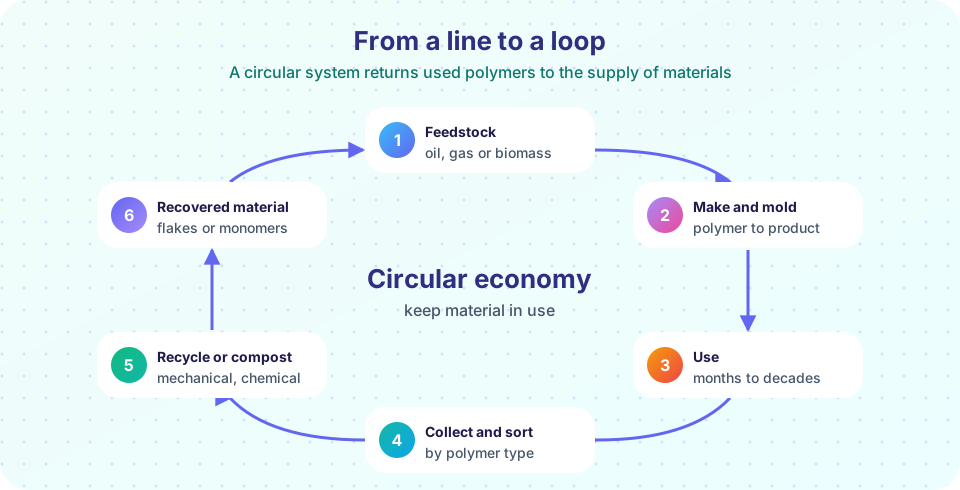
For most of the history of plastics the system was linear: take oil or gas, make a polymer, make a product, use it, throw it away. A circular system tries to close the loop at several points at once.
- Redesign so products use less material, can be refilled or reused, and are made from a single polymer that is easy to recycle.
- Replace feedstock: make polymers from biomass or from recovered material, so less fossil carbon enters the system.
- Recover at end of life by mechanical recycling, chemical recycling, composting (for materials designed for it) or, as the last resort, energy recovery.
- Prevent leakage into the environment, where polymers fragment into microplastics.
One widely cited estimate, published in 2017, concluded that of all the plastic produced between 1950 and 2015 only about 9 % had been recycled, about 12 % incinerated and the rest (roughly 79 %) had gone to landfill or the environment. Numbers differ between studies and have improved in some regions since, but the order of magnitude explains why the topic gets so much attention.
Linear to circular
Where the carbon comes from
What happens at the end
Measuring
Questions to ask about any claim
A claim such as "this bottle is eco-friendly" is almost meaningless until you ask what it compares with. Useful habits:
- What exactly is claimed? Bio-based (where the carbon came from), biodegradable (what happens at end of life) and recyclable (whether a working system exists where you live) are three different statements.
- Per what unit? Per kilogram of material or per use? A light plastic bottle and a heavy glass bottle can only be compared fairly per liter of drink delivered, because they differ so much in mass.
- Under what conditions? "Compostable" often means in an industrial composter at around 58 °C, not in a garden heap or the ocean.
- What is the system boundary? Production only, or all the way to disposal? Which impacts are counted: carbon, water, land, toxicity?
What each lesson in this chapter covers
- Biopolymers and biodegradable plastics: PLA, PHA, starch, bio-PE, composting standards and why bio-based does not mean biodegradable.
- Recycling polymers: sorting, mechanical and chemical recycling, degradation per cycle and loop yield.
- Life cycle assessment and microplastics: how to compare impacts per function, plus what microplastics are, where they come from and what is known.
- Chapter review: a one-page summary and a ten-question quiz.
Common misconceptions
"Biodegradable means it will vanish anywhere." It depends on temperature, moisture, microbes and time. Many biodegradable plastics break down only in industrial compost.
"Recycling solves the plastic problem." Recycling matters, but it is limited by sorting, contamination and quality loss, and reduction and reuse come earlier in the waste hierarchy.
"There is one right answer." Trade-offs among carbon, water, land, toxicity and function are real, and the best choice can change with the application and the local waste system.
Try it
A claim checker. Each row below states a claim as three yes/no facts; the function reports which words the facts actually support. Edit the facts and see how the vocabulary changes.
Press Run (or Ctrl + Enter) to see the console output here.
No output.
Second, the loop yield. If only part of the material survives each trip around the loop, how much is left after several trips? Change the three efficiencies to see which matters most.
Press Run (or Ctrl + Enter) to see the result here.
Program input · what you'd type while the program runs
Type the answers before you press Run, one per line. Each time the program reads a line (with input()), it gets the next line from this box.
Check your understanding
Quick check · 4 questions
of 4 answered You scored / 4 · perfect!
-
1. Which statement is correct?
Source and end of life are independent. A bio-based polyethylene is not biodegradable; a fossil PBAT can be. -
2. Why does a functional unit matter in comparing packaging?
Containers differ in mass and in how often they are reused, so only a per-use comparison is fair. -
3. Which step of the waste hierarchy comes first?
Reduce and reuse prevent waste, so they rank above recycling, energy recovery and disposal. -
4. A recycling loop with collection 0.6, sorting 0.9 and processing 0.9 has a loop yield of about:
0.6 × 0.9 × 0.9 = 0.486.
Summary
- The chapter replaces simple slogans with three precise questions: where does the carbon come from, what happens at end of life, and what does the whole system cost per function?
- Circular systems close the loop by redesigning, replacing feedstock, recovering and preventing leakage.
- Recycling loses material at every step, so the waste hierarchy puts reduction and reuse first.
Track your progress
Create a free account to tick off lessons and pick up where you left off on any device.
of Polymer and Materials Chemistry lessons completed