


















Lesson 3 of 47 · Getting Started
Chemistry refresher: bonds, forces and thermodynamics
Review the chemistry you need for polymers: covalent bonds, functional groups, intermolecular forces and the thermodynamics that decides whether monomers will link.
Polymer chemistry is ordinary chemistry used at an unusual scale. The reactions that join monomers are the same ones you meet in organic chemistry: addition to double bonds, ester and amide formation, radical steps. The forces that hold chains together are the same forces that hold liquids together. The difference is that a polymer chain repeats these events thousands of times, and small effects add up to big ones. This lesson reviews exactly the ideas you will lean on most, with a polymer slant, so that the rest of the course can move quickly.
What you will learn
- The covalent bonds and functional groups that form polymer backbones
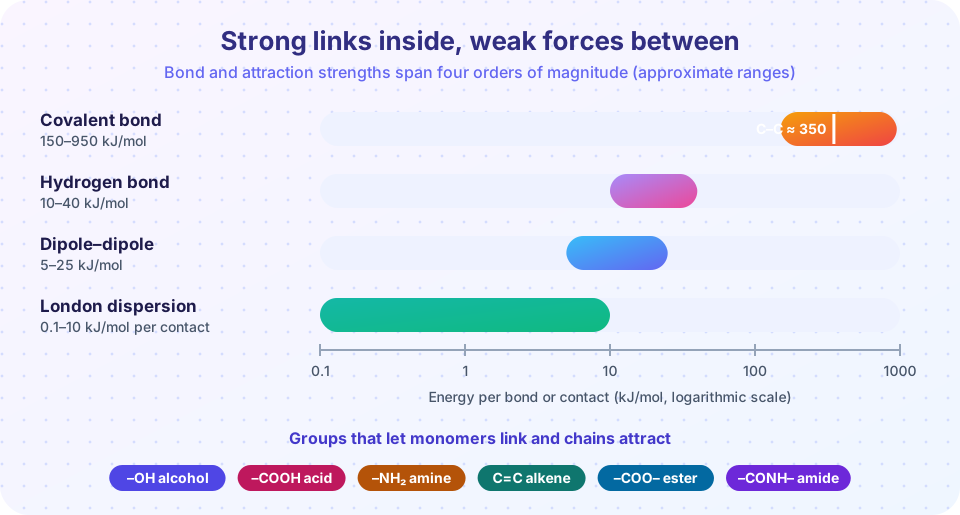
- The four kinds of intermolecular force and how strong each is
- Why polymerization releases energy but costs entropy
- How to estimate whether a monomer will polymerize at a given temperature
Key terms
Covalent bond: a shared pair of electrons between two atoms; the "links" inside a chain.
Functional group: a small group of atoms with characteristic reactivity, such as –OH or –COOH.
Intermolecular force: an attraction between separate molecules or between different parts of one chain.
Enthalpy of polymerization (ΔHp): heat released when a mole of monomer joins a chain; negative means energy is released.
Ceiling temperature (Tc): the temperature above which polymerization is no longer favorable.
Covalent bonds: the links in the chain
Backbones are mostly carbon. Each carbon forms four bonds, and the strong, fairly nonpolar carbon-carbon single bond (about 347 kJ/mol) is the reason long carbon chains are stable. Some other bond energies you will meet are approximate averages:
| Bond | Approx. energy (kJ/mol) | Where it appears |
|---|---|---|
| C–C | 347 | polyethylene backbone |
| C=C | 614 | vinyl monomers before polymerization |
| C–H | 413 | side groups and backbones |
| C–O | 358 | polyesters, polyethers |
| C–N | 305 | polyamides |
| C–Cl | 339 | PVC |
| C–F | 485 | PTFE (Teflon) |
| Si–O | 452 | silicones |
The strong C–F and Si–O bonds help explain why fluoropolymers and silicones are so resistant to heat and chemicals. Bond energies are averages and change a little with the surroundings, but the trends are reliable.
Bond angle and rotation matter just as much as strength. A carbon with four single bonds has bond angles of about 109.5 degrees, and its neighbors can rotate around the bond with only a small energy barrier. A chain of thousands of such bonds can therefore adopt a huge number of shapes, which explains why chains coil up. A double bond or a ring is stiff, and a polymer with many of them is stiffer (chapter 4).
Functional groups used to build chains
You will recognize the following groups repeatedly:
- C=C (alkene): the reactive site of vinyl monomers like ethylene, styrene and vinyl chloride. Chain-growth polymerization opens this double bond.
- –OH and –COOH (alcohol, carboxylic acid): react to make esters; two of each in one molecule each make polyesters such as PET.
- –NH₂ (amine) plus –COOH: make amides, the linkage in nylons and proteins.
- –N=C=O (isocyanate) plus –OH: make urethanes, used in foams and coatings.
- Epoxide rings and cyclic esters: strained rings that open to form chains (chapter 3).
A molecule with one reactive site per end, such as a diol or diacid, is bifunctional. A molecule with three or more is polyfunctional, and these create branches and networks.
Intermolecular forces: what holds chains together
Between molecules, four kinds of attraction matter:
- London dispersion forces. Temporary fluctuations of electron clouds create short-lived dipoles. Present in everything, they grow with molecular size and surface contact. Per contact they are weak, roughly 0.1 to 10 kJ/mol, but a long chain makes thousands of contacts.
- Dipole-dipole forces. Polar groups such as C–Cl or C=O attract each other. They are typically 5 to 25 kJ/mol.
- Hydrogen bonds. An H attached to N, O or F is attracted to a lone pair on another such atom, about 10 to 40 kJ/mol. They are directional, which is why nylons, proteins and cellulose form strong, ordered structures.
- Ion-dipole and ionic interactions. Charges attract strongly; ionic groups in ionomers and polyelectrolytes work this way.
You can see the key idea in a familiar series. The boiling points of simple alkanes climb steadily as the chain gets longer, because each additional CH₂ adds more contact for dispersion forces. By the time you reach a molecule with thousands of carbons, the attraction between chains is so large that the polymer would decompose before it could boil. That is why polyethylene has a melting range but no boiling point at atmospheric pressure.
Why a polymer forms: the thermodynamics
A reaction goes forward when the Gibbs energy change is negative:
ΔG = ΔH − TΔS
When a monomer joins a chain, it converts a π bond (in a vinyl monomer) into a σ bond. For ethylene, that releases about 90 kJ/mol; a simple bond-energy estimate gives roughly 80 kJ/mol (about 347 for the new C–C σ bond minus about 267 for the π bond broken), and measured values are near −93 kJ/mol. So ΔHp is negative: polymerization is exothermic.
But the monomer loses freedom. Free molecules translate and rotate; units fixed in a chain do not. So ΔSp is negative too, typically −100 to −160 J/(mol·K) for vinyl monomers, and −TΔS is a positive penalty that grows with temperature. At low temperature the favorable ΔH wins. As temperature rises, the penalty catches up. The temperature where ΔG = 0 is the ceiling temperature:
Tc = ΔHp / ΔSp
Above Tc, the polymer depolymerizes (unzips) instead of forming. Polymers with small |ΔHp|, such as poly(α-methylstyrene), have low ceiling temperatures; polyethylene's is very high. Ceiling temperature is also why some polymers must be processed carefully and why chemical recycling by depolymerization works best for them (chapter 8).
Practical consequences follow. Because polymerization is exothermic, large reactors need cooling; a runaway reaction is a real industrial hazard. Because it lowers entropy, polymers need a driving force: strong bond formation or the release of ring strain.
Reaction types you will see again
Three reaction classes recur throughout the course, so it helps to recognize them now.
Addition to a double bond. A species attacks the C=C bond of an alkene and bonds to one carbon, leaving the other carbon able to continue. If the attacker is a radical, the new species is a radical; if it is a carbanion, the new species is a carbanion; if it is a cation, a carbocation. Which one works depends on the substituent on the double bond. Electron-withdrawing groups (–CN, –COOR) stabilize anions, and electron-donating groups (alkyl, alkoxy) stabilize cations. Styrene, with its phenyl ring, can stabilize all three, which is why it can be polymerized by radical, anionic and cationic routes.
Condensation. Two functional groups react and release a small molecule: an alcohol and a carboxylic acid make an ester and water, an amine and an acid make an amide and water. Because the product keeps reactive ends when the starting molecules have two groups each, the reaction can be repeated, and chains form.
Ring opening. A strained ring is attacked at a bond, relieves its strain and becomes part of a chain. Epoxides, lactones, lactams and cyclic siloxanes all do this.
Stereochemistry in one paragraph
Many polymer properties depend on three-dimensional arrangement. Two molecules with the same connections but different spatial arrangement are stereoisomers. A carbon with four different groups is a stereocenter. In a vinyl polymer –CH₂–CHR–, every second carbon is such a center, so a chain of 1,000 units has 500 stereocenters whose configurations can be all the same, alternating or random. That is the idea of tacticity in chapter 2. Likewise, a C=C double bond inside a chain, as in polyisoprene or polybutadiene, can be cis (chain continues on the same side) or trans (opposite sides). Natural rubber is almost entirely cis-1,4-polyisoprene, whereas gutta-percha, with the same formula, is trans and is hard and crystalline, a striking example of how geometry alone changes a material.
Common misconceptions
"Weak forces are unimportant." Individually weak, intermolecular forces multiply along a chain. They decide melting, solubility, stiffness and strength.
"Polymerization releases energy, so it always goes." Entropy opposes it. Above the ceiling temperature, polymerization is not favorable even though ΔH is negative.
"Covalent bonds make polymers unbreakable." The backbone bonds are strong, but heat, UV light, oxygen and mechanical stress can still break them. Weak links and impurities often fail first.
Try it
The first example plots boiling points of the first ten alkanes against chain length; it shows how steadily dispersion forces build up. The second calculates ceiling temperatures from approximate polymerization enthalpies and entropies for several monomers.
Press Run (or Ctrl + Enter) to see the result here.
Program input · what you'd type while the program runs
Type the answers before you press Run, one per line. Each time the program reads a line (with input()), it gets the next line from this box.
Press Run (or Ctrl + Enter) to see the result here.
Program input · what you'd type while the program runs
Type the answers before you press Run, one per line. Each time the program reads a line (with input()), it gets the next line from this box.
Check your understanding
Quick check · 5 questions
of 5 answered You scored / 5 · perfect!
-
1. Which interaction is typically the strongest?
Covalent bonds are typically hundreds of kJ/mol; the other interactions are roughly 0.1 to 40 kJ/mol. -
2. Why does polymerization of a vinyl monomer have a negative ΔS?
Linking molecules into a chain reduces the number of ways the units can move, so entropy decreases. -
3. Above the ceiling temperature a polymer
At Tc, ΔG for polymerization equals zero; above it, ΔG is positive and the reverse reaction is favored. -
4. Which functional group pair forms an amide, the link in nylon?
An amine reacts with a carboxylic acid to give an amide plus water; an alcohol and acid give an ester. -
5. Why do very long alkane-like chains have no boiling point at normal pressure?
Attraction grows with size, so decomposition occurs at a lower temperature than boiling.
Summary
- Carbon backbones are held by strong covalent bonds, while chains attract each other through weak but numerous forces: dispersion, dipole-dipole, hydrogen bonds and ionic interactions.
- Functional groups (alkene, alcohol, acid, amine, isocyanate, strained rings) are the reactive handles for making chains; bifunctional units give chains, polyfunctional units give branches and networks.
- Polymerization has negative ΔH and negative ΔS, so there is a ceiling temperature Tc = ΔHp/ΔSp above which chains unzip.
Next: Materials families: metals, ceramics, polymers and composites
Track your progress
Create a free account to tick off lessons and pick up where you left off on any device.
of Polymer and Materials Chemistry lessons completed