


















Lesson 18 of 47 · Structure and Properties
Crystallinity, glass transition and melting
Learn why polymers crystallize partially, how Tg and Tm arise, what controls them, and how to compute degree of crystallinity from density and DSC data.
If you heat a block of ice, it stays solid until 0 °C and then turns into water in one sharp step. A polymer does not behave like ice. A polymer such as polyethylene softens and melts across a range of temperatures; polystyrene softens gradually without a sharp melting point at all; a rubber band is soft at room temperature and becomes stiff and brittle in a freezer. All of this follows from two facts: chains are long and tangled, so they can never pack perfectly, and chain motion needs room. This lesson explains the glass transition, melting, crystallinity and the structural features that raise or lower each one.
What you will learn
- How chains fold into lamellae and spherulites and why crystallinity is never 100 percent
- What the glass transition is and which factors raise or lower Tg
- What decides the melting temperature Tm
- How to estimate crystallinity from density and from DSC melting enthalpy
- How to predict Tg of a copolymer with the Fox equation
Key terms
Degree of crystallinity (Xc): the fraction (by mass or volume) of the polymer that is crystalline.
Lamella: a thin crystalline plate, about 10 nm thick, formed by chains folding back and forth.
Spherulite: a spherical aggregate of lamellae radiating from a nucleus, visible under a polarizing microscope.
Glass transition temperature (Tg): the temperature range where amorphous regions change from glassy to rubbery.
Melting temperature (Tm): the temperature at which crystals melt; for polymers it is a range, usually quoted as the peak of a DSC curve.
How polymers crystallize
For a crystal to form, chain segments must line up in a regular array. Short, regular, symmetric segments can do this easily; branched, bulky or irregular chains cannot. In 1957 Andrew Keller grew single crystals of polyethylene from dilute solution and showed that the chains run perpendicular to the thin plates, which are only about 10 nanometers thick, while the chains are thousands of nanometers long. The chains must therefore fold back and forth, like a ribbon laid in a stack. From a melt, the result is a mixture of folded-chain lamellae and amorphous material between them: a semicrystalline structure. Lamellae are organized into spherulites, often micrometers across.
Because tangled chains cannot fully disentangle as they crystallize, some portions remain amorphous, even in the best polymer. Typical crystallinities are 30 to 80 percent. HDPE reaches 70 to 80 percent, LDPE about 40 to 50, isotactic PP 50 to 70, a PET bottle about 25 to 35, and atactic PS and PMMA essentially 0.
What encourages crystallization?
- Regularity. Linear chains, isotactic or syndiotactic arrangements, and symmetrical repeat units crystallize. Atactic polystyrene cannot; isotactic polystyrene can, slowly.
- Small or compact side groups and few branches.
- Strong, directional intermolecular forces. Hydrogen bonds in nylons help chains lock together in sheets.
- Time and temperature. Between Tg and Tm, chains have enough mobility to organize. Fast quenching (cooling quickly) can leave a polymer largely amorphous; slow cooling and annealing grow more crystals. PET bottles are made clear by cooling fast enough that crystals stay small or do not form, and are made strong by stretching, which induces crystals.
Glass transition
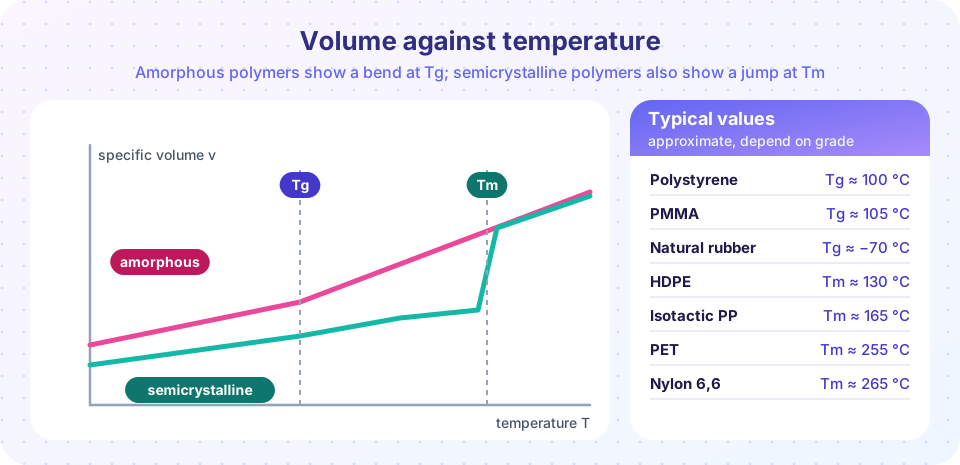
Cool a polymer melt. The chains slow down, the free volume shrinks and, at a temperature that depends on the cooling rate, the long-range segmental motion freezes. The polymer becomes a glass: rigid and often brittle. The volume–temperature curve changes slope at that point, as the picture above shows, and the stiffness (modulus) falls by three orders of magnitude in a range of about 10 to 20 °C on warming through Tg. This is not a phase transition like melting: there is no latent heat, and Tg shifts a few degrees with cooling rate or heating rate.
You can measure Tg by differential scanning calorimetry (a step in heat capacity), by dynamic mechanical analysis (a peak in tan δ) or by dilatometry (the slope change). Chapter 5 discusses these.
What raises Tg?
- Stiff backbones. Rings and double bonds in the chain, as in PET (aromatic) and polycarbonate, restrict rotation. Flexible Si–O or C–O–C linkages lower Tg: silicones reach about −125 °C.
- Bulky or polar side groups. Phenyl in polystyrene raises Tg to about 100 °C; the polar chlorine in PVC gives about 80 °C.
- Strong intermolecular forces, such as hydrogen bonding.
- Crosslinking, which restricts motion.
- Higher molar mass, up to a limit. The Flory–Fox equation says
Tg = Tg,∞ − K/Mn: chain ends carry extra free volume, so very short chains have a lower Tg.
What lowers Tg? Plasticizers: small molecules that sit between chains and increase free volume. Plasticized PVC, with Tg below room temperature, is flexible, while unplasticized PVC is rigid. Absorbed water lowers Tg of nylons, which is why nylon gets tougher and softer when it is moist.
Copolymers and blends have a single Tg between those of the components, predicted by the Fox equation: 1/Tg = w₁/Tg₁ + w₂/Tg₂, with Tg in kelvin and w the weight fractions. A random 50:50 copolymer of styrene (Tg 373 K) and butyl acrylate (about 219 K), for example, has 1/Tg = 0.5/373 + 0.5/219 giving Tg ≈ 276 K, or about 3 °C. Tuning Tg this way is how coatings and adhesives are designed.
Melting
At Tm the crystals break up, the chains regain mobility and the material becomes a melt. Thermodynamically, Tm = ΔHm / ΔSm: melting needs a high heat of fusion (strong interactions between chains, as with hydrogen bonds) and is easier when the entropy gained is high (flexible chains gain more). Stiff chains and strong attraction raise Tm: nylon 6,6 melts at about 265 °C, PET at about 255 °C, isotactic polypropylene at about 165 °C, HDPE at about 130 °C and LDPE at 105 to 115 °C.
Polymers melt over a range, because lamellae differ in thickness: thin or imperfect crystals melt first. The equilibrium melting point of an ideal, infinitely thick polyethylene crystal is about 141 °C, above any practical sample. Thicker lamellae melt higher, and annealing just below Tm thickens them.
A useful rule of thumb relates the two transitions: in kelvin, Tg/Tm is roughly 0.5 for symmetric polymers such as polyethylene and about 0.67 for unsymmetrical ones such as PET (Tg ≈ 343 K, Tm ≈ 528 K, ratio 0.65). If you know one, you can estimate the other.
Putting temperatures to work
| Polymer | Tg (°C) | Tm (°C) | State at room temperature |
|---|---|---|---|
| Polystyrene (atactic) | about 100 | none | glassy |
| PMMA | about 105 | none | glassy |
| PVC (unplasticized) | about 80 | none | glassy |
| PET | about 70 to 80 | about 255 | semicrystalline, glassy amorphous regions |
| Nylon 6,6 | about 50 (dry) | about 265 | semicrystalline |
| HDPE | about −120 (weak, disputed) | about 130 | semicrystalline, rubbery amorphous regions |
| Natural rubber | about −70 | none | rubbery |
For a thermoplastic that is glassy at room temperature, such as polystyrene, the service temperature is below Tg: a PS cup cannot take boiling water. A semicrystalline polymer with Tg below room temperature, such as polyethylene, has rubbery amorphous regions that give toughness, while crystals provide stiffness; it is useful until Tm. A PET bottle has Tg of about 75 °C, so hot-filling a standard bottle makes it shrink.
Estimating crystallinity
From density. Crystals pack more densely than amorphous regions, so density reports crystallinity. For a two-phase model, the mass fraction crystalline is
Xc = ρc (ρ − ρa) / [ρ (ρc − ρa)]
where ρ is the sample density, ρc the density of the perfect crystal and ρa that of the amorphous polymer. For polyethylene, ρc ≈ 1.000 and ρa ≈ 0.855 g/cm³. An HDPE sample of ρ = 0.960 gives Xc = 1.000 × (0.960 − 0.855) / (0.960 × 0.145) = 0.754, or 75 percent; a LDPE of 0.920 gives 49 percent.
From DSC. Integrate the melting peak to get ΔHm (J/g) and compare with the heat of fusion of a 100 percent crystalline sample, Xc = ΔHm / ΔHm°. Reference values are about 293 J/g for PE, 207 J/g for isotactic PP and 140 J/g for PET. A PET sample that releases 36 J/g on melting is about 26 percent crystalline. If the sample crystallizes during the heating scan ("cold crystallization"), subtract that enthalpy.
Common misconceptions
"Tg is the melting point of the amorphous part." Tg is a kinetic transition in which segmental motion starts, not a melting of crystals. It depends on heating rate and has no latent heat.
"Crystalline polymers are fully crystalline." Polymers are semicrystalline at best; chain ends, branches and entanglements remain amorphous.
"Above Tg the material is a liquid." Between Tg and Tm (or above Tg for a crosslinked polymer) the material is a soft, rubbery solid, with entanglements acting like temporary crosslinks.
Try it
The first program plots the Fox equation for a styrene–butyl acrylate copolymer and the Flory–Fox dependence of polystyrene's Tg on molar mass. The second computes crystallinity from densities and from DSC enthalpies for several samples. Reference values are typical literature numbers; real samples vary.
Press Run (or Ctrl + Enter) to see the result here.
Program input · what you'd type while the program runs
Type the answers before you press Run, one per line. Each time the program reads a line (with input()), it gets the next line from this box.
Press Run (or Ctrl + Enter) to see the result here.
Program input · what you'd type while the program runs
Type the answers before you press Run, one per line. Each time the program reads a line (with input()), it gets the next line from this box.
Check your understanding
Quick check · 5 questions
of 5 answered You scored / 5 · perfect!
-
1. Which change would RAISE the glass transition temperature?
Stiff backbones restrict segmental motion, so more thermal energy is needed to free it. -
2. Fox equation: a random copolymer is 50 wt% of A (Tg 300 K) and 50 wt% of B (Tg 200 K). Its Tg is about
1/Tg = 0.5/300 + 0.5/200 = 0.004167, so Tg = 240 K. -
3. An HDPE sample has density 0.960 g/cm³ (ρc 1.000, ρa 0.855). Its crystallinity is about
Xc = 1.000 × 0.105 / (0.960 × 0.145) ≈ 0.75. -
4. Why does atactic polystyrene not crystallize?
Crystals need regular chains; random placement of phenyl groups prevents packing. -
5. A PET sample releases 42 J/g on melting. With ΔHm° = 140 J/g, its crystallinity is
Xc = 42/140 = 0.30.
Summary
- Polymers crystallize partially: chains fold into lamellae inside spherulites, leaving amorphous regions; crystallinity depends on regularity, interactions and cooling history.
- Tg is the kinetic transition from glass to rubber and is raised by stiff backbones, bulky groups, strong forces and crosslinks, and lowered by plasticizers; the Fox equation predicts copolymer Tg.
- Tm = ΔHm/ΔSm, and Tg/Tm in kelvin is about 0.5 to 0.67; crystallinity can be estimated from density or DSC enthalpy.
Next: Mechanical properties
Track your progress
Create a free account to tick off lessons and pick up where you left off on any device.
of Polymer and Materials Chemistry lessons completed