


















Lesson 17 of 47 · Structure and Properties
Chapter 4 overview: structure and properties
Preview how chain packing, crystallinity and crosslinking set a polymer's behavior: glass transition, melting, stiffness, toughness and time-dependent flow.
Hold a PET water bottle, a rubber band and a nylon rope. All three are polymers, all three are made of long chains, and yet one is hard and clear, one snaps back after being stretched five times its length, and one is strong enough to hold a climber. Their chemical formulas differ, but what really sets them apart is structure: how the chains are packed, whether they are ordered, whether they are linked, and what temperature they are at relative to their transitions. This chapter links structure to behavior. It is the point where the molecule-level ideas of chapters 1 to 3 turn into the engineering properties you can feel in your hands.
What you will learn
- The three structural states of polymers: amorphous, semicrystalline and crosslinked
- What the glass transition and melting point are and why they matter
- How stress and strain curves, and time, reveal mechanical behavior
- How the lessons of this chapter fit together
The big picture
A polymer chain is flexible, so it can fold, tangle and slide. Everything in this chapter flows from three facts.
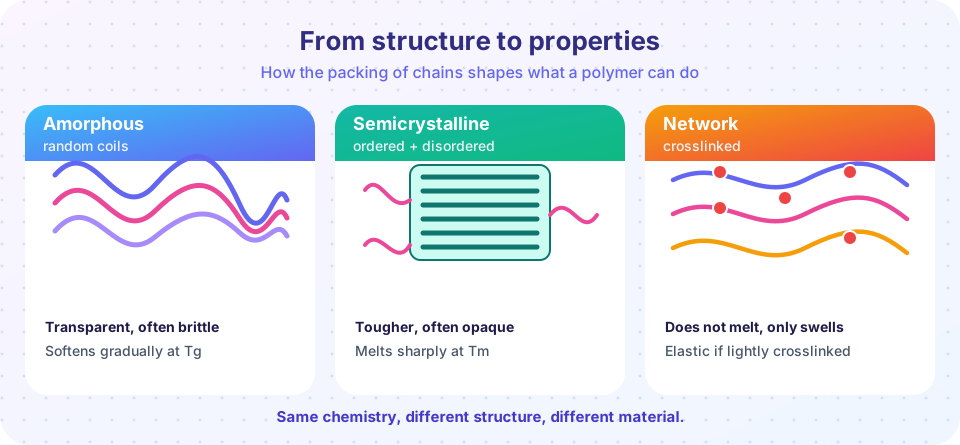
Chains can order or not. If the chain is regular enough, segments pack side by side into crystals; irregular chains stay random in an amorphous state. Most commercial polymers are semicrystalline: tiny crystals (lamellae about 10 nanometers thick) embedded in an amorphous matrix and tied together by chains that pass through both. Crystals make a polymer stiffer, stronger, denser, more heat-resistant and often more opaque.
Chain motion depends on temperature. At low temperature the segments are frozen in place and the polymer is a hard, sometimes brittle glass. On warming through the glass transition temperature (Tg), long segments start to move, and the polymer turns into a soft rubber or a viscous liquid. Crystals melt at a higher temperature, the melting point (Tm). These transitions are the most important temperatures for any polymer.
Chains can be tied together. Crosslinks stop chains from sliding past each other. A lightly crosslinked polymer above Tg is a rubber; a densely crosslinked one is a hard thermoset.
Three structures
Three temperatures
Time matters too
What each lesson covers
| Lesson | Question it answers |
|---|---|
| Crystallinity and thermal transitions | Why do some polymers crystallize, and what set Tg and Tm? |
| Mechanical properties | What do stress-strain curves tell us about stiffness, strength and toughness? |
| Viscoelasticity and rheology | Why do polymers creep, relax and flow, and how do temperature and time trade off? |
| Chapter 4 review | Do I have the whole picture? |
Why it matters
When engineers choose a polymer, they rarely ask only for its chemistry. They ask: what is its Tg, so I know whether it is glassy at my service temperature? What is its Tm, so I know how to mold it? What are its modulus, yield strength and elongation at break? How much will it creep over ten years? The answers come from structure. A water bottle made from PET works because its Tg (about 70 to 80 °C) is above room temperature and its crystallinity can be controlled during blow molding; a rubber band works because it is a lightly crosslinked network well above its Tg (about −70 °C). The same ideas explain why a plastic chair becomes soft in a hot car, why a polystyrene cup is rigid but cracks, and why tires are stiffer in winter.
Try it
This explorer shows the same idea for the three structures. Slide the temperature and read the state of a typical glassy amorphous polymer (Tg 100 °C), a semicrystalline polymer (Tg 70 °C and Tm 250 °C) and a crosslinked rubber (Tg −50 °C). The stiffness bar is a schematic scale on a logarithmic axis, not a measurement.
Check your understanding
Quick check · 3 questions
of 3 answered You scored / 3 · perfect!
-
1. What is Tg?
The glass transition marks the change from a hard glassy state to a soft rubbery or viscous state in amorphous regions. -
2. Which structure is a lightly crosslinked network above Tg?
Light crosslinking prevents flow but leaves segments mobile, so the material stretches and recovers. -
3. Why are most commercial thermoplastics semicrystalline?
Crystals form where chains are regular enough, and most polymers cannot crystallize completely.
Summary
- Three structures (amorphous, semicrystalline, crosslinked) and two key temperatures (Tg and Tm) explain much of polymer behavior.
- Mechanical response depends on temperature and on how fast you load, which leads to viscoelasticity.
- The next lessons treat crystallinity and transitions, stress-strain behavior and viscoelastic flow in turn.
Track your progress
Create a free account to tick off lessons and pick up where you left off on any device.
of Polymer and Materials Chemistry lessons completed