


















Lesson 28 of 47 · Plastics, Rubbers and Fibers
Commodity Plastics: PE, PP, PVC, PS and PET
Learn the structure, properties, processing and uses of polyethylene, polypropylene, PVC, polystyrene and PET, and what the resin identification codes mean.
Five polymers make up most of the plastic you handle every day: polyethylene, polypropylene, polyvinyl chloride, polystyrene and PET. They are called commodity plastics because they are made in enormous volume, cost little and are shaped by the same few processes. Together they account for the large majority of plastic produced worldwide, which is measured in hundreds of millions of tonnes per year.
Each has a simple structure and a distinctive personality. Learning to link a small change in the repeat unit, such as swapping a hydrogen for a chlorine or a benzene ring, to a large change in behavior is the central skill of polymer chemistry, and this lesson is practice for it.
What you will learn
- Draw or name the repeat unit of PE, PP, PVC, PS and PET.
- Explain how branching and tacticity change density, melting point and clarity.
- Link each polymer's structure to its typical uses.
- Use density to predict which plastics float and how recyclers exploit it.
Key terms
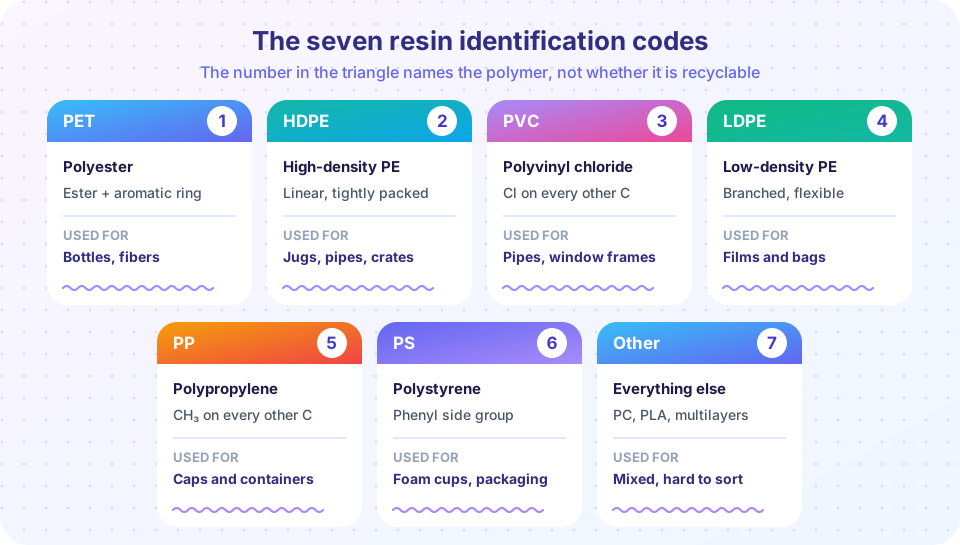
Resin identification code: the number 1 to 7 in a triangle that names the polymer type. It is a sorting aid, not a promise that something can be recycled where you live.
Tacticity: the arrangement of side groups along the chain. Isotactic means all on the same side, atactic means random.
Plasticizer: a small molecule added to soften a polymer by pushing chains apart.
Injection molding: melting pellets and forcing them into a mold, the main route for rigid parts.
Blow molding: inflating a hot hollow tube of plastic inside a mold, used for bottles.
Polyethylene: the simplest polymer
The repeat unit of polyethylene is –CH₂–CH₂–. Everything interesting about PE comes from how those chains are packed.
- LDPE (low-density polyethylene, code 4) is made by free-radical polymerization at high pressure and temperature. Back-biting reactions create many branches, both short and long. Branches stop chains packing tightly, so the density is low (about 0.92 g/cm³), crystallinity is modest and the melting point is about 110 °C. LDPE is flexible, tough and easy to blow into thin film: bags, wraps, squeeze bottles.
- HDPE (high-density polyethylene, code 2) is made with Ziegler–Natta or Phillips catalysts at lower pressure. Chains are almost linear, so they pack closely (density 0.94 to 0.97 g/cm³), crystallinity is high and Tm is about 130 °C. HDPE is stiffer and stronger: milk jugs, pipes, crates, fuel tanks.
- LLDPE (linear low-density) is a copolymer of ethylene with a little 1-butene, 1-hexene or 1-octene. The short branches reduce density while keeping the chains linear, giving films with excellent puncture resistance. Stretch wrap is a familiar example.
Because C–H and C–C bonds are nonpolar, PE resists water, acids and bases. Its glass transition is very low (around −120 °C), so PE stays flexible in a freezer.
Polypropylene: a methyl group makes the difference
Adding one CH₃ group on every other carbon gives –CH₂–CH(CH₃)–. The methyl group stiffens the chain, raising Tm to about 165 °C and Tg to around 0 °C, and the density drops to about 0.90 g/cm³, the lightest of the common plastics.
Polymerization needs a catalyst that controls tacticity. Isotactic PP, with all methyl groups on the same side, crystallizes well and is the useful material. Atactic PP, with randomly placed methyls, is a soft, sticky solid that cannot crystallize. Giulio Natta's work on stereoregular polymerization in the 1950s earned a Nobel Prize in 1963 for him and Karl Ziegler.
PP's key strengths are stiffness at moderate cost, high-temperature resistance (it survives a dishwasher and hot-fill foods) and fatigue life. Thin PP sections can be flexed millions of times, which is why flip-top bottle caps use a living hinge. Its weaknesses are brittleness at low temperature, sensitivity to UV and oxidation, and difficulty bonding with glues.
PVC: chlorine adds polarity, flame resistance and a problem
PVC has –CH₂–CHCl– units. Each chlorine atom adds a strong dipole and 56.7 % of the polymer's mass is chlorine (35.45 / 62.50). The consequences are large:
- Strong intermolecular forces make PVC rigid with a Tg of about 80 °C.
- Inherent flame resistance: the chlorine is released as HCl in a fire and quenches flames.
- Instability on heating: above about 150 °C PVC begins to lose HCl, as you saw in the TGA lesson. Processing requires stabilizers (calcium-zinc or organotin compounds).
Two forms are common. Rigid PVC (uPVC) is used for water and drain pipes, window frames and cladding. Plasticized PVC contains 20 to 50 % plasticizer by weight and is soft: cable insulation, flooring, medical tubing, flexible hose. Historic concerns about phthalate plasticizers have pushed many applications toward alternatives, and the production of vinyl chloride monomer, a known human carcinogen, is tightly regulated.
Polystyrene: the brittle, clear, foamable one
PS has a phenyl ring on every other carbon: –CH₂–CH(C₆H₅)–. The bulky ring prevents crystallization (ordinary PS is atactic), so it is amorphous, hard and transparent with a Tg of about 100 °C. Its main weakness is brittleness.
- General-purpose PS (GPPS): clear cases, disposable cutlery, CD cases.
- HIPS (high-impact polystyrene): small rubber particles of polybutadiene dispersed in the PS matrix absorb impact energy and make it opaque and tough: refrigerator liners, toys.
- EPS (expanded polystyrene): beads containing a blowing agent such as pentane are steam-expanded to a foam that is mostly air, which is why EPS insulates and cushions so well.
PET: stiff, clear and gas-tight
PET (polyethylene terephthalate) is a polyester made from terephthalic acid and ethylene glycol. Its chain contains a rigid benzene ring and polar ester links, so it has a Tg of around 70 to 80 °C and a Tm of about 250 to 260 °C.
PET has an elegant processing story. A thick test-tube shaped preform is injection-molded and cooled so fast that it stays amorphous and clear. The preform is reheated just above Tg and stretch-blown into a bottle. Stretching aligns the chains and induces crystallization in the wall, which raises strength and makes the bottle a much better barrier to carbon dioxide and oxygen. Crystallization is limited to small crystals, so the bottle stays clear. The same polymer drawn into fiber is the polyester used in clothing.
Floating and sinking: why density matters
PE (0.92 to 0.97) and PP (about 0.90) are less dense than water and float. PS (1.05), PET (about 1.38) and PVC (about 1.4) sink. Recycling plants use a sink-float tank to separate them after shredding. A single PVC label or cap mixed with PET flakes can ruin a batch, because PVC releases HCl at PET processing temperatures: one reason PVC is the recycler's least favorite contaminant.
Common misconceptions
"The number in the triangle means it is recyclable." The code only identifies the polymer. Whether it is collected depends on local sorting capacity and markets. In many places only codes 1 and 2 are widely accepted.
"HDPE and LDPE are different chemicals." They are the same chemical formula, (C₂H₄)ₙ. The difference is branching and therefore packing.
"Polystyrene foam is a different material from polystyrene." It is polystyrene expanded with gas, so most of its volume is air.
Try it
Slide the liquid density and watch which plastics float. The widget is a model that uses typical densities; real parts can differ because of fillers, pigments and trapped air.
Next, compare the thermal windows of the five polymers. Tg marks where amorphous regions soften and Tm where crystals melt; the room-temperature line shows which are glassy and which are rubbery at 25 °C. Values are typical, not exact.
Press Run (or Ctrl + Enter) to see the result here.
Program input · what you'd type while the program runs
Type the answers before you press Run, one per line. Each time the program reads a line (with input()), it gets the next line from this box.
Check your understanding
Quick check · 5 questions
of 5 answered You scored / 5 · perfect!
-
1. What is the main structural difference between LDPE and HDPE?
Both are (C₂H₄)ₙ. Branches in LDPE prevent close packing, lowering density, crystallinity and melting point. -
2. Which resin code and polymer pair is correct?
1 = PET, 2 = HDPE, 3 = PVC, 4 = LDPE, 5 = PP, 6 = PS, 7 = other. -
3. Why is isotactic polypropylene useful while atactic PP is not?
Crystallization requires regular chains; atactic PP stays soft and sticky. -
4. PET bottles are clear because the preform is:
Fast cooling keeps the preform amorphous; stretch blowing then creates small crystals that do not scatter light. -
5. In a sink-float tank (water, 1.0 g/cm³), which pair floats?
PE (0.92 to 0.97) and PP (about 0.90) are less dense than water; PS, PET and PVC are denser.
Summary
- PE, PP, PVC, PS and PET dominate plastic production; their repeat units differ by only one or two atoms.
- Branching (LDPE vs. HDPE) and tacticity (isotactic vs. atactic PP) control packing, density, crystallinity and melting point.
- Chlorine makes PVC polar, rigid and flame-resistant but thermally unstable; the benzene ring makes PS clear and brittle; the ester and ring in PET give strength and barrier properties.
- Resin codes 1 to 7 identify polymers; density differences let recyclers separate floating polyolefins from sinking plastics.
Track your progress
Create a free account to tick off lessons and pick up where you left off on any device.
of Polymer and Materials Chemistry lessons completed