


















Lesson 16 of 47 · Polymerization Mechanisms
Chapter 3 review: polymerization mechanisms
Compare step-growth, radical, living, coordination and ring-opening polymerization in one table, practice with worked problems and take a ten-question mixed quiz.
Chapter 3 covered five ways of building a polymer chain. Each answers the same question, how do small molecules become long chains, with a different trade-off between speed, control, cost and monomer scope. A skilled polymer chemist can look at a target material and say which route to use and why. This review puts the mechanisms side by side, gives you worked problems to rehearse the key equations and ends with a quiz that mixes everything.
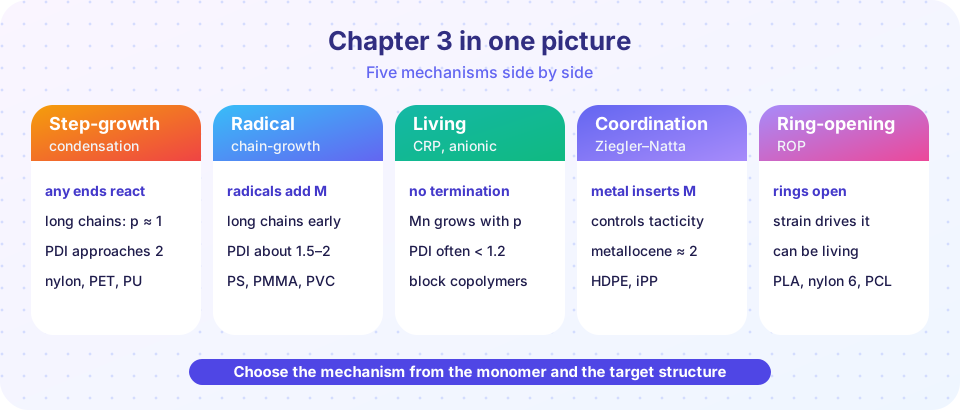
Recap table
| Mechanism | How chains grow | Key equation | Typical Đ | Examples |
|---|---|---|---|---|
| Step-growth | any two functional groups react | Xn = 1/(1−p); with imbalance (1+r)/(1+r−2rp) |
about 2 | nylon 6,6, PET, polyurethane |
| Free-radical chain | initiation, propagation, termination | Rp = kp[M](f kd[I]/kt)^½; ν = Rp/Ri |
1.5 to 3 | PS, PMMA, PVC, LDPE |
| Living (anionic) | no termination or transfer | Xn = ([M]₀/[I]₀)p; Đ ≈ 1 + 1/Xn |
1.01 to 1.1 | SBS, PS-b-PMMA |
| Controlled radical (ATRP, RAFT, NMP) | reversible deactivation | same linear Mn growth | 1.05 to 1.3 | block and functional polymers |
| Coordination | monomer inserts at a metal center | stereocontrol, H₂ transfer | 2 (single site), 4 to 8 (multi-site) | HDPE, iPP, LLDPE |
| Ring-opening | strained rings open | [M]eq = exp(ΔG°/RT) |
1.1 to 2 | PLA, PCL, nylon 6, PEG, silicones |
Worked problems
1. Step-growth. A polyester needs Xn = 150. Required conversion: p = 1 − 1/150 = 0.9933. If there is a 0.5 percent excess of one monomer (r = 0.995), what is the maximum Xn? (1 + r)/(1 − r) = 1.995/0.005 = 399, so the target is reachable, but only at high conversion: solving 150 = (1 + r)/(1 + r − 2rp) for p gives p = (1 + r)(1 − 1/150)/(2r) ≈ 0.996.
2. Radical kinetics. If the initiator concentration is quadrupled, the rate rises by a factor of 2 (half order) and the kinetic chain length falls by a factor of 2 (ν ∝ [I]^−½).
3. Living polymerization. To make poly(methyl methacrylate) with Mn = 25,000 g/mol at full conversion, use [M]₀/[I]₀ = 25,000 / 100.12 ≈ 250.
4. Ring-opening. If ΔH° = −23 kJ/mol and ΔS° = −41 J/(mol·K), the ceiling temperature is T = ΔH/ΔS = 561 K, but the equilibrium monomer concentration at 130 °C is exp(ΔG°/RT) with ΔG° = −23,000 + 41 × 403 = −6,477 J/mol, so [M]eq = exp(−6,477/(8.314 × 403)) ≈ 0.14 mol/L. Some monomer is always left.
One monomer, several routes
It helps to see how the mechanisms differ using familiar monomers. Styrene can be polymerized by free radicals (cheap, atactic, Đ near 2, the way most polystyrene is made), by living anionic initiation (Đ near 1.02, blocks with butadiene) and by ATRP or RAFT (Đ near 1.1, with end groups you can later modify). Ethylene is polymerized by radicals at very high pressure to give branched LDPE, and by Ziegler–Natta or metallocene catalysts at moderate pressure to give linear HDPE or LLDPE. Lactide opens by coordination-insertion with tin octoate to give PLA with a defined end group. A diacid and a diol give a polyester only through step-growth, and no radical can substitute.
The lesson is that the mechanism is a choice made for the material you want, not a property of the monomer alone. For each route the chemist must also manage heat (all polymerizations are exothermic), purification of monomer and solvent, removal of catalyst or byproduct, and the control of molar mass by the recipe: initiator concentration in radical polymerization, monomer-to-initiator ratio in living systems, stoichiometry and conversion in step-growth, and hydrogen in coordination catalysis. If you can say, for each of the five mechanisms, what sets the molar mass and what sets the dispersity, you have understood the chapter.
How to choose
Start with the monomer. Two reactive end groups: step-growth. A vinyl group: radical, ionic or coordination. A strained ring: ROP or ROMP.
Then the target. Narrow chains or blocks: living or RDRP. Stereoregular polyolefin: coordination catalyst. Cheapest, most tolerant route: free radical.
Then the practicalities. Purity requirements, heat removal, catalyst residues and cost.
Common misconceptions to double-check
"Step-growth is slower than chain-growth, so its chains are shorter." The issue is not speed but the need for extreme conversion and balance.
"All radical polymerizations are uncontrolled." RDRP methods bring control while keeping radical chemistry.
"Ring-opening is always irreversible." It is an equilibrium; above the ceiling temperature polymer depolymerizes.
Try it
A decision helper: choose the features of your monomer and what you want, and it suggests a mechanism. It encodes the rules of thumb from the chapter and is a study aid, not a substitute for the literature.
Check your understanding
Quick check · 10 questions
of 10 answered You scored / 10 · perfect!
-
1. What conversion gives Xn = 50 in an ideal step-growth polymerization?
p = 1 − 1/Xn = 1 − 1/50 = 0.98. -
2. Which statement about radical polymerization kinetics is correct?
Steady state gives Rp ∝ [M][I]^½, and ν ∝ [I]^−½. -
3. Which method gives the lowest dispersity for styrene-b-butadiene blocks?
Living anionic polymerization has no termination and fast initiation, giving Đ near 1. -
4. For 300 equivalents of monomer (M₀ = 104.15) per initiator in a living polymerization at 40% conversion, Mn is about
DP = 300 × 0.40 = 120, so Mn = 120 × 104.15 ≈ 12,500 g/mol. -
5. Hydrogen is added to a Ziegler–Natta polymerization to
H₂ cleaves the metal–polymer bond, ending one chain and starting another. -
6. A 1% excess of one monomer in an A–A + B–B reaction (r ≈ 0.99) limits Xn at p = 1 to about
Xn = (1 + r)/(1 − r) = 1.99/0.01 ≈ 199. -
7. Why does a free-radical polymerization usually give atactic polymer?
The sp²-hybridized radical lacks a stereochemical bias, unlike a chiral metal catalyst. -
8. Which ring is NOT expected to polymerize by ring-opening?
Cyclohexane is a strain-free ring, so opening it gives no enthalpy to pay for the lost entropy. -
9. Which pair is correctly matched?
ATRP uses copper and an alkyl halide; NMP uses nitroxides; Ziegler–Natta uses a transition-metal halide with an aluminium alkyl. -
10. What is the dispersity of a linear step-growth polymer as p approaches 1?
Đ = 1 + p, tending to 2 (Flory most probable distribution).
Summary
- Step-growth needs extreme conversion and balance; chain-growth makes long chains from the start; living and controlled methods give predictable length and blocks.
- Coordination catalysts control stereochemistry; ring-opening needs strain and is an equilibrium with a ceiling temperature.
- Choose by monomer functional groups, target structure and practical constraints.
Track your progress
Create a free account to tick off lessons and pick up where you left off on any device.
of Polymer and Materials Chemistry lessons completed