


















Lesson 36 of 47 · Advanced and Functional Materials
Chapter Review: Advanced and Functional Materials
Review composites, conducting polymers, hydrogels, smart polymers, ceramics and nanomaterials with a summary picture, key equations and a ten-question quiz.
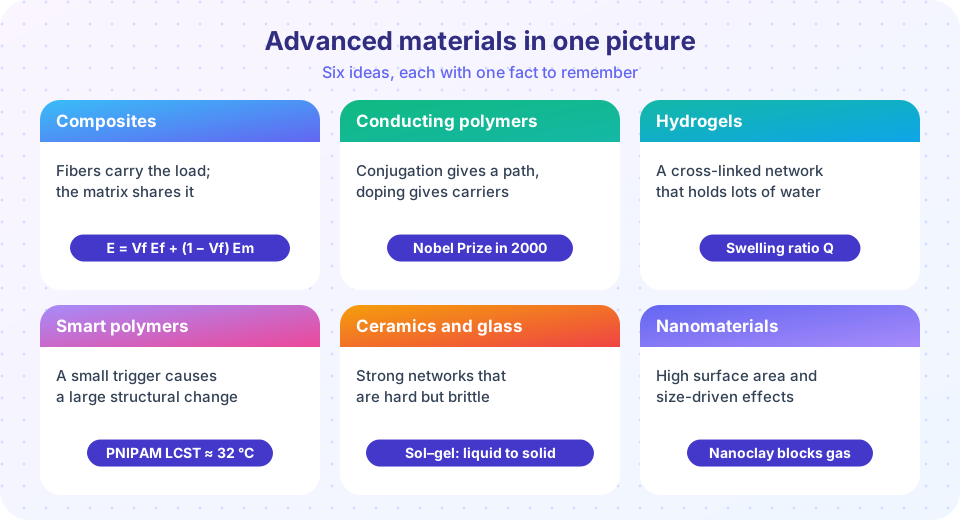
This chapter showed how structure is turned into function: aligned fibers for stiffness, conjugated and doped chains for conduction, cross-linked networks that swell and collapse, and inorganic or nanoscale components that add hardness, heat resistance or barrier properties. Here are the main ideas, the equations worth memorizing and a quiz that mixes the whole chapter.
Try the self-test habit again: pick a product (a phone screen, a diaper, a bicycle frame) and say which of the six families is at work and what the structural reason is.
Key equations
Composite along fibers:   E = Vf Ef + (1 − Vf) Em
Composite across fibers:  1/E = Vf/Ef + (1 − Vf)/Em
Critical fiber length:    lc = σf d / (2 τ)
Conductivity:             σ = n q μ
Swelling ratio:           Q = Ws / Wd
Polyacid ionization:      α = 1 / (1 + 10^(pKa − pH))
Photon wavelength:        λ (nm) ≈ 1240 / E (eV)
How the lessons connect
The three lessons of this chapter look different, but they use the same few ideas. In a composite, a stiff phase and a soft phase share load, and the answer depends on whether they act in parallel or in series. In a conducting polymer, a conjugated backbone provides a pathway and doping provides carriers, and in a filled composite the pathway is built by particles touching, which is why percolation matters. In a hydrogel, a cross-linked network balances mixing, elasticity and ionic osmotic pressure, and a small change in temperature or pH tips the balance. In every case the lesson is the same: write down which structural feature supplies the function, then ask what could remove it.
Look also at the trade-offs. More fiber raises stiffness but eventually starves the matrix. More doping raises conductivity but can reduce stability. More cross-links make a gel stronger but let it swell less. Good design is the art of choosing a point on each trade-off curve that suits the application.
Self-check list
Before the quiz, make sure you can do each of these without notes:
- Compute the Voigt and Reuss moduli for a given fiber fraction, and explain in one sentence why they differ.
- Explain why a doped polymer conducts and an undoped one barely does, using the words band gap, polaron and carrier.
- Convert a pair of weights into a swelling ratio and a water content.
- Explain why PNIPAM collapses on heating even though most solids dissolve better when warm.
- Describe how a nanofiller such as clay can lower the permeability of a film.
- State one benefit and one weakness of ceramics and glass.
If one of these stalls you, reopen the matching lesson and redo the calculation in the Try it cell.
A mini-case to reason through
Imagine a wearable skin patch that must stay flexible, carry a small electrical signal and release a drug when the skin warms slightly. No single polymer does all three, so the design combines ideas from this chapter: a hydrogel matrix swollen with water for softness and comfort, a thermoresponsive component such as a PNIPAM copolymer whose transition sits near skin temperature, and a conductive pathway such as a PEDOT:PSS network above its percolation threshold. Each requirement points to a different structural feature, and the trade-offs (more conductor makes the gel stiffer, a higher transition temperature delays release) are exactly the ones you practiced.
Try it
Re-compute the chapter's headline numbers. Predict each before you run it.
Press Run (or Ctrl + Enter) to see the result here.
Program input · what you'd type while the program runs
Type the answers before you press Run, one per line. Each time the program reads a line (with input()), it gets the next line from this box.
Check your understanding
Quick check · 10 questions
of 10 answered You scored / 10 · perfect!
-
1. A composite has Vf = 0.5, Ef = 200 GPa and Em = 4 GPa. Its modulus along the fibers (Voigt) is:
0.5 × 200 + 0.5 × 4 = 102 GPa. -
2. For the same composite, the Reuss (transverse) modulus is about:
1/E = 0.5/200 + 0.5/4 = 0.0025 + 0.125 = 0.1275, so E ≈ 7.8 GPa. -
3. Why are fiber composites called anisotropic?
Stiffness along the fibers is much higher than across them. -
4. In a conducting polymer, what does doping do?
Doping creates polarons and bipolarons, which carry current. -
5. A film has n = 10²¹ cm⁻³ and μ = 0.1 cm²/(V s). Its conductivity is about:
σ = 1e21 × 1.602e-19 × 0.1 ≈ 16 S/cm. -
6. The percolation threshold is:
Below it, particles are isolated; above it, they connect across the sample. -
7. A gel weighs 0.4 g dry and 8 g swollen. Its swelling ratio is:
Q = 8 / 0.4 = 20. -
8. PNIPAM gels collapse when warmed above about:
That is its lower critical solution temperature. -
9. A polyacrylic acid gel (pKa about 4.5) swells most at:
At pH 8 nearly all acid groups are ionized, so charge repulsion and osmotic pressure are highest. -
10. Nanoclay reduces gas permeability mainly because it:
Exfoliated platelets create a tortuous diffusion path.
Summary
- Composites: fibers carry load, the matrix transfers it; properties are directional and follow the Voigt and Reuss bounds.
- Conducting polymers need conjugation plus doping;
σ = n q μ; percolation governs filled composites. - Hydrogels and smart polymers respond through swelling balance: temperature (LCST), pH (ionization), light and more.
- Ceramics, glass and nanofillers add hardness, heat resistance and barrier properties when well dispersed and bonded.
- Next: environmental responsibility, from biopolymers to recycling and life-cycle thinking.
Track your progress
Create a free account to tick off lessons and pick up where you left off on any device.
of Polymer and Materials Chemistry lessons completed