


















Lesson 22 of 47 · Characterization
Chapter Overview: Characterization
A map of polymer characterization: which instrument answers which question about size, heat, chemistry and shape, and how to choose a method.
You can make a polymer in an afternoon and still not know what you made. Two white powders can look identical and behave nothing alike: one dissolves, one does not; one melts at 130 °C, the other at 260 °C. Characterization is the toolkit that turns "I made something" into "I know what I made, how big its chains are, how they are arranged and how it will behave".
This chapter is a tour of that toolkit. You will not learn to operate every instrument, but you will learn what each one measures, what its output looks like and which questions it cannot answer. That skill, choosing the right method for the question, is what separates a lab report from a guess.
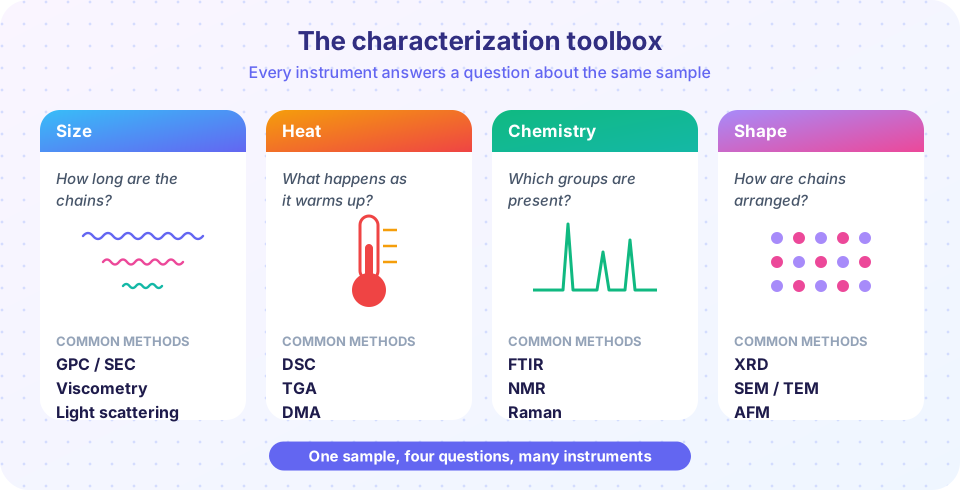
The big picture
A polymer is not one molecule but a population of molecules with different chain lengths, arranged in a solid that may be partly ordered. That makes characterization different from small-molecule chemistry, where a single sharp melting point or one clean spectrum can identify a compound. For polymers we always ask four linked questions.
- Size. How long are the chains, and how widely do lengths vary? This controls strength, toughness and how the melt flows. The workhorse is gel permeation chromatography (GPC, also called size-exclusion chromatography, SEC).
- Heat. At what temperatures does the material soften, crystallize, melt or decompose? Differential scanning calorimetry (DSC) and thermogravimetric analysis (TGA) answer this, and dynamic mechanical analysis (DMA) links it to stiffness.
- Chemistry. Which bonds and groups are present, and in what ratio? Infrared (FTIR) and nuclear magnetic resonance (NMR) spectroscopy read the molecular fingerprint.
- Shape. How are chains packed, and what does the surface look like from micrometers down to nanometers? X-ray diffraction (XRD), electron microscopy (SEM, TEM) and atomic force microscopy (AFM) show this.
Four questions
Size: GPC
Heat: DSC and TGA
Chemistry: FTIR and NMR
Shape: XRD and microscopy
Why one number is never enough
Suppose a supplier promises "polyethylene, molar mass 100,000". Which average? Two batches can share the same number average and still have very different tails of long chains, and the long chains are what make a melt viscous and a film strong. Likewise a "melting point" depends on how the sample was cooled: a slowly cooled sample has thicker crystals and melts higher than a quenched one. For that reason polymer data always come with conditions attached: solvent, temperature, heating rate, thermal history.
A good habit is to ask of every measurement three things: What exactly does this number average over? What did the sample experience before the measurement? What would a different instrument say? Agreement between two independent methods, such as crystallinity from DSC and from XRD, is far more convincing than one result.
What each lesson in this chapter covers
- Molar mass and GPC: Mn, Mw, Mz, dispersity, how a column sorts chains and how to compute averages from data.
- Thermal analysis: DSC and TGA: reading Tg, Tc and Tm, computing percent crystallinity, and using mass-loss curves to find fillers.
- Spectroscopy, diffraction and microscopy: fingerprinting with infrared light, Bragg's law and matching the imaging method to the length scale.
- Chapter review: a one-page recap and a ten-question quiz.
Common misconceptions
"Every instrument gives the true value." Each method measures a property under specific conditions and has its own bias. GPC gives molar mass relative to the calibration standard unless it has absolute detectors; DSC crystallinity depends on a literature value for a perfect crystal.
"A polymer has one melting point." It has a melting range, because crystals of different thickness melt at different temperatures. Amorphous polymers have no melting point at all, only a glass transition.
Try it
A decision helper is the quickest way to rehearse the mapping from question to method. The console below holds a small lookup; add your own questions and see which instrument family it returns.
Press Run (or Ctrl + Enter) to see the console output here.
No output.
A second drill: given a measurement, name the question it answers. Try to predict the family before you run it.
Press Run (or Ctrl + Enter) to see the console output here.
No output.
Check your understanding
Quick check · 4 questions
of 4 answered You scored / 4 · perfect!
-
1. Which question is best answered by GPC?
GPC (SEC) separates chains by coil size in solution and gives the molar-mass distribution. -
2. A technician wants to know whether a plastic contains glass fiber. Which measurement is the most direct?
Glass does not burn or evaporate, so the mass remaining at high temperature in TGA estimates the filler content. -
3. Why must a polymer measurement always be reported with its conditions?
Polymer properties depend on history and test conditions, so a number without them cannot be reproduced or compared. -
4. Which pair of methods gives independent estimates of crystallinity?
DSC uses the heat of melting; XRD compares crystalline peaks with the amorphous halo. Agreement strengthens the conclusion.
Summary
- Characterization answers four linked questions: size, heat, chemistry and shape.
- GPC gives the molar-mass distribution; DSC and TGA give thermal transitions and mass loss; FTIR and NMR give chemistry; XRD and microscopy give structure.
- Polymers are populations, so averages, ranges and thermal history matter.
- Independent methods that agree give the strongest evidence.
Next: Molar mass and GPC
Track your progress
Create a free account to tick off lessons and pick up where you left off on any device.
of Polymer and Materials Chemistry lessons completed