


















Lesson 14 of 47 · Polymerization Mechanisms
Living and controlled polymerization: anionic, ATRP and RAFT
Learn how living anionic polymerization and reversible-deactivation radical methods such as ATRP and RAFT give narrow molar mass distributions, end-group control and block copolymers.
Free-radical polymerization is cheap and robust, but it is also messy. Every chain starts at a random moment, grows for a random length of time and stops at random, so the product has a broad range of chain lengths and chemists have no way to say what is at the end of each chain. For many modern uses (self-assembling block copolymers, lithography masks, drug-delivery particles, coatings with precise surface chemistry) that is not good enough. Living and controlled polymerizations remove the randomness. Every chain starts together, grows at the same pace and stays alive, ready to be extended or end-capped. This lesson shows how that is achieved in anionic polymerization and in the radical methods that brought the same idea to more forgiving chemistry.
What you will learn
- What makes a polymerization "living" and the conditions it requires
- How anionic living polymerization works and how it gives block copolymers
- The principle of reversible deactivation and the persistent radical effect
- How ATRP, RAFT and nitroxide-mediated polymerization differ
- How to design a target molar mass from the monomer-to-initiator ratio
Key terms
Living polymerization: chain growth without irreversible termination or chain transfer, so chain ends remain active as long as monomer is present.
Dormant species: a chain whose end is temporarily capped, unable to grow until reactivated.
Reversible-deactivation radical polymerization (RDRP): IUPAC's term for controlled radical methods such as ATRP, RAFT and NMP.
Block copolymer: a chain made of two or more long blocks of different monomers.
Chain-transfer agent (CTA): a molecule that exchanges chain ends with growing chains; in RAFT it controls the polymerization.
What "living" means
In 1956 Michael Szwarc dissolved sodium naphthalenide in tetrahydrofuran and added styrene. Sodium naphthalenide transfers an electron to styrene and starts anionic chains; the solution turned a deep red color, which is the color of the polystyryl carbanion. When the styrene was consumed, the red color remained, because the carbanions did not die. When Szwarc added more styrene, the chains grew further. He called them living polymers.
A polymerization is living if it fulfills four conditions:
- Fast initiation. All chains start at about the same time (initiation is at least as fast as propagation).
- No termination. The active ends do not react with each other or with other species.
- No chain transfer. Active centers are not passed to solvent, monomer or polymer.
- Irreversible, uniform growth. Each active center adds monomer at the same rate.
When these hold, the number of chains equals the number of initiator molecules, and each grows by the same average amount:
Xn = ([M]₀ / [I]₀) × p, and so Mn = M₀ × ([M]₀/[I]₀) × p.
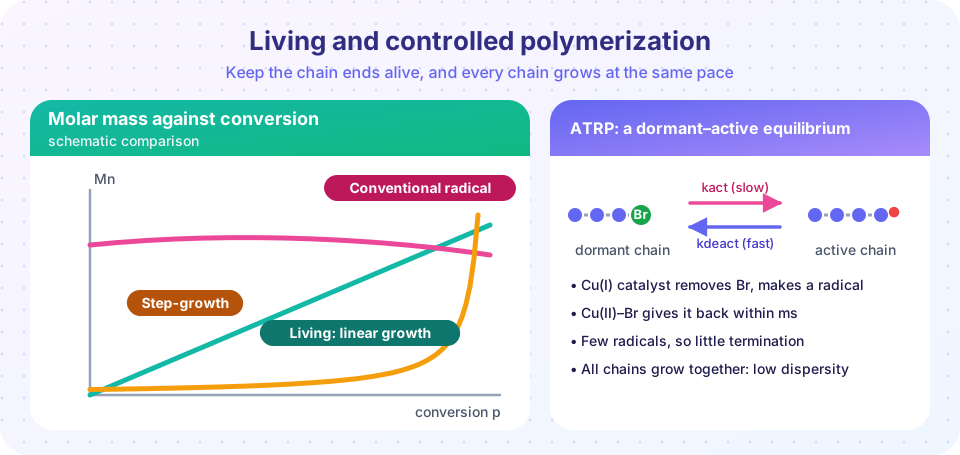
Molar mass is set by the recipe (monomer to initiator ratio) and increases linearly with conversion p. For 200 equivalents of styrene per initiator, full conversion gives DP = 200, Mn = 200 × 104.15 ≈ 20,800 g/mol. If chains all grow at the same average rate, chain lengths follow a Poisson distribution with Đ ≈ 1 + 1/Xn, a value like 1.005 to 1.05 in good experiments. Compare that with 1.5 to 3 for free-radical polymerization.
Living anionic polymerization
Typical initiators are alkyllithiums (n-butyllithium) or sodium naphthalenide. Styrene, dienes (butadiene, isoprene), methacrylates and ethylene oxide can be polymerized this way. The method requires high-purity monomer, dry solvent, and an inert atmosphere, because carbanions react instantly with water, oxygen and carbon dioxide. That strict purification is why anionic polymerization is used for specialty materials rather than commodity plastics.
Its strength is sequential monomer addition. After the first monomer is consumed, a second monomer is added and the living ends continue. Making polystyrene–polybutadiene–polystyrene (SBS) by feeding styrene, then butadiene, then styrene (or by coupling a diblock) gives the thermoplastic elastomer found in shoe soles and adhesives. The monomer order matters: a poly(methyl methacrylate) enolate is too stable to initiate styrene, so styrene must go first. Chemists end-cap the living anion with CO₂, ethylene oxide or other electrophiles to place a defined functional group on the end.
Controlled radical polymerization: the idea
Anionic chemistry is demanding. Radicals tolerate water and many functional groups, so it was a goal to make radical polymerization "living-like". True living radical chains cannot exist, since two radicals will always terminate at a diffusion-limited rate. The trick is to keep the radical concentration very low and to put most chains to sleep, reactivating them reversibly. In a good system:
- Most chains are dormant (capped by a halogen, a nitroxide or a thiocarbonylthio group), and cannot terminate.
- A small fraction is active at any time. An active chain adds a few monomers and then returns to the dormant state.
- The exchange between states is fast compared with propagation, so every chain gets the same number of chances to grow, and the distribution is narrow.
- Because so few radicals are present at once, termination is rare, though not zero (typically a few percent of chains).
This is called reversible deactivation, and the family is RDRP. Three methods dominate.
Nitroxide-mediated polymerization (NMP)
A stable nitroxide radical such as TEMPO caps the growing chain reversibly. Georges and coworkers showed in 1993 that styrene heated with benzoyl peroxide and TEMPO at about 120 °C gave narrow distributions. The persistent radical effect explains why it works: the nitroxide does not terminate with itself, so as a few chains terminate irreversibly it accumulates, which suppresses the radical concentration and favors reversible capping.
Atom transfer radical polymerization (ATRP)
Matyjaszewski and Wang (1995; Sawamoto reported a related ruthenium system the same year) used a copper catalyst. A chain end carries a halogen, P–Br (dormant). A Cu(I)/ligand complex removes Br to give an active radical P• and Cu(II)–Br; the Cu(II) species returns the Br to the radical within milliseconds:
P–Br + Cu(I)/L ⇌ P• + Br–Cu(II)/L
The activation rate constant kact is small and the deactivation rate constant kdeact is large, so the equilibrium lies far toward the dormant side. The initiator is an alkyl halide, and ATRP can polymerize styrenes, (meth)acrylates, acrylonitrile and many functional monomers. The drawback is the copper catalyst, which must be removed from the product. Newer variants (ARGET, ICAR, photo-induced and electrochemical ATRP) use ppm levels of copper.
Reversible addition-fragmentation chain transfer (RAFT)
Reported by a CSIRO team in 1998, RAFT keeps an ordinary radical source (AIBN) and adds a chain-transfer agent of the form Z–C(=S)–S–R (a thiocarbonylthio compound: dithioester, trithiocarbonate, xanthate or dithiocarbamate). A growing radical adds to the C=S bond, the intermediate radical fragments and releases a new radical that starts another chain. The thiocarbonylthio group is passed from chain to chain in a degenerate transfer, so all chains share it. The molar mass is set by the ratio of monomer consumed to CTA:
Mn ≈ M₀ × ([M]₀/[CTA]₀) × p + M_CTA
RAFT works with the widest range of monomers and under mild conditions. The price is that the CTA must be matched to the monomer family, the product is colored and may smell, and the end group is often removed afterward.
| Method | Control agent | Strengths | Limits |
|---|---|---|---|
| Anionic | carbanion | Đ near 1.01, block copolymers | rigorous purity, few monomers |
| NMP | nitroxide | no metal | high temperature, limited monomers |
| ATRP | Cu/ligand + alkyl halide | many monomers, precise end groups | metal removal |
| RAFT | thiocarbonylthio CTA | widest monomer scope | CTA choice, color/odor |
Typical dispersities for RDRP are 1.05 to 1.3.
Why control matters
Controlled synthesis makes materials whose structure you can plan. Block copolymers such as polystyrene-block-poly(methyl methacrylate) self-assemble into domains a few tens of nanometers across, and are studied for nanolithography. End-functional polymers can be attached to surfaces, proteins or nanoparticles. Gradient and star polymers, brush coatings and drug-delivery nanocarriers all rely on control. Even small changes in molar mass and distribution can alter solubility, mechanical response and self-assembly.
Common misconceptions
"Living means no chain ever stops." Even good systems have some termination (usually a few percent). "Living" is an ideal; the practical term is controlled or reversibly deactivated.
"ATRP and RAFT are the same." ATRP uses a metal catalyst and halogen end groups; RAFT uses a thiocarbonylthio CTA and an external radical source.
"Narrow distribution means a better material." Narrow distributions are essential for self-assembly and standards, but broad ones can be better for processing.
Try it
The first program contrasts how molar mass and dispersity evolve with conversion for living, conventional-radical and step-growth polymerizations. The second is a design calculator: choose the monomer, the monomer-to-CTA ratio and the conversion, and it gives the expected Mn. Both use the ideal equations; real data deviate somewhat.
Press Run (or Ctrl + Enter) to see the result here.
Program input · what you'd type while the program runs
Type the answers before you press Run, one per line. Each time the program reads a line (with input()), it gets the next line from this box.
Check your understanding
Quick check · 5 questions
of 5 answered You scored / 5 · perfect!
-
1. Which condition is NOT required for a living polymerization?
Temperature is not a defining condition; living systems operate at many temperatures. -
2. A living polymerization uses 400 equivalents of styrene per initiator. What is the DP at 50% conversion?
Xn = ([M]₀/[I]₀) × p = 400 × 0.5 = 200. -
3. In ATRP, the equilibrium lies mostly on the side of
kact is small and kdeact large, so few radicals exist at a time, which suppresses termination. -
4. The reagent that makes RAFT a controlled process is
The Z–C(=S)–S–R compound transfers the end group between chains in degenerate exchange. -
5. Why must anionic living polymerization exclude water and oxygen?
Carbanions are strong bases and nucleophiles, so protic impurities and oxygen terminate the chains.
Summary
- Living polymerization has fast initiation, no termination and no transfer, so
Xn = ([M]₀/[I]₀) × p, with Poisson distribution and Đ ≈ 1 + 1/Xn. - Anionic living polymerization gives the narrowest chains and block copolymers like SBS, but needs very pure conditions.
- ATRP, RAFT and NMP bring the control to radical chemistry through reversible deactivation; typical Đ is 1.05 to 1.3.
- Control of length, end groups and sequence lets chemists design self-assembling and functional materials.
Track your progress
Create a free account to tick off lessons and pick up where you left off on any device.
of Polymer and Materials Chemistry lessons completed