


















Lesson 21 of 47 · Structure and Properties
Chapter 4 review: structure and properties
Review crystallinity, Tg and Tm, stress-strain behavior, rubber elasticity, viscoelasticity and melt flow with a summary picture, recap table, practice generator and ten-question quiz.
You now have the tools to connect how a polymer chain is built to what a polymer does. A regular chain crystallizes, so the material is stiffer and melts at a definite temperature. A stiff or bulky chain freezes at a higher glass transition temperature. A crosslinked chain stretches and snaps back. And because everything depends on how fast chains can move, time and temperature are two sides of the same coin. This review collects the chapter in one picture and one table, then tests whether you can use the numbers.
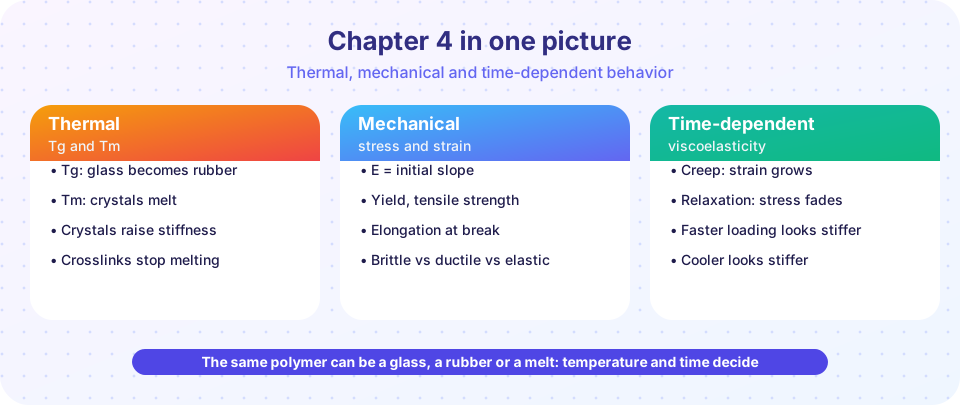
Recap table
| Topic | Key facts and formulas |
|---|---|
| Crystallinity | Chains fold into lamellae in spherulites; regularity, strong forces and slow cooling favor crystals; Xc = ρc(ρ−ρa)/[ρ(ρc−ρa)] or ΔHm/ΔHm°. |
| Glass transition | Kinetic change from glass to rubber in amorphous regions; raised by stiff backbones, bulky groups, forces, crosslinks; lowered by plasticizers and short chains; 1/Tg = w₁/Tg₁ + w₂/Tg₂. |
| Melting | Tm = ΔHm/ΔSm; Tg/Tm (K) about 0.5 to 0.67. |
| Stress and strain | σ = F/A₀, ε = ΔL/L₀, E = σ/ε; yield, necking, cold drawing, tensile strength, elongation; toughness is the area under the curve. |
| Rubber elasticity | Entropic: σ = νRT(λ − 1/λ²), G = ρRT/Mc, E ≈ 3G; stress increases with T. |
| Viscoelasticity | Maxwell τ = η/E, relaxation σ = σ₀e^(−t/τ); Kelvin–Voigt creep ε = (σ₀/E)(1 − e^(−t/τ)); De = τ/t_obs. |
| Time and temperature | WLF: log aT = −17.44(T−Tg)/(51.6 + T − Tg); DMA gives E′, E″ and tan δ. |
| Melt flow | Shear thinning; η₀ ∝ M below Mc and η₀ ∝ M^3.4 above it. |
Worked examples to rehearse
Copolymer Tg. A random copolymer is 30 wt% poly(methyl acrylate) (Tg 283 K) and 70 wt% poly(methyl methacrylate) (Tg 378 K): 1/Tg = 0.30/283 + 0.70/378 = 0.001060 + 0.001852 = 0.002912, so Tg ≈ 343 K (70 °C).
Crystallinity from DSC. A polypropylene sample melts with ΔHm = 104 J/g, and ΔHm° = 207 J/g gives Xc = 104/207 = 50%.
Modulus from a test. A 100 mm gauge length stretches by 0.5 mm under 20 MPa: ε = 0.005, E = 20/0.005 = 4,000 MPa = 4 GPa.
Rubber. A rubber with ρ = 900 kg/m³ and Mc = 6,000 g/mol at 300 K has ν = 900,000/6,000 = 150 mol/m³ and G = 150 × 8.314 × 300 ≈ 0.374 MPa; E ≈ 1.1 MPa.
Three short case studies
A water bottle (PET). PET has an aromatic, stiff backbone, so Tg is about 70 to 80 °C, and it crystallizes slowly, so it can be cooled quickly into a clear amorphous preform. The preform is warmed above Tg and stretched and blown in a mold. Stretching orients chains and induces small crystals, which raises strength and gas barrier and, since the crystals are tiny, keeps the bottle clear. Because Tg is not far above room temperature, a bottle filled hot, or left in a hot car, can shrink or deform: the amorphous regions are softening.
A rubber band. Natural rubber is a lightly crosslinked network of cis-polyisoprene with Tg of about −70 °C, far below room temperature. Its chains are mobile and coiled, so stretching reduces entropy and the band pulls back. Its modulus is a thousand times lower than that of a plastic, because only entropy resists. Cool it in liquid nitrogen and it passes through Tg and shatters like glass.
A plastic shelf bracket (nylon or polypropylene). Under a steady load, any thermoplastic creeps: the Kelvin–Voigt and Maxwell pictures say the strain keeps growing slowly. The designer must use the long-term creep modulus, not the short-term modulus from the data sheet, and must allow for higher temperature, which accelerates creep according to the WLF-type shift. That is why structural plastic parts are often glass-fiber reinforced, which raises the modulus and cuts creep.
In each case, the same chain of reasoning applies: identify the structure (amorphous, semicrystalline, network), locate the service temperature relative to Tg and Tm, then ask what the loading time and speed are.
Common misconceptions to double-check
"A polymer with a high Tg is always more heat-resistant." For amorphous polymers, yes up to Tg; for semicrystalline ones, Tm and crystallinity set the limit, and fibers or fillers can extend it.
"Crystalline means transparent." Crystals scatter light, so semicrystalline polymers are often cloudy; clarity needs very small crystals or none.
"Viscosity of a melt doubles when you double molar mass." Above the entanglement threshold it rises tenfold.
Try it
A practice generator for the Fox equation, the most mechanical calculation of the chapter. It makes a new problem each time; type your answer in kelvin and check. It is a study aid.
Check your understanding
Quick check · 10 questions
of 10 answered You scored / 10 · perfect!
-
1. Which structural change would lower the Tg of PVC?
Plasticizers increase free volume and chain mobility, lowering Tg. -
2. A polypropylene sample has ΔHm = 83 J/g (ΔHm° = 207 J/g). Its crystallinity is
Xc = 83/207 ≈ 0.40. -
3. A specimen with L₀ = 50 mm and A₀ = 20 mm² reaches 600 N at ΔL = 0.75 mm in the linear region. E is
σ = 600/20 = 30 MPa; ε = 0.75/50 = 0.015; E = 30/0.015 = 2,000 MPa = 2 GPa. -
4. For an ideal rubber, stress at fixed stretch
The force is entropic, σ = νRT(λ − 1/λ²), so it grows linearly with T. -
5. A Kelvin–Voigt element is loaded with σ₀ = 0.2 MPa; E = 2 MPa. The limiting creep strain is
The strain tends to σ₀/E = 0.2/2 = 0.1 (10 percent). -
6. What is the Deborah number of a material with τ = 100 s observed for 0.01 s?
De = τ/t_obs = 100/0.01 = 10⁴, so the material acts as a solid. -
7. Which polymer is expected to have the LOWEST Tg?
The flexible Si–O backbone gives PDMS a Tg near −125 °C. -
8. According to WLF with the universal constants, heating 20 K above Tg speeds relaxation by about
log aT = −17.44 × 20/71.6 = −4.87, so relaxation is about 10^4.87 ≈ 7 × 10⁴ times faster. -
9. A toughened plastic like HIPS is tougher because
Rubber domains spread the deformation over many crazes instead of one crack. -
10. Polymer A has Mw = 100,000 and Polymer B has Mw = 200,000, both well above Mc. The ratio of their zero-shear viscosities is about
η₀ ∝ Mw^3.4, so doubling gives 2^3.4 ≈ 10.6.
Summary
- Structure sets properties: regular chains crystallize, flexible chains have a low Tg, crosslinks make rubbers and thermosets.
- Stress-strain curves give E, yield, strength, elongation and toughness; rubber elasticity is entropic.
- Viscoelastic response depends on time and temperature (Maxwell, Kelvin–Voigt, De, WLF), and melt viscosity scales as
M^3.4above Mc.
Track your progress
Create a free account to tick off lessons and pick up where you left off on any device.
of Polymer and Materials Chemistry lessons completed