


















Lesson 1 of 47 · Getting Started
Course map: how to study polymer and materials chemistry
Start here: who this course is for, what you need to know first, how the nine chapters fit together and how to get the most from the interactive examples.
Look around the room you are in. The case of your phone, the cable that charges it, the sole of your shoes, the bottle on the desk, the foam in the chair, the paint on the wall: nearly all of it is made of polymers, giant molecules built by joining small ones into long chains. Add the metals, ceramics and composites that sit beside them in every product, and you have the subject of this course: how the chemistry of atoms and bonds turns into the properties of the materials we use.
This course takes you from "what is a polymer?" to the way chemists design, measure, process and recycle modern materials. It is written for curious learners aged about 15 and up, for students taking chemistry, materials or engineering courses, and for adults who want to understand the plastics, rubbers and fibers around them. Nothing here is copied from a textbook; every example is built for this site.
What you will learn
- What the course covers and the order in which the ideas build on each other
- Which background knowledge helps, and which does not matter
- How the lessons, interactive examples and quizzes work
- A study routine that keeps the ideas connected
Key terms
Polymer: a molecule made of many repeating units joined by covalent bonds.
Monomer: the small molecule that becomes the repeating unit.
Macromolecule: any very large molecule; polymers are the synthetic and natural kind built from repeats.
Material: a substance chosen for a use, described by properties such as stiffness, strength, melting point and density.
Structure-property relationship: the link between how atoms and chains are arranged and how the material behaves.
Who this course is for
You do not need to be a chemist. If you know that atoms form bonds, that carbon makes four of them and that molecules attract each other weakly, you can start. Chapter 1 refreshes exactly those ideas. Some lessons use simple algebra and a little logarithm, and the examples show every step of the arithmetic. If you have studied high school or first-year university chemistry, the course will feel like a natural continuation and will give you a new way to use what you know.
You do not need to program either. The interactive examples are small Python or JavaScript programs that run in your browser; you can run them as they are, read them to see how a formula becomes a calculation, or change a number and watch the answer move. Programming is a tool for exploring here, not a prerequisite.
How the course is built
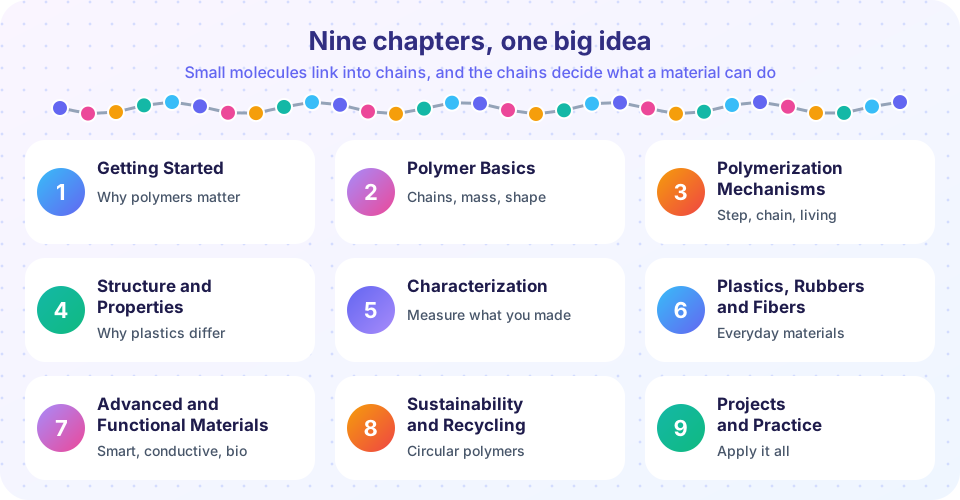
The nine chapters follow the way a materials scientist thinks: first the molecule, then the chain, then how the chain is made, then how the finished material behaves, then how we check it, then the real families of materials, then the frontier, and finally the responsibility of what happens after use.
| Chapter | Question it answers |
|---|---|
| 1. Getting Started | What are polymers and why do they matter? What chemistry do I need? |
| 2. Polymer Basics | How do we describe a chain: repeat unit, molar mass, architecture? |
| 3. Polymerization Mechanisms | How are chains actually built, step by step? |
| 4. Structure and Properties | Why is one polymer a glass, another a rubber, another a fiber? |
| 5. Characterization | How do we measure size, structure and thermal behavior? |
| 6. Plastics, Rubbers and Fibers | What are the main commercial families and how are they processed? |
| 7. Advanced and Functional Materials | How do conductive, smart, biomedical and composite materials work? |
| 8. Sustainability and Recycling | What happens at end of life, and how can the cycle close? |
| 9. Projects and Practice | Can I apply everything to realistic problems? |
Part 1: the chain
Part 2: the material
Part 3: the future
How each lesson works
Every content lesson uses the same shape so you always know where you are. It opens with the outcomes you should reach, then the key terms, then the explanation with worked examples and a picture. After that comes a short list of common misconceptions, because the best way to learn a subject is to know where people usually go wrong. Then you meet the Try it section: small programs that let you test the idea. Finally a quiz and a summary close the lesson.
Chapters begin with an overview lesson that shows the big picture and end with a review lesson. The review lesson has a one-page summary picture and a longer quiz that mixes the whole chapter. Do not skip those: pulling ideas back out of memory a few days later is the most effective study technique known, and the review quiz is designed for it.
A study routine that works
- Read with a pencil. When a worked example gives numbers, cover the answer and compute it yourself first.
- Run the example, then break it. Change one number in the code and predict the result before you run it again.
- Explain it aloud. After each lesson, say in two sentences what the main idea was, as if to a friend.
- Come back. Return to the previous lesson's quiz before starting a new one. A week later, try the chapter review without notes.
- Connect it to something you own. Pick an object near you and ask which polymer it is, how it was made and why that polymer was chosen.
This course is educational. Descriptions of laboratory methods explain what chemists do and why; they are not step-by-step protocols, and no measurement in the lessons is presented as a result from your own experiments. Always follow a qualified instructor and proper safety rules before doing real chemistry.
Common misconceptions
"Plastic" and "polymer" mean the same thing. Plastics are only one family of polymers. Rubbers, fibers, paints, glues, proteins, DNA and cellulose are polymers too.
"Polymers are always man-made." Nature made them first: cellulose in wood, proteins in your hair, natural rubber from trees, DNA in every cell.
"Materials science is only about strength." Strength is one property among dozens. Often the winning material is the one that is light, cheap, transparent, flexible, recyclable or simply easy to shape.
Try it
The first example is a chain builder. Move the slider to choose how many repeat units to join, and see both the chain and the molar mass that results. The second is a tiny calculator you will reuse in chapter 2. These are demonstrations of the arithmetic, not experimental data.
Press Run (or Ctrl + Enter) to see the result here.
Program input · what you'd type while the program runs
Type the answers before you press Run, one per line. Each time the program reads a line (with input()), it gets the next line from this box.
Check your understanding
Quick check · 4 questions
of 4 answered You scored / 4 · perfect!
-
1. Which statement about polymers is correct?
Polymers can be natural or synthetic, can contain many elements, and include proteins, DNA, cellulose and rubber as well as plastics. -
2. In which chapter will you learn how polymer chains are actually built?
Chapter 3 covers step-growth, chain-growth, living and ring-opening mechanisms. -
3. What is the best way to study a worked example?
Active recall, computing before you look, builds much stronger memory than rereading. -
4. Which is NOT a polymer?
Water is a small molecule. The other three are chains of repeating units.
Summary
- Polymers are giant molecules built from repeating units; they include plastics, rubbers, fibers and many natural materials.
- The course moves from the chain (chapters 1 to 3) to the material (4 to 6) to advanced topics and sustainability (7 to 9).
- Every lesson gives outcomes, key terms, worked examples, a picture, misconceptions, interactive examples and a quiz.
- Study actively: compute first, change the code, explain aloud, and revisit old quizzes.
Track your progress
Create a free account to tick off lessons and pick up where you left off on any device.
of Polymer and Materials Chemistry lessons completed