


















Lesson 30 of 47 · Plastics, Rubbers and Fibers
Rubbers and Fibers
Understand why rubbers snap back, how vulcanization works, how fibers are spun and drawn, and calculate rubber modulus and fiber tenacity.
A rubber band and a nylon thread are both made of long flexible chains, yet one stretches six times its length and snaps back while the other holds a hanging weight and hardly stretches at all. In both cases the secret is what the chains are doing at the molecular level and how they have been connected or aligned during manufacture.
This lesson explains the physics of rubber elasticity (which, surprisingly, is about entropy rather than energy), the chemistry of vulcanization, and the processes that turn a polymer melt or solution into a high-strength fiber. You will compute the modulus of a rubber from its network structure and the tenacity of a fiber from a tensile test.
What you will learn
- Explain rubber elasticity as an entropy effect and predict how stress changes with temperature.
- Describe vulcanization and name the main synthetic rubbers.
- Distinguish melt, solution and gel spinning, and explain what drawing does.
- Calculate rubber modulus from cross-link density and convert fiber units (tex, denier, tenacity).
Key terms
Elastomer: a polymer that can be stretched to several times its length and recovers almost completely.
Cross-link: a covalent bridge between two chains.
Vulcanization: cross-linking rubber, traditionally with sulfur and heat.
Draw ratio: the final length of a filament divided by its initial length during drawing.
Tex: the mass in grams of 1000 meters of fiber. Denier is the mass of 9000 meters.
Why rubber snaps back
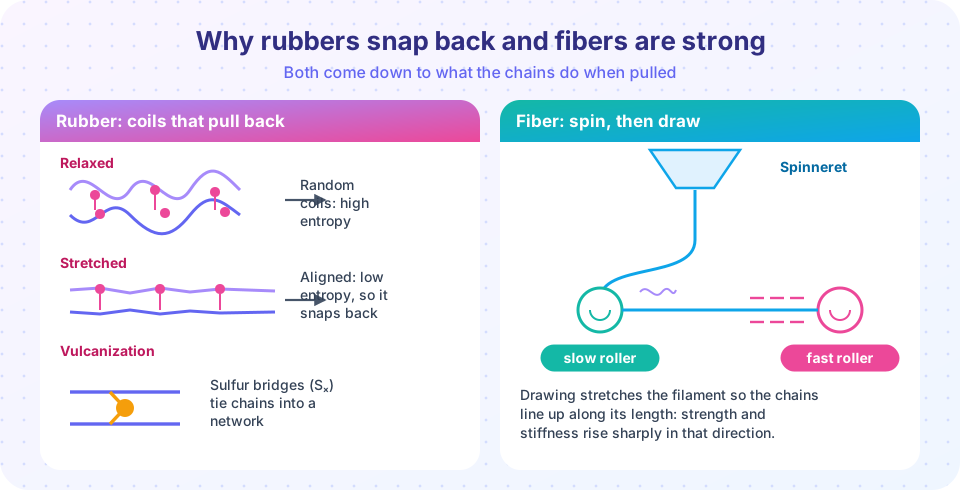
When you stretch a steel spring you stretch atomic bonds, and energy is stored in them. A rubber is different. Its chains are long, flexible and tangled. Between cross-links a chain segment adopts a random coil, which is the most probable shape because there are astronomically many ways to be coiled and very few ways to be straight. That count of arrangements is what physicists call entropy.
Stretching straightens the segments. The number of available arrangements drops, so entropy falls, and thermal motion pushes the chains back toward the more probable coiled state. The restoring force is therefore entropic: it arises from the tendency of disorder to increase, and it grows with temperature. Three consequences are surprising and easy to test:
- A rubber band that is held stretched and then heated contracts (the Gough–Joule effect). A steel wire would expand.
- Stretching a rubber band quickly warms it slightly, because the aligned chains give out heat; you can feel this against your lip.
- The stress needed for a given stretch is proportional to absolute temperature.
For an ideal network the stress needed to stretch by a ratio λ = L / L₀ is
σ = G (λ − 1/λ²) with G = ρ R T / Mc
where ρ is the density, R = 8.314 J mol⁻¹ K⁻¹, T the temperature in kelvin and Mc the average molar mass between cross-links. More cross-links (smaller Mc) mean a larger modulus G. With ρ = 920 kg/m³, T = 298 K and Mc = 5 kg/mol (5,000 g/mol), G ≈ 0.46 MPa, in the right range for a soft rubber band.
This is a model for modest stretches. Real rubbers stiffen at large extension because chains approach their full length, and filled rubbers (such as tire tread) also show energy loss on every cycle.
Vulcanization
Raw natural rubber, cis-1,4-polyisoprene from the Hevea tree, is sticky in heat, brittle in cold and flows slowly under load, because its chains are not connected. In 1839 Charles Goodyear discovered that heating rubber with sulfur transforms it, and the process was named after Vulcan, the Roman god of fire.
Sulfur adds bridges –Sₓ– between chains at the allylic positions next to the double bonds. A few percent sulfur gives a soft, elastic rubber; a much larger fraction gives a hard material known as ebonite. In modern practice the reaction is accelerated by organic compounds and zinc oxide, and antioxidants are added because the double bonds left in the chain are attacked by oxygen and ozone, which cracks rubber under strain.
Cross-linking brings three benefits: the rubber no longer flows, its stiffness hardly changes with temperature, and it recovers fully after deformation. It also means that vulcanized rubber cannot be remelted, which is a challenge for recycling tires.
The main elastomers
| Rubber | Structure highlight | Notable property | Typical use |
|---|---|---|---|
| Natural rubber (NR) | cis-polyisoprene, Tg about −70 °C | High strength, resilience | Tires, gloves, vibration mounts |
| SBR | Butadiene with about 25 % styrene | Abrasion resistance | Tire tread |
| BR (polybutadiene) | Very flexible chain, Tg about −100 °C | Low heat build-up | Tire sidewalls, impact modifier |
| NBR (nitrile) | Butadiene with acrylonitrile | Oil resistance | Seals, fuel hoses |
| EPDM | Ethylene–propylene with a diene | Weather and ozone resistance | Roofing, weatherstrips |
| Silicone | –Si(CH₃)₂–O– backbone, Tg about −125 °C |
Stable from cold to hot | Seals, medical tubing |
| TPE | Hard and soft blocks | Melts and reshapes | Soft grips, shoe soles |
Thermoplastic elastomers (TPEs) such as SBS block copolymers avoid chemical cross-links. Glassy polystyrene end blocks cluster into small domains that act as physical cross-links at room temperature but melt when heated, so the material is a rubber to use and a thermoplastic to process and recycle.
Fibers: strength from alignment
A fiber has a length at least a hundred times its diameter and is strong in the length direction. Most polymer fibers share a processing story: make a viscous liquid, extrude it through a spinneret (a plate with many tiny holes), solidify the filaments, then draw them.
- Melt spinning extrudes a molten polymer and cools it in air: nylon, polyester, polypropylene. It needs no solvent.
- Solution spinning is used when the polymer decomposes before melting or cannot melt. In dry spinning the solvent evaporates in warm air; in wet spinning the filament enters a bath where the polymer precipitates. Viscose rayon, acrylics and aramids are made this way.
- Gel spinning extrudes a dilute solution of ultrahigh molecular weight polyethylene (UHMWPE) so the chains are lightly entangled and can be drawn to extreme alignment.
Drawing is what turns a weak as-spun filament into a useful fiber. Pulling the cooled filament between rollers running at different speeds (see the figure) can stretch it several times its length. Chains slide, unfold and line up with the axis, and crystals align too. The result is a large jump in strength and stiffness along the fiber. Without drawing, nylon thread would be weak and easily stretched.
Notable fibers
- Nylon 6,6: invented by Wallace Carothers's group at DuPont in 1935 and commercialized from 1938. Tough, elastic and abrasion resistant: stockings, carpets, ropes.
- Polyester (PET): the most produced synthetic fiber; crease resistant and low cost.
- Aramids (Kevlar, Nomex): poly(p-phenylene terephthalamide) has rigid rod-like chains. Stephanie Kwolek at DuPont found in the 1960s that its solution in sulfuric acid is liquid-crystalline, which lets spinning produce nearly perfectly aligned chains. Body armor, tire cord and cables use it.
- UHMWPE fiber (Dyneema, Spectra): extremely strong for its weight and less dense than water.
- Carbon fiber: made by oxidizing and then carbonizing polyacrylonitrile (PAN) fibers at very high temperature; it appears in the composites chapter.
Fiber units
Because fibers are thin and irregular, their "thickness" is given as mass per length. Tex is grams per 1000 m; denier is grams per 9000 m, so denier = 9 × tex. Tenacity is breaking force divided by linear density (N/tex). Converting to engineering stress needs the density:
σ (GPa) = tenacity (N/tex) × density (g/cm³)
Common misconceptions
"A stretched rubber stores energy in stretched bonds." Mostly it stores a tendency toward disorder (entropy). Bond stretching contributes only at very large extension.
"All rubber comes from trees." Natural rubber does, but most rubber used today is synthetic (SBR, BR and others), made from petrochemical monomers.
"Strong fibers are just thin plastic." Strength comes from orientation and, in the best fibers, from rigid or very long chains. The same polymer as a molded block can be an order of magnitude weaker.
Try it
First, plot the stress needed to stretch rubbers with different cross-link densities. Compare a lightly cross-linked and a heavily cross-linked rubber, then change the temperature and watch the stress rise.
Press Run (or Ctrl + Enter) to see the result here.
Program input · what you'd type while the program runs
Type the answers before you press Run, one per line. Each time the program reads a line (with input()), it gets the next line from this box.
Second, a fiber calculator for linear density, tenacity and strength. It converts between tex and denier and then to gigapascals using the density.
Press Run (or Ctrl + Enter) to see the result here.
Program input · what you'd type while the program runs
Type the answers before you press Run, one per line. Each time the program reads a line (with input()), it gets the next line from this box.
Check your understanding
Quick check · 5 questions
of 5 answered You scored / 5 · perfect!
-
1. What is the main origin of the restoring force in a stretched rubber?
Stretching reduces the number of possible chain conformations; thermal motion drives the chains back toward the more probable random coils. -
2. A rubber band is held under constant load and heated. It will:
Because the restoring force is proportional to temperature, heating increases the pull of the chains and the band shortens (Gough–Joule effect). -
3. What does vulcanization do to natural rubber?
Sulfur bridges tie chains into a network, giving elasticity, strength and thermal stability. -
4. Why is drawing a filament so important for strength?
Aligned chains share load along their strong covalent backbones, giving large increases in strength and stiffness. -
5. A yarn has a linear density of 20 tex. What is it in denier?
Denier is mass per 9000 m, so 20 tex × 9 = 180 denier.
Summary
- Rubber elasticity is entropic: cross-linked chains uncoil under load and return to disorder. Stress rises with temperature and with cross-link density (
G = ρRT/Mc). - Vulcanization cross-links rubber with sulfur bridges so it does not flow; thermoplastic elastomers use physical cross-links instead.
- Fibers are spun by melt, solution or gel methods and then drawn; drawing aligns chains and multiplies strength along the axis.
- Fiber units: tex (g per 1000 m), denier (g per 9000 m), tenacity (N/tex);
σ (GPa) = tenacity × density.
Track your progress
Create a free account to tick off lessons and pick up where you left off on any device.
of Polymer and Materials Chemistry lessons completed