


















Lesson 32 of 47 · Advanced and Functional Materials
Chapter Overview: Advanced and Functional Materials
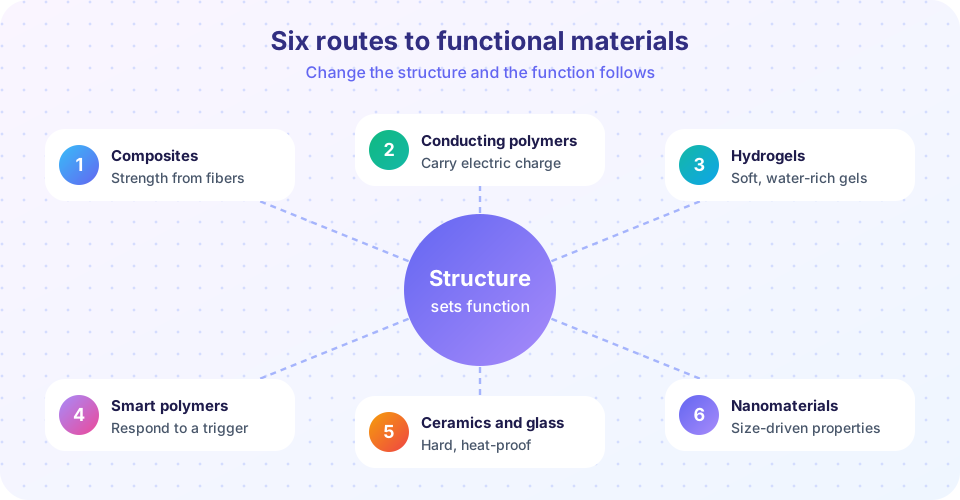
A map of advanced and functional materials: composites, conducting polymers, hydrogels, smart polymers, ceramics and nanomaterials, and how structure sets function.
So far the polymers in this course have been valued for what they are: strong, stretchy, moldable. Functional materials are valued for what they do: carry current, change shape when warmed, hold water like a sponge, keep a wing light yet stiff. The jump from "structural" to "functional" is not a change of chemistry so much as a change of design thinking. You choose the function first, then build the structure that delivers it.
This chapter introduces six families of advanced materials. Each lesson follows the same arc: what the structure is, why it produces the function, a calculation you can run, and where the material is used.
The big picture
Almost every advanced material is built from one of three design moves.
- Combine phases so that each does what it is best at. A fiber carries load, a matrix shares it: that is a composite. Add a nanoparticle to a rubber and the combination is stiffer and tougher than either part.
- Tune the electronic structure. Conjugation, then doping, turns an insulating chain into a semiconductor or a conductor.
- Build a responsive network. A cross-linked network whose swelling or shape depends on temperature, pH or light turns a small trigger into a large, useful change.
Underneath all three lies a theme you have met already: properties come from connectivity, order and interaction. A network that swells, a chain that conducts and a laminate that is stiff in one direction all follow from the same polymer physics you used for chain statistics and crystallinity.
Combine phases
Move electrons
Respond
Design rule
A short design vocabulary
- Anisotropy. Many functional materials have different properties in different directions, because their structure is directional (aligned fibers, aligned chains).
- Percolation. A property that depends on connectivity, such as conduction through a filler network, switches on sharply at a critical fraction.
- Stimulus and response. A trigger (temperature, pH, light) changes an interaction (hydrogen bonding, ionization, a bond geometry), which changes a measurable property (swelling, color, shape).
- Trade-offs. Gains in one property usually cost another. Stiff and tough are often in conflict; high conductivity may reduce flexibility; more filler raises stiffness but can make a melt hard to process.
What each lesson in this chapter covers
- Composites, ceramics and nanomaterials: the rule of mixtures, anisotropy, laminates, critical fiber length, sol-gel glass and nanoclay.
- Conducting polymers: conjugation, doping, polarons,
σ = n q μ, PEDOT:PSS, OLEDs and percolation. - Smart polymers and hydrogels: swelling ratio, PNIPAM and its LCST, pH response, shape memory and self-healing.
- Chapter review: one-page summary and a ten-question quiz.
Common misconceptions
"Advanced materials are always better materials." They are better for a function. A carbon-fiber panel is a poor choice for a disposable bag, and a PNIPAM gel is a poor choice for a car bumper.
"Smart means electronic." Many smart polymers have no electronics at all; their response is built into the molecular structure.
Try it
Practice linking a requirement to a design move. The helper below returns a suggested approach and a lesson to review for each requirement; extend the list with your own examples.
Press Run (or Ctrl + Enter) to see the console output here.
No output.
Next, a quick count of trade-offs. Each row lists a gain and what it usually costs; add your own rows.
Press Run (or Ctrl + Enter) to see the console output here.
No output.
Check your understanding
Quick check · 4 questions
of 4 answered You scored / 4 · perfect!
-
1. Which of these is a design move used in functional materials?
Combining phases lets each constituent do what it does best. -
2. What does anisotropic mean?
Aligned fibers and aligned chains give directional properties. -
3. A property that switches on sharply at a critical filler fraction is an example of:
Percolation: a continuous network of particles suddenly forms. -
4. Why is a PNIPAM-based gel attractive for biomedical use?
A transition near 32 to 37 °C lets body heat trigger the change.
Summary
- Functional materials are chosen for what they do; the structure is designed to deliver the function.
- Three design moves cover most cases: combine phases, tune electronic structure, build responsive networks.
- Anisotropy, percolation, stimulus-response and trade-offs recur throughout the chapter.
Track your progress
Create a free account to tick off lessons and pick up where you left off on any device.
of Polymer and Materials Chemistry lessons completed