


















Lesson 41 of 47 · Sustainability and Recycling
Chapter Review: Sustainability and Recycling
Review bio-based versus biodegradable, recycling routes, loop yield, life cycle assessment and microplastics with a summary table, formulas and a ten-question quiz.
This chapter swapped slogans for definitions and calculations. Bio-based and biodegradable turned out to be separate questions. Recycling turned out to be a chain of imperfect steps, each with a yield. Life cycle assessment showed that the unit you compare per, and the number of reuses, can decide the answer. And microplastics showed why particle size changes everything.
Use this page to check that the pieces fit together, then try the ten-question quiz, which mixes the chapter.
Formulas and facts to keep
Loop yield:            y = c × s × p                 (collection × sorting × process)
After n trips:         y^n of the original remains
Mn after n cycles:     1/Mn,n = 1/Mn,0 + n k
Reuse break-even:      n > E_r / (E₁ − w)
Particles per gram:    N = 6 / (π ρ d³)      Surface per gram: 6 / (ρ d)
Arrhenius ratio:       k(T)/k(Tref) = exp[(Ea/R)(1/Tref − 1/T)]
| Fact | Detail |
|---|---|
| Bio-based vs. biodegradable | Independent; bio-PE is bio-based and persistent; PBAT is fossil and biodegradable |
| PLA | Ring-opening of lactide; Tg about 60 °C; composts at about 58 °C |
| Recycling limits | Contamination, chain scission, additive build-up |
| Chemical recycling | Depolymerization back to monomers or feedstocks; energy-intensive |
| LCA phases | Goal and scope, inventory, impact assessment, interpretation |
| Microplastic size | 1 µm to 5 mm (nano: below about 1 µm) |
How the lessons connect
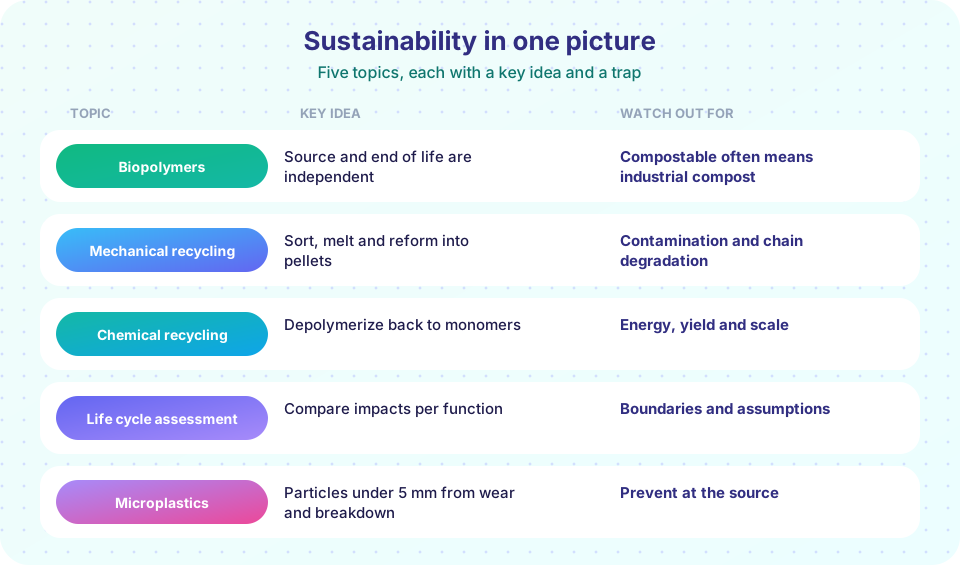
The four lessons of this chapter are really one argument seen from different sides. Bio-based and biodegradable are separate properties, so a label can be true and still misleading. Recycling is a chain of steps, each with a yield and each with a quality cost, so the product of the yields caps what a recycling system can deliver. Life cycle assessment says that every comparison needs a function, a boundary and honest assumptions, and that the number of times a container is reused can matter more than the polymer it is made of. Microplastics remind us that the environmental problem is not only about the mass of plastic but also about how it is distributed: the same gram can be a bottle cap or trillions of particles.
A useful mental routine is to ask four questions of any claim: where did the carbon come from, what happens at end of life, what is the system boundary, and what is the unit of comparison. Most weak claims fail at least one of them.
Self-check list
Make sure you can do each of these without notes:
- Place PLA, PBAT, bio-PE and PET in the two-by-two matrix and explain each placement.
- Explain why a PLA cup survives in a garden but disintegrates in an industrial composter, using the Arrhenius ratio.
- Compute a loop yield from three efficiencies and the fraction left after several trips.
- Explain why a recycled-content target above the loop yield is impossible in a steady state.
- Derive the reuse break-even number of trips from the formula.
- Explain how particle number and surface area change when diameter shrinks by a factor of ten.
If a line is shaky, return to the matching lesson and rerun its Try it cell.
Try it
Recompute the headline numbers in one go and change at least one input to see the sensitivity.
Press Run (or Ctrl + Enter) to see the result here.
Program input · what you'd type while the program runs
Type the answers before you press Run, one per line. Each time the program reads a line (with input()), it gets the next line from this box.
Check your understanding
Quick check · 10 questions
of 10 answered You scored / 10 · perfect!
-
1. Which pair is correct?
PBAT is made from fossil feedstock but is a biodegradable copolyester. -
2. Why does a PLA cup survive in a garden but not in an industrial composter?
Higher temperature accelerates hydrolysis and lets water enter the chains. -
3. A recycling loop has c = 0.7, s = 0.9 and p = 0.9. What is y?
0.7 × 0.9 × 0.9 = 0.567. -
4. After three trips with y = 0.5, what fraction of the original polymer remains?
0.5³ = 0.125. -
5. Which is chemical recycling?
Methanolysis breaks PET into DMT and ethylene glycol. -
6. In an LCA, the functional unit is:
All alternatives are scaled to the same function. -
7. A reusable bottle has E_r = 0.50, wash w = 0.05 and the single-use bottle has E₁ = 0.10 (kg CO₂e, illustrative). Break-even trips are:
n > 0.50 / (0.10 − 0.05) = 10. -
8. A 3 mm pellet is classified as:
Particles up to 5 mm count as microplastics under the common convention. -
9. If particle diameter drops from 100 µm to 10 µm at constant mass, the particle count grows by:
N is proportional to 1/d³, so a tenfold decrease gives 10³ = 1000 times more particles. -
10. Which statement best summarizes the state of knowledge on microplastics?
Microplastics are found widely, but how much harm they do at real exposure is still under research.
Summary
- Keep source (bio-based or fossil) and end of life (biodegradable or persistent) as separate questions.
- Recycling is limited by sorting, contamination and chain degradation; loop yield compounds, so reduction and reuse come first.
- LCA compares systems per function and is only as good as its boundary and assumptions; reuse counts often decide the result.
- Microplastics are defined by size (1 µm to 5 mm), form by fragmentation or are manufactured small, and scale as
1/d³in number. - The last chapter puts everything together in projects and practice.
Track your progress
Create a free account to tick off lessons and pick up where you left off on any device.
of Polymer and Materials Chemistry lessons completed