


















Lesson 27 of 47 · Plastics, Rubbers and Fibers
Chapter Overview: Plastics, Rubbers and Fibers
See how thermoplastics, thermosets, elastomers and fibers differ in structure, heating behavior and stress-strain response before diving into each family.
Look around your room. A water bottle, a rubber band, a nylon jacket and an epoxy-coated circuit board are all polymers, yet nobody would confuse them. One is rigid and recyclable, one stretches to several times its length, one is a thread you can weave and one will burn rather than melt. The difference is not the chemistry of a single bond but how the chains are arranged and connected.
This chapter organizes the whole world of everyday polymers into four families and shows what each is good for. If the characterization chapter taught you how to look at a polymer, this one teaches you what you are likely to find.
The big picture
Two questions sort almost any polymer into a family.
1. What happens when you heat it? If it softens and can be shaped again and again, its chains are separate and held by weak secondary forces: it is a thermoplastic. If it stays solid until it chars, its chains are tied into one covalent network: it is a thermoset.
2. What happens when you pull it? If it stretches a little, then yields or breaks, it behaves as a plastic. If it stretches several times its length and snaps back, it is an elastomer. If it hardly stretches but carries enormous load for its weight along one direction, it is a fiber.
Those two questions interact. A rubber is a lightly cross-linked network, so it is thermoset-like in heat behavior but extremely flexible in its response to force. A fiber is usually a thermoplastic (nylon, polyester) whose chains have been aligned by drawing, so it is a plastic processed in a way that exploits its chain direction.
Thermoplastics
Thermosets
Elastomers
Fibers
What decides it
Reading the stress-strain picture
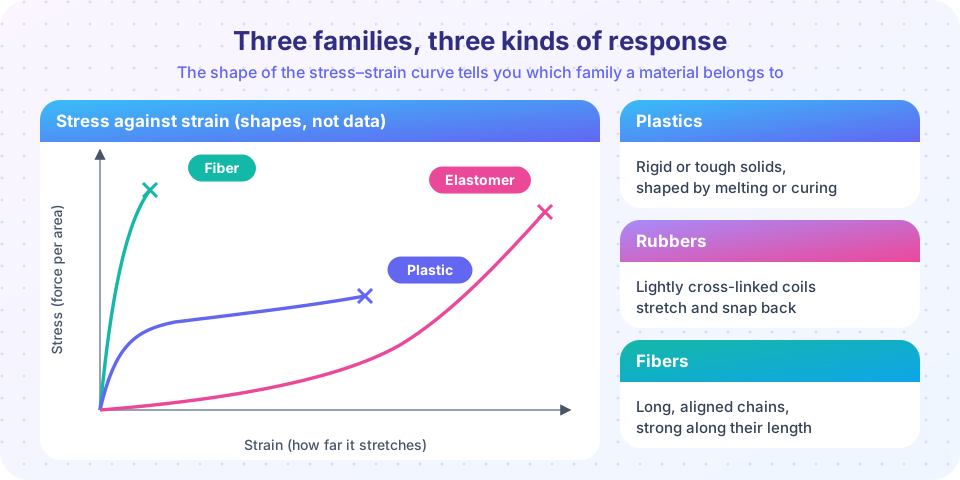
The chart above is the single most useful diagram in this chapter. Stress is force divided by cross-sectional area; strain is the fractional change in length. The slope at the start is the stiffness (Young's modulus), the highest point is the strength and the right-hand end is the elongation at break.
- The fiber curve is steep and ends early: very high modulus, high strength, low elongation.
- The plastic curve climbs, bends over at the yield point where chains start to slide past each other for good, then often continues as the material "draws" or necks, and finally breaks.
- The elastomer curve is shallow because uncoiling chains costs very little energy, and it can stiffen near the end as the chains run out of slack.
Modulus spans about five orders of magnitude from a soft rubber (around a megapascal) to a drawn aramid fiber (around a hundred gigapascals). Few other material properties vary so widely within one chemical class, and this is why polymers can replace everything from rubber bands to steel cables.
What each lesson in this chapter covers
- Commodity plastics: the seven resin codes (PET, HDPE, PVC, LDPE, PP, PS and others), their structures, properties and the processing routes that turn pellets into products.
- Engineering plastics and thermosets: nylon, polycarbonate, PEEK, epoxy and phenolic resins, plus gelation theory for networks.
- Rubbers and fibers: rubber elasticity, vulcanization, and how spinning and drawing create strong fibers.
- Chapter review: a four-family comparison and a ten-question quiz.
Common misconceptions
"Plastic" means one material. The word names a family of hundreds of chemically different polymers with very different properties, recyclability and safety profiles.
"Rubber is a thermoplastic that happens to stretch." Conventional rubbers are chemically cross-linked, so they do not melt and cannot be simply remolded. Thermoplastic elastomers are the special case that behave like rubber at room temperature but flow when hot.
Try it
The console below classifies a material from three observations. Change the observations and predict the answer first; note that "stretches a lot and recovers" outranks the heat behavior in this simplified rule.
Press Run (or Ctrl + Enter) to see the console output here.
No output.
The second example plots approximate stiffness (Young's modulus, in gigapascals) of familiar polymers on a log scale. The values are typical textbook figures and vary with grade, processing and temperature, so read the picture, not the digits.
Press Run (or Ctrl + Enter) to see the result here.
Program input · what you'd type while the program runs
Type the answers before you press Run, one per line. Each time the program reads a line (with input()), it gets the next line from this box.
Check your understanding
Quick check · 4 questions
of 4 answered You scored / 4 · perfect!
-
1. A material softens when heated and can be re-molded many times. It is a:
Separate chains held by secondary forces can flow when heated, so the material can be reshaped repeatedly. -
2. What best explains why a rubber band does not melt?
Cross-links tie the chains together, so they cannot flow past each other even when hot. -
3. On a stress-strain chart, which curve belongs to a fiber?
Aligned chains give high stiffness and strength but little extension. -
4. The yield point of a plastic is where:
Beyond yield the deformation no longer recovers fully.
Summary
- Four families cover everyday polymers: thermoplastics, thermosets, elastomers and fibers.
- Heat behavior depends on connectivity (separate chains versus a network); mechanical behavior depends on chain order and cross-link density.
- The stress-strain curve is the fingerprint: fiber steep and short, plastic yielding, elastomer shallow and long.
- Polymer stiffness spans roughly five orders of magnitude, from soft rubber to aramid fiber.
Next: Commodity plastics
Track your progress
Create a free account to tick off lessons and pick up where you left off on any device.
of Polymer and Materials Chemistry lessons completed