


















Lesson 5 of 47 · Getting Started
Chapter 1 review: getting started
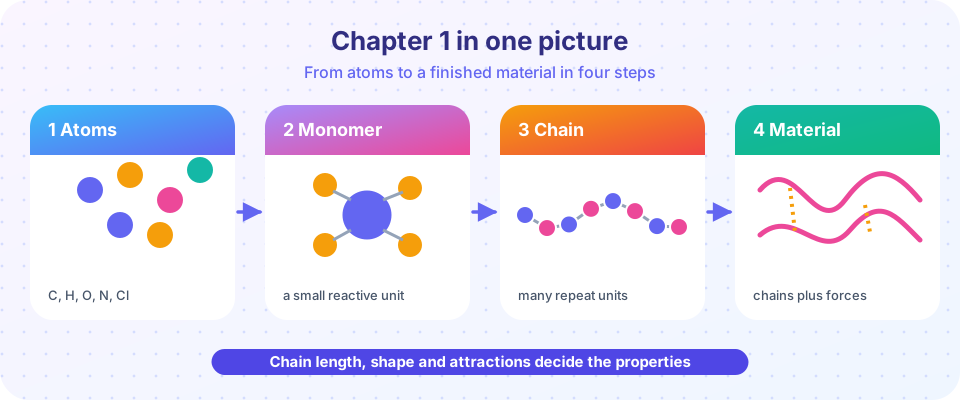
Review chapter 1 with a one-page picture, a recap table, flashcards and a ten-question quiz covering polymer history, bonds, forces, thermodynamics and material families.
You have met the main characters of the course: monomers that join into chains, the covalent bonds that hold chains together, the weaker forces that hold chains to each other, and the four families of materials that engineers choose between. This review pulls the chapter into one picture, gives you a table to check your memory against, and ends with a longer quiz that mixes all four lessons. Try the flashcards and the quiz before you read the recap table, then use the table to find the gaps.
Recap table
| Lesson | The idea to remember |
|---|---|
| Course map | Nine chapters move from chain to material to frontier; study actively and revisit old quizzes. |
| A short history | Vulcanization (1839) and Bakelite (1907) showed chemical design; Staudinger (1920) proved polymers are covalent macromolecules; Carothers and Flory explained step-wise growth; Ziegler and Natta added stereocontrol; living and controlled polymerization added control of length and sequence. |
| Chemistry refresher | Covalent bonds (C–C about 347 kJ/mol) hold chains; dispersion, dipole, hydrogen and ionic forces hold chains to each other; ΔG = ΔH − TΔS with both ΔH and ΔS negative gives a ceiling temperature Tc = ΔHp/ΔSp. |
| Materials families | Metals, ceramics, polymers and composites differ in bonding, density, stiffness and failure; compare with specific stiffness E/ρ and Ashby charts. |
How the four lessons connect
The lessons of this chapter form a chain of reasoning. The course map told you where you are going. The history lesson showed that polymer science advanced each time chemists gained a new kind of control: control of the network (vulcanization), of the molecule (Staudinger's proof and Carothers's design), of the three-dimensional structure (Ziegler and Natta) and of the length and sequence (living and controlled methods). The chemistry refresher then explained what makes such control possible: strong covalent links inside the chain, weak forces between chains, and a thermodynamic balance that decides whether monomers will link at all. Finally the materials lesson placed polymers among the other families, so that you can see why they are chosen and when they are not.
If you want to test your understanding rather than your memory, try to explain each of these in two sentences without looking: why a polymer has no boiling point, why polymerization needs a driving force despite releasing heat, why an oriented polyethylene fiber can be stronger than steel by weight, and why a ceramic that is stiffer than steel is still a poor choice for a tool handle that may be dropped. If a sentence stalls, return to the lesson that covers it.
Key numbers worth knowing
- Repeat unit of polyethylene: –CH₂–CH₂–, 28.05 g/mol.
- Covalent bond: roughly 150 to 950 kJ/mol; hydrogen bond: about 10 to 40; dipole-dipole: 5 to 25; dispersion: 0.1 to 10 per contact.
- Polymerization of ethylene: ΔH about −93 kJ/mol, ΔS about −155 J/(mol·K).
- Densities: HDPE about 0.95 g/cm³, steel 7.8, alumina 3.9, CFRP about 1.6.
- Stiffness: plastics 1 to 4 GPa, steel about 200 GPa, alumina about 380 GPa, rubbers a few MPa.
Self-test strategy
Retrieval beats rereading. Look at each card below, say the answer aloud, then flip it. Put the cards you missed into a second pile and try them again tomorrow. When you can answer from memory, take the quiz without notes. After the quiz, reread only the explanations for the questions you missed.
Common misconceptions to double-check
"Polymerization always works if the monomer has a double bond." Thermodynamics and kinetics both matter; above the ceiling temperature chains unzip.
"Plastics, polymers and macromolecules are exact synonyms." Polymers are macromolecules made of repeat units; plastics are only one use of polymers.
"A material has one stiffness." Stiffness depends on direction (composites), temperature (polymers) and loading time.
Try it
Flashcards for the chapter: click a card to flip it. The cards are a study aid, not a test of anything beyond what the lessons taught.
Check your understanding
Quick check · 10 questions
of 10 answered You scored / 10 · perfect!
-
1. Who is credited with the macromolecule hypothesis?
Staudinger argued in 1920 that polymers are long chains held by covalent bonds. -
2. Bakelite is an example of a
Bakelite cures into a permanent crosslinked network, which makes it a thermoset. -
3. Which advance in the 1950s allowed control of how side groups are arranged in space?
Natta's catalysts made isotactic polypropylene, with all methyl groups on the same side. -
4. Rank these from weakest to strongest per interaction: covalent bond, dispersion contact, hydrogen bond.
Typical ranges are dispersion 0.1 to 10, hydrogen bond 10 to 40, covalent 150 and above kJ/mol. -
5. For a vinyl monomer, which signs do ΔH and ΔS of polymerization usually have?
Forming a σ bond releases heat while fixing monomers in a chain lowers entropy. -
6. Poly(α-methylstyrene) has a low ceiling temperature mainly because
With a small |ΔHp| the −TΔS term overcomes it at a modest temperature. -
7. Which material is best described as ductile with a sea of shared electrons?
Metals have nondirectional metallic bonding, which lets planes of atoms slide. -
8. A carbon-fiber composite is anisotropic because
Aligned fibers give high stiffness along their direction and much lower stiffness across. -
9. Which has the highest specific stiffness (E/ρ) among these typical values?
CFRP gives about 81, steel about 25, glass about 28 and HDPE about 1 GPa per g/cm³. -
10. Why does polyethylene have no boiling point at normal pressure?
The total attraction grows with chain length until bonds break before the chain can leave the liquid.
Summary
- A polymer is a chain of repeat units; materials combine chains, forces and processing.
- History shows a pattern: each new tool of control (crosslinks, catalysts, living chains) opened new materials.
- Bond strengths and weak forces explain thermal behavior; ΔH and ΔS explain whether chains form at all.
- Metals, ceramics, polymers and composites trade off density, stiffness and failure mode.
Track your progress
Create a free account to tick off lessons and pick up where you left off on any device.
of Polymer and Materials Chemistry lessons completed