


















Lesson 39 of 47 · Sustainability and Recycling
Recycling Polymers
How plastics are sorted and recycled: mechanical and chemical routes, why quality drops each cycle, and how to calculate loop yield and molar-mass loss.
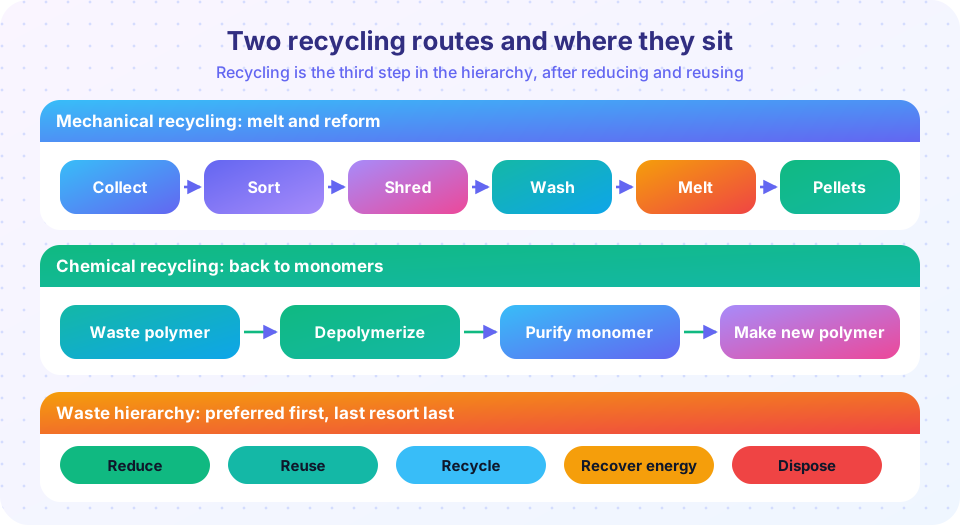
Recycling a plastic bottle sounds simple: collect it, melt it, make a new one. In practice almost every step fights the chemistry. Bottles are mixed with other plastics, labels, glues and food residue; the polymer chains are shortened each time they are melted; and the market must want the recycled material at a price that makes the loop work.
This lesson follows plastic through a recycling plant, compares mechanical and chemical recycling, explains why quality tends to fall each cycle and gives you two simple calculations that show why recycling alone cannot close the loop.
What you will learn
- Describe how plastics are sorted, including density and spectroscopic methods.
- Compare mechanical and chemical recycling and their limits.
- Explain why molar mass drops and quality falls over repeated cycles.
- Calculate loop yield, recycled content limits and molar-mass loss per cycle.
Key terms
Mechanical recycling: shredding, washing and melting plastic into new pellets without changing its chemistry.
Chemical recycling: breaking polymers down to monomers or other chemicals that can be made into new polymer.
Downcycling: reuse in a lower-value application, such as turning bottles into fleece or park benches.
Closed-loop recycling: reuse in the same application, such as bottle to bottle.
Contaminant: material that harms the quality of the recycled polymer, such as PVC in PET.
From bin to flake: sorting
Quality starts with sorting, because different polymers do not mix well. Most polymer pairs are immiscible: melted together they separate into droplets, and the blend is weak and brittle at the interfaces. Even a small amount of PVC in PET releases HCl at PET processing temperatures and ruins the batch.
Plants combine several tools:
- Near-infrared (NIR) sorting. A belt of items passes under an NIR light source; each polymer has a characteristic spectrum (the same principle as the FTIR in the characterization chapter), and a computer fires a puff of air to eject the target. Black plastics are hard because carbon black absorbs NIR.
- Density separation. After shredding, flakes go into water. PE and PP float; PET, PVC and PS sink. Adjusted liquids (brine) separate further.
- Color sorting and metal removal with cameras, magnets and eddy currents.
- Washing, hot caustic baths and friction to remove labels, glue and food.
The better the sorting, the more valuable the output. Deposit-return systems for bottles deliver an exceptionally clean stream, which is why many bottle-to-bottle systems depend on them.
Mechanical recycling
After sorting and washing, flakes are dried, melted in an extruder, filtered to remove debris, and cut into pellets. The pellets are sold to converters.
What goes wrong during melting
Each pass through an extruder exposes the polymer to heat, shear, oxygen and water, which cause chain scission and sometimes cross-linking. The result is a drop in molar mass and in properties.
- PET is especially sensitive to water: at melt temperature residual moisture hydrolyzes ester links and shortens chains, so flakes must be dried to a very low moisture. Food-grade rPET restores molar mass with solid-state polycondensation, heating pellets below their melting point under vacuum so chains reconnect.
- Polyolefins (PE, PP) tend to degrade by oxidation; processors add antioxidants and sometimes mix in virgin polymer to maintain performance. PE can cross-link while PP tends to chain-scission.
- Additives accumulate. Pigments, fillers and stabilizers remain in the material, along with unknown substances from earlier uses, which is a concern for food contact.
The net effect is that mechanical recycling usually gives a polymer of slightly lower quality each time. In practice it is topped up with virgin material, or used in less demanding products.
Calculating the loss: molar mass per cycle
If each cycle introduces a roughly constant number of chain scissions per gram, the number-average molar mass drops according to
1 / Mn,n = 1 / Mn,0 + n k
where k is the moles of new chain ends created per gram in one cycle. For a polymer with Mn,0 = 40,000 g/mol and k = 2 × 10⁻⁶ mol/g, after one cycle Mn = 37,037 and after five Mn = 28,571 g/mol: a loss of about 29 % in Mn from five cycles, with the largest drop in the first few.
Chemical recycling
Chemical routes aim to reverse the polymerization or to break the polymer into simple chemicals, so purity limits matter less. Main routes:
- Solvolysis (depolymerization with a reagent). PET can be broken by glycol (glycolysis), methanol (methanolysis) or water (hydrolysis) into monomers such as BHET, dimethyl terephthalate or terephthalic acid and ethylene glycol, which are purified and repolymerized. Engineered enzymes that break down PET have also been demonstrated at pilot scale, though economics are still developing.
- Thermal depolymerization of polymers that unzip. PMMA heated strongly gives back much of its monomer (MMA); polystyrene yields styrene along with other products; nylon 6 can be returned to caprolactam. These work best on clean, single-polymer streams.
- Pyrolysis heats mixed polyolefins without oxygen to produce an oil (and gas and char) that can be fed to a refinery or cracker. It tolerates contamination but is energy-intensive, its yields and the share that really becomes new plastic (rather than fuel) are debated.
- Gasification makes synthesis gas (CO and H₂).
Chemical recycling is not a replacement for mechanical recycling: it usually needs more energy and capital, it is not yet at large scale for most polymers, and it works best for streams mechanical recycling cannot handle (colored, multilayer or contaminated polyester, nylon carpets).
Thermosets and tires
Cross-linked materials cannot be remelted. Options include grinding to a filler, devulcanization (selectively breaking sulfur links), pyrolysis and use of tire crumb in asphalt or playground surfaces. A newer approach uses vitrimers, networks with exchangeable covalent bonds that can be reshaped on heating, though they are not yet commonplace.
Design for recycling
The cheapest way to recycle well is to make products that are easy to recycle:
- Mono-material packaging, such as an all-PE pouch instead of a laminate of PET, aluminum and PE.
- Compatible closures and labels, with caps in PP or HDPE (which float, unlike PET) and labels that wash off.
- Light colors, no carbon black, and additives that do not interfere.
- Minimize additives and fillers, and use standardized formulations.
Why recycling alone cannot close the loop
Every loop loses some material to leakage, rejection and processing. Suppose the share of polymer collected is c, the share correctly sorted is s and the process yield is p. The loop yield is y = c × s × p. For c = 0.6, s = 0.9 and p = 0.9, y = 0.486: after one trip fewer than half of the polymer atoms are back, and after three trips about 11 %.
A second consequence is a hard limit on recycled content. If a product is made from a fraction r of recycled material and the system returns a fraction y of the product mass at each cycle, then in a steady-state non-growing system the recycled share cannot exceed y. A target of 100 % recycled content is impossible without growth in material demand, because there are always losses to make up from fresh sources.
Common misconceptions
"The recycling symbol means it is recycled." It identifies the polymer. Whether it is collected, sorted and used depends on local systems.
"Plastic can be recycled forever." Mechanical recycling shortens chains and accumulates contaminants, so quality falls. Chemical recycling can restore quality but costs energy.
"One dirty item does no harm." A single PVC cap or an oily container can contaminate a batch, which is why sorting and clean collection matter so much.
Try it
First, the loop yield and the fraction of the original material remaining. Adjust each efficiency to find which one improves the result the most.
Press Run (or Ctrl + Enter) to see the result here.
Program input · what you'd type while the program runs
Type the answers before you press Run, one per line. Each time the program reads a line (with input()), it gets the next line from this box.
Second, molar-mass loss with repeated melting, using the model from the lesson. Compare different scission rates, and note how much of the drop happens in the first cycles.
Press Run (or Ctrl + Enter) to see the result here.
Program input · what you'd type while the program runs
Type the answers before you press Run, one per line. Each time the program reads a line (with input()), it gets the next line from this box.
Third, a sink-float planner: given the density of the wash liquid, which flakes sink and which float?
Press Run (or Ctrl + Enter) to see the console output here.
No output.
Check your understanding
Quick check · 5 questions
of 5 answered You scored / 5 · perfect!
-
1. Why is PVC a serious contaminant in PET recycling?
PVC dehydrochlorinates around 150 °C, below PET's melt temperature, damaging the PET and discoloring it. -
2. Which method separates PE and PP from PET, PVC and PS flakes in water?
PE and PP are less dense than water and float; the others sink. -
3. A loop has collection 0.8, sorting 0.9 and processing 0.95. Its loop yield is about:
0.8 × 0.9 × 0.95 = 0.684. -
4. Which is chemical recycling?
Chemical recycling breaks the polymer down to monomers or other chemicals that are repolymerized. -
5. Why does mechanical recycling usually lower quality over cycles?
Chain scission lowers molar mass and additives and contaminants build up, so performance declines.
Summary
- Sorting by NIR, density, color and washing determines the value of recycled plastic; mixed polymers do not blend well.
- Mechanical recycling melts and reforms; it shortens chains (
1/Mn,n = 1/Mn,0 + nk) and accumulates contaminants. Chemical recycling returns to monomers or feedstocks but is energy-intensive and still scaling. - Loop yield
y = c × s × pcompounds: recycled content cannot exceed the loop yield in a steady state. - Design for recycling (mono-materials, compatible closures, light colors) is the most effective lever.
Track your progress
Create a free account to tick off lessons and pick up where you left off on any device.
of Polymer and Materials Chemistry lessons completed