


















Lesson 11 of 47 · Polymerization Mechanisms
Chapter 3 overview: polymerization mechanisms
Get the big picture of how polymer chains are built: step-growth versus chain-growth, living and controlled methods, coordination catalysis and ring-opening, and how to choose among them.
You know what a polymer chain looks like. This chapter explains how it gets that way. The mechanism by which monomers join decides almost everything a chemist cares about: how long the chains are, how uniform they are, what end groups they carry, whether side groups are arranged in order, and even which monomers can be used. Two polymers with identical repeat units can come from different mechanisms and behave differently. Here is the map of the chapter before you walk through it.
What you will learn
- The two fundamental ways chains grow: step-growth and chain-growth
- Why the old addition/condensation split was replaced by a mechanism-based view
- What living, coordination and ring-opening polymerization add
- How to choose a mechanism for a given monomer and target polymer
Two basic strategies
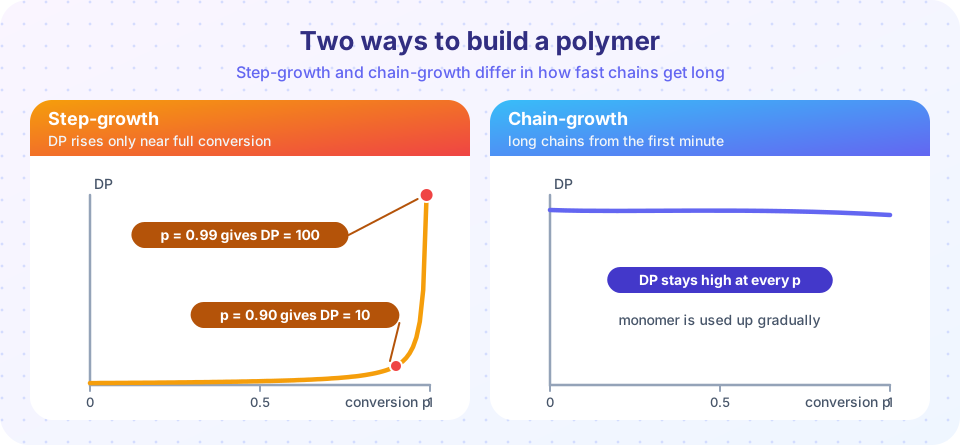
Step-growth polymerization. Any two molecules that carry reactive groups can react: monomers join to form dimers, dimers join to form tetramers, and so on. Growth is a series of equal "steps" between species of every size. Monomer disappears early, but the chains are short until the very end of the reaction. To obtain high molar mass you need extremely high conversion, 99 percent or more. Polyesters, polyamides, polyurethanes and polycarbonates are made this way.
Chain-growth polymerization. Only an active chain end (a radical, an anion, a cation, or a metal-bound carbon) can add monomer. A chain is started, grows rapidly, adding hundreds or thousands of monomers in a fraction of a second to seconds, and then stops. At any moment the reaction mixture holds monomer and finished high-molar-mass chains, with very few growing chains between. Vinyl polymers such as polyethylene, polystyrene, PVC and PMMA come from chain-growth.
The difference shows up in the graph above. In step-growth the average degree of polymerization is 1/(1−p), where p is the fraction of functional groups that have reacted. At 90 percent conversion the chains are on average only 10 units long; at 99 percent, 100. In chain-growth, long chains exist from the first minute.
| Feature | Step-growth | Chain-growth |
|---|---|---|
| What reacts | any two functional groups | an active end with a monomer |
| Species during reaction | monomer, dimers, trimers... all sizes | monomer and long polymer, few growing chains |
| Molar mass vs conversion | rises late, needs p > 0.99 | high early, nearly constant |
| Byproduct | often (water) | none |
| Examples | nylon, PET, polyurethane | PE, PS, PVC, PMMA |
From addition and condensation to mechanism
Carothers in the 1920s and 30s classified polymers as addition (no small molecule lost) or condensation (small molecule lost). That works in many cases but misleads in some. Polyurethane forms without any byproduct but grows by steps. Nylon 6 made by ring opening of caprolactam loses nothing yet is a polyamide. Flory proposed to classify by how chains grow, which is what controls molar mass, distribution and processing. This chapter uses Flory's mechanism-based scheme.
The five lessons ahead
| Lesson | What it adds |
|---|---|
| Step-growth polymerization | The Carothers equation, stoichiometric balance, gelation, nylon and PET. |
| Radical chain polymerization | Initiation, propagation, termination, kinetics and chain transfer; PE, PS, PMMA, PVC. |
| Living and controlled polymerization | Anionic living chains, ATRP, RAFT and nitroxide-mediated routes; narrow distributions and block copolymers. |
| Coordination and ring-opening polymerization | Ziegler–Natta and metallocene catalysts, stereocontrol, ROP and ROMP. |
| Chapter 3 review | A comparison table and a long quiz. |
Two ways to grow a chain
Add control
Choosing a route
How to choose
Ask three questions. What functional groups does the monomer have? A vinyl group suggests chain-growth (radical, ionic or coordination), two reactive end groups suggest step-growth, and a strained ring suggests ring-opening. What structure do you want? Narrow distributions and block copolymers need living or controlled methods; stereoregular chains need coordination catalysts; very high molar mass is easy in chain-growth but demands extreme purity in step-growth. What can you afford? Free-radical polymerization is cheap and robust to impurities, living anionic polymerization needs rigorous purification, and metal catalysts need care and recovery.
Try it
This explorer shows the contrast in the hero picture with numbers you control. Slide the conversion and see the average degree of polymerization of a step-growth reaction; the chain-growth value stays high from the start. The chain-growth number is a typical illustrative value, not a prediction for a specific monomer.
Check your understanding
Quick check · 3 questions
of 3 answered You scored / 3 · perfect!
-
1. In step-growth polymerization, what conversion is needed for an average DP of 100?
DP = 1/(1−p), so DP = 100 needs p = 0.99. -
2. Which polymer is made by chain-growth?
Polystyrene forms from a vinyl monomer by chain-growth; the other three grow stepwise. -
3. Why is the addition/condensation classification not always reliable?
Polyurethane is formed with no byproduct but by a step-growth mechanism, so the byproduct test misclassifies it.
Summary
- Polymer chains grow in two ways: step-growth (any ends react, long chains only near full conversion) and chain-growth (active ends add monomer, long chains from the start).
- Mechanism, not byproducts, is the useful basis for classification.
- Living/controlled, coordination and ring-opening methods add control over length, sequence and stereochemistry.
- Choose by monomer functional groups, target structure and cost.
Track your progress
Create a free account to tick off lessons and pick up where you left off on any device.
of Polymer and Materials Chemistry lessons completed