


















Lesson 38 of 47 · Sustainability and Recycling
Biopolymers and Biodegradable Plastics
Learn the difference between bio-based and biodegradable polymers, how PLA, PHA, starch and bio-PE are made, and what composting standards actually require.
Few words in polymer science are used as loosely as "bioplastic". It can mean a plastic made from plants, a plastic that rots in a compost heap, both, or neither. A bottle made from sugarcane ethanol can be chemically identical to a bottle made from oil; a bag made from oil can break down in soil faster than one made from corn. Keeping the ideas separate is the most useful skill you can take away from this lesson.
We will start with that distinction, then meet the main families of biopolymers, see how biodegradation works at the molecular level and why temperature controls it so strongly, and finish with the standards behind the word "compostable".
What you will learn
- Separate bio-based content from biodegradability and place common polymers in the matrix.
- Describe how PLA, PHA, starch blends and bio-PE are made and used.
- Explain the steps of biodegradation and the effect of temperature on hydrolysis.
- Interpret composting standards and the problem with "oxo-degradable" plastics.
Key terms
Bio-based: made wholly or partly from renewable biological carbon (plants, algae, microbes).
Biodegradable: broken down by microorganisms into CO₂ (or methane), water and biomass under stated conditions.
Compostable: biodegradable within a specified time in a composting system, according to a standard.
Hydrolysis: reaction with water that cleaves ester or amide bonds in the polymer backbone.
Mineralization: complete conversion of the polymer carbon to CO₂ by microorganisms.
Two independent questions
Where did the carbon come from? If it was captured from the atmosphere by plants in recent years, the polymer is bio-based. If it came from oil or gas, it is fossil-based. What happens at end of life? If microorganisms can digest it, it is biodegradable; if not, it persists.
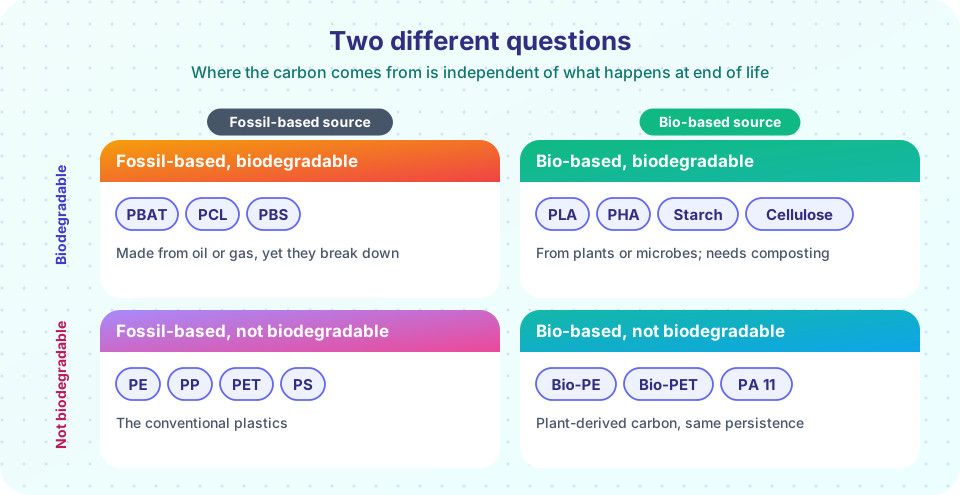
The two questions give four combinations, as the matrix shows:
- Fossil-based and not biodegradable: the conventional plastics (PE, PP, PET, PS).
- Bio-based and not biodegradable ("drop-in" polymers): bio-PE made from sugarcane ethanol (dehydrated to ethylene, then polymerized) is chemically identical to fossil PE. Bio-PET uses ethylene glycol from bioethanol while the terephthalic acid is usually still fossil-based. Polyamide 11 is made from castor oil.
- Bio-based and biodegradable: PLA, PHAs, starch blends, cellulose-based materials.
- Fossil-based and biodegradable: PBAT, PCL and PBS, flexible polyesters that microbes can digest even though they come from oil.
Drop-in bio-polymers have an important advantage: they use existing recycling systems, because a recycler cannot tell bio-PE from fossil PE. Biodegradable polymers can contaminate those same systems if they end up in the wrong bin.
How much of a polymer is really "bio-based"?
Bio-based content is measured by carbon-14 analysis (fossil carbon contains none, because its ¹⁴C has decayed away) and is usually given as a percentage of carbon. A PET repeat unit contains 10 carbons: 8 in terephthalate and 2 in ethylene glycol. If only the glycol is bio-based, the polymer is 20 % bio-based by carbon, even though the glycol makes up about 32 % of the mass. Check which basis a claim uses.
The main biodegradable and bio-based polymers
PLA (polylactic acid)
PLA is a polyester made from lactic acid, produced by fermenting sugar from corn, sugarcane or sugar beet. In industry, lactic acid is converted into a cyclic dimer called lactide, which is polymerized by ring-opening polymerization with a tin catalyst. The L-isomer gives semicrystalline PLLA with a Tg of about 60 °C and a Tm of about 175 °C. PLA is stiff, clear and glossy, and it is used in cups, clamshells, films, fibers and 3D-printer filament, and, as copolymers with glycolic acid, in dissolving sutures. Its weaknesses are brittleness and low heat resistance: a PLA cup softens in a hot car. It degrades by hydrolysis, which is slow at room temperature and fast above Tg.
PHAs (polyhydroxyalkanoates)
Many bacteria store carbon and energy as granules of PHA when they have plenty of food and few other nutrients, the way animals store fat. Poly(3-hydroxybutyrate), PHB, is the best-known member (Tm about 175 °C, brittle). Copolymers such as PHBV are tougher. PHAs are made by fermentation and degrade in soil and, for some grades, in marine water, which makes them interesting for fishing gear and agricultural films, though they cost much more than commodity plastics.
Starch, cellulose and proteins
Native starch is not thermoplastic, but with glycerol or water as a plasticizer and mechanical shear it becomes thermoplastic starch (TPS), used in blends for compostable bags and loose-fill packaging. Cellulose, the most abundant polymer on Earth, is processed as cellophane, cellulose acetate and nanocellulose. Proteins such as gelatin and casein have niche uses. These materials are hydrophilic, which makes them sensitive to moisture.
Fossil-based biodegradables
PBAT (polybutylene adipate terephthalate) is a flexible copolyester used with PLA and starch in compostable film. PCL (polycaprolactone) melts at only about 60 °C and is used in medical devices and as a plasticizer. PBS (polybutylene succinate) resembles polypropylene in some properties.
How biodegradation works
Biodegradation is a sequence, not a single event.
- Hydrolysis or enzymatic attack cleaves backbone bonds, usually in the amorphous regions first. Chains get shorter.
- Fragmentation occurs once the molar mass has dropped enough for the material to lose strength and break into small pieces.
- Assimilation: microorganisms take up small fragments, oligomers and monomers as food.
- Mineralization: the carbon ends up as CO₂ (or methane without oxygen), water and new biomass.
Polymers made of carbon-carbon backbones such as PE, PP and PS have no easily hydrolyzed links, so they fragment but are essentially not mineralized on human timescales. Ester-containing backbones (PLA, PHA, PBAT, PCL) can be hydrolyzed.
Why temperature matters so much
Hydrolysis rates follow the Arrhenius equation, k = A e^(−Ea/RT). For an activation energy of about 80 kJ/mol, going from 25 °C to a composter at 58 °C increases the rate by a factor of about 25. Above its Tg of about 60 °C, PLA's chains also become mobile and let water in, which speeds degradation further. This is why a PLA cup can stay intact for years in a garden or in the sea, yet disintegrate within weeks in a hot industrial composter. It is also why the label "compostable" always needs the question: where?
Standards and the problem of oxo-degradables
Standards such as EN 13432 and ASTM D6400 define "compostable" for packaging: in controlled composting conditions the material must mineralize to a high level (90 % of the organic carbon in six months in the standard test), disintegrate into small pieces within about twelve weeks, and leave compost with no toxic effect on plants. Separate "home compostable" certifications exist for lower, uncontrolled temperatures.
Oxo-degradable plastics, ordinary polyolefins with additives that speed up oxidative cracking, fragment faster but are not shown to biodegrade, and so mainly create microplastics. Many jurisdictions, including the EU, have banned them.
Common misconceptions
"Bioplastic means biodegradable." The word covers four combinations. Many bio-based plastics (bio-PE, bio-PET) are as persistent as fossil ones.
"Biodegradable plastics solve litter." They may break down faster under the right conditions, but littering remains a behavior problem, and breakdown in cold seawater can be very slow.
"Compostable plastics are recycled with ordinary plastics." PLA in a PET recycling stream is a contaminant. Each material needs its own collection route.
Try it
First, see how temperature changes hydrolysis rate with the Arrhenius equation. The activation energy is an illustrative round value, not a measured property of one specific PLA grade.
Press Run (or Ctrl + Enter) to see the result here.
Program input · what you'd type while the program runs
Type the answers before you press Run, one per line. Each time the program reads a line (with input()), it gets the next line from this box.
Second, a mass-loss model for a polyester film in three environments. First-order decay is a simplified picture; the rate constants are assumptions chosen to illustrate the ratio from the Arrhenius calculation above, not measured values.
Press Run (or Ctrl + Enter) to see the result here.
Program input · what you'd type while the program runs
Type the answers before you press Run, one per line. Each time the program reads a line (with input()), it gets the next line from this box.
Third, bio-based carbon content for PET with a bio-based glycol.
Press Run (or Ctrl + Enter) to see the result here.
Program input · what you'd type while the program runs
Type the answers before you press Run, one per line. Each time the program reads a line (with input()), it gets the next line from this box.
Check your understanding
Quick check · 5 questions
of 5 answered You scored / 5 · perfect!
-
1. Which polymer is bio-based but not biodegradable?
Bio-PE is chemically identical to fossil PE, so it is made from renewable carbon but it persists. -
2. How is PLA typically made?
Lactic acid from fermentation is turned into lactide, which polymerizes by ring opening. -
3. Why can PLA last for years in a garden but disintegrate in an industrial composter?
Temperature accelerates hydrolysis (Arrhenius) and, above Tg, lets water enter the chains. -
4. A PET repeat unit has 10 carbons, 2 from bio-based glycol. Its bio-based carbon content is:
2 of 10 carbons: 20 % by carbon, even though the glycol's mass share is higher. -
5. Oxo-degradable plastics are a concern because they:
Additives speed fragmentation of polyolefins but do not make the carbon backbone biodegradable.
Summary
- Bio-based (source) and biodegradable (end of life) are independent properties; all four combinations exist.
- PLA, PHAs, starch blends and cellulose are the main bio-based biodegradables; PBAT, PCL and PBS are fossil-based biodegradables; bio-PE and bio-PET are bio-based drop-ins.
- Biodegradation runs through hydrolysis, fragmentation, assimilation and mineralization; temperature accelerates it dramatically (Arrhenius).
- "Compostable" is defined by standards and conditions; oxo-degradable plastics are not biodegradable.
Next: Recycling polymers
Track your progress
Create a free account to tick off lessons and pick up where you left off on any device.
of Polymer and Materials Chemistry lessons completed