


















Lesson 42 of 47 · Projects and Practice
Case Study: The Life of a PET Bottle
Follow a PET bottle from monomers to polycondensation, preform, stretch blow molding, collection and recycling, with mass balance and loop-yield calculations.
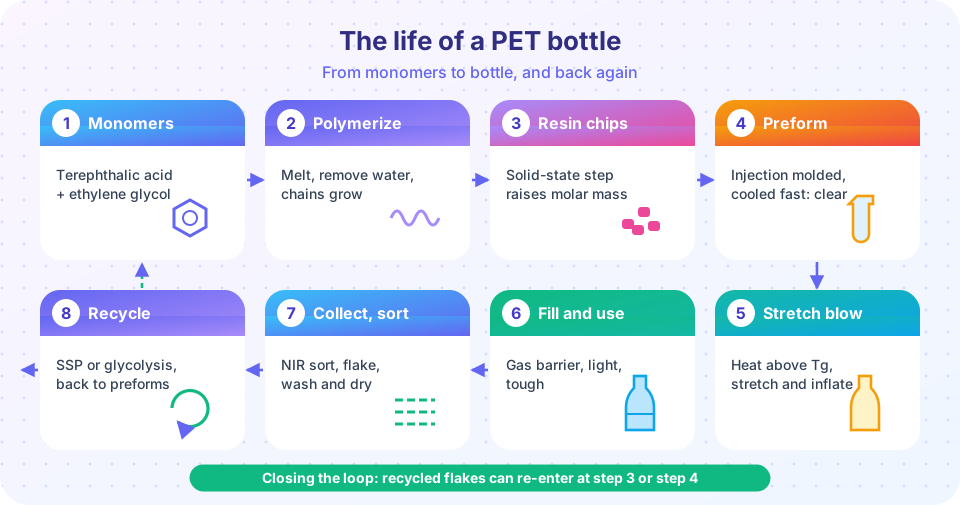
Almost everything in this course meets in a single, ordinary object: a plastic drink bottle. Step-growth polymerization makes its polymer. Crystallinity, glass transition and orientation decide whether it is clear and strong. Characterization methods check its quality. Sorting, washing and solid-state polymerization decide whether it can become a bottle again. This case study walks through the whole life, with numbers you can calculate along the way.
Treat it as a model for how to think about any polymer product: start with the molecules, follow them through each process, ask what each step does to the chain and then ask what happens at the end.
What you will learn
- Trace the chemistry and processing of PET from monomers to bottle.
- Explain how fast cooling, reheating and stretching produce a clear, strong, gas-tight bottle.
- Compute a mass balance for polycondensation.
- Estimate stretch ratios and loop yield for a bottle-to-bottle system.
Key terms
Polycondensation: step-growth polymerization that releases a small molecule (water or glycol) at each link.
Intrinsic viscosity (IV): a solution viscosity measure related to molar mass through the Mark–Houwink equation.
Solid-state polycondensation (SSP): heating pellets below their melting point under vacuum or inert gas so chains grow further.
Preform: the injection-molded test-tube shape that is later blown into a bottle.
Strain-induced crystallization: crystals formed because stretching aligns chains.
Step 1: monomers
PET is a polyester of terephthalic acid (TPA, C₈H₆O₄, 166.13 g/mol) and ethylene glycol (EG, C₂H₆O₂, 62.07 g/mol). TPA is made by oxidizing p-xylene, a petroleum-derived aromatic hydrocarbon, with air at elevated temperature and pressure in the presence of a cobalt, manganese and bromide catalyst. EG is made from ethylene by way of ethylene oxide. As the last lesson showed, either monomer can in principle come from biomass, and EG from bioethanol is already commercial.
Step 2: polycondensation
TPA and EG react to form ester links and release water:
n HOOC–C₆H₄–COOH + n HO–CH₂CH₂–OH → [–OC–C₆H₄–COO–CH₂CH₂–O–]ₙ + 2n H₂O
In practice this runs in two stages: esterification at roughly 250 °C forms short oligomers (such as bis-hydroxyethyl terephthalate, BHET), and melt polycondensation at about 280 °C under vacuum links them into long chains while removing excess glycol. Because the reaction is a reversible equilibrium, chain growth depends on removing the by-product. The more completely it is removed, the higher the degree of polymerization, following the Carothers relationship you may know as Xn = 1/(1 − p).
For bottles the melt product is typically a chip with an intrinsic viscosity of about 0.6 dL/g. A solid-state step then heats the crystallized chips at around 200 to 220 °C (below the 255 °C melting point) in vacuum or flowing nitrogen. Chain ends find each other in the amorphous regions, and the by-products diffuse out, raising the molar mass further (IV about 0.8) and removing acetaldehyde, a degradation by-product that would give bottled water an off taste. Small amounts of a comonomer such as isophthalic acid (a few percent) slow crystallization so that the preform stays clear.
Mass balance
For every 192.17 g of PET repeat unit, 166.13 g of TPA and 62.07 g of EG go in and 36.03 g (two molecules) of water come out. Per tonne of PET that means about 864.5 kg of TPA, 323.0 kg of EG, and 187.5 kg of water removed.
Step 3: preform, step 4: stretch blow molding
PET chips are melted at about 270 to 290 °C and injection molded into a thick test-tube shape. The mold is chilled so the polymer is cooled faster than it can crystallize, and the preform is amorphous and transparent, a direct use of what you learned about crystallization kinetics and DSC. The neck, where the cap screws on, is sometimes allowed to crystallize for better heat resistance.
The preform is then reheated by infrared lamps to roughly 100 °C, just above the PET glass transition (about 75 to 80 °C), where the chains are mobile but the material is not a melt. A rod stretches it axially while high-pressure air inflates it against the mold, stretching it biaxially in both axial and hoop directions. Orientation produces:
- Strain-induced crystallization: small crystals, too small to scatter light, so the bottle stays clear.
- Higher strength and stiffness in the wall, so a very thin wall carries the internal pressure of a carbonated drink.
- Better barrier to CO₂ and O₂, because aligned chains and crystals make diffusion paths longer.
That is how a bottle wall of a few tenths of a millimeter can hold the pressure of a fizzy drink. If the plastic were simply blown without being above Tg or without stretching, it would be thick, hazy or weak.
Step 5: use, step 6: collection
Bottle weights have fallen over time through light-weighting; a modern bottle often weighs between roughly 10 and 25 g depending on the product. Collection is where recycling is won or lost. Deposit-return systems can reach collection rates above 90 % and deliver a clean, single-polymer stream; curbside collection typically yields much less and a more contaminated stream.
Step 7: reprocessing
Bales are opened and NIR-sorted to remove other polymers and colors. Caps and labels (PP and PE, which float) are separated from PET flakes (which sink) by density; hot caustic washing removes adhesives and food residue. Flakes are dried thoroughly, because water at melt temperature hydrolyzes ester links, cutting chain length. Food-grade recycling then repeats the SSP step to restore molar mass and decontaminate, or uses chemical recycling to monomers.
Because the whole loop is mass-limited, recycled content is capped by the loop yield, the idea from the sustainability chapter. Recycled PET also goes into fiber (fleece, carpet), strapping and thermoformed trays, uses that tolerate lower quality, but a true closed loop (bottle to bottle) is the aim.
Measuring along the way
- GPC or IV monitors molar mass after each stage.
- DSC shows Tg, Tc and Tm and the crystallinity of preform and bottle wall.
- FTIR identifies the polymer (PET's strong ester band near 1715–1730 cm⁻¹ and aromatic bands) and detects contamination.
- TGA checks moisture and fillers.
Common misconceptions
"A clear bottle means the plastic is amorphous." The preform is amorphous; the stretched wall is partly crystalline (small crystals that do not scatter light).
"Recycled PET is just melted bottles." Food-grade rPET involves sorting, hot washing, drying and often solid-state polycondensation or chemical depolymerization.
"Thinner always means weaker." Orientation by stretching makes the thin wall far stronger than the same plastic in a thick, unstretched form.
Try it
First, a stoichiometry check of the mass balance. Change the production size to see the monomer demand and the water that must be removed.
Press Run (or Ctrl + Enter) to see the result here.
Program input · what you'd type while the program runs
Type the answers before you press Run, one per line. Each time the program reads a line (with input()), it gets the next line from this box.
Second, how stretching thins the wall. The ratios are illustrative values typical of the process, not data for one bottle.
Press Run (or Ctrl + Enter) to see the result here.
Program input · what you'd type while the program runs
Type the answers before you press Run, one per line. Each time the program reads a line (with input()), it gets the next line from this box.
Third, compare a deposit-return system with a mixed curbside system as a bottle loop, using the loop-yield idea from the sustainability chapter. The efficiencies are placeholders chosen to illustrate the effect.
Press Run (or Ctrl + Enter) to see the result here.
Program input · what you'd type while the program runs
Type the answers before you press Run, one per line. Each time the program reads a line (with input()), it gets the next line from this box.
Check your understanding
Quick check · 5 questions
of 5 answered You scored / 5 · perfect!
-
1. Why is the PET preform clear?
Rapid cooling prevents crystallization, leaving an amorphous, transparent preform. -
2. At what temperature is the preform stretch-blown?
Above Tg (about 75 to 80 °C) the chains are mobile enough to orient, but the material is not molten. -
3. How much water is released per mole of repeat unit formed from TPA and EG?
Two acid–alcohol condensations form two ester links per repeat unit, releasing two water molecules. -
4. What does solid-state polycondensation do?
Chain ends react in the amorphous regions and by-products diffuse out, so Mn rises and volatile impurities fall. -
5. A system with collection 0.92, sorting 0.98 and process yield 0.90 has a loop yield of about:
0.92 × 0.98 × 0.90 = 0.811.
Summary
- PET is made by polycondensation of terephthalic acid and ethylene glycol; removing water and glycol drives chain growth, and SSP raises molar mass further.
- A fast-cooled amorphous preform is reheated just above Tg and stretch-blown; biaxial orientation gives strain-induced crystallinity, strength and gas barrier.
- Recycling success depends on collection, sorting, washing, drying and restoring molar mass; loop yield caps recycled content.
- Every characterization method from Chapter 5 has a role along the way.
Track your progress
Create a free account to tick off lessons and pick up where you left off on any device.
of Polymer and Materials Chemistry lessons completed