


















Lesson 7 of 47 · Polymer Basics
Monomers, repeat units and degree of polymerization
Learn the difference between monomer and repeat unit, how to name polymers, how to count degree of polymerization and why a stretched chain is far longer than its coil.
Every polymer is built from a pattern. If you can find the pattern, you can predict the polymer's chemistry, calculate its molar mass and name it. The pattern is called the repeat unit, and the molecule it comes from is the monomer. Most of the time the two have nearly the same formula, but not always, and the difference tells you how the polymer was made. This lesson shows you how to read a polymer structure, how to count how many units a chain has, and how to turn those counts into mass and length.
What you will learn
- The difference between monomer, repeat unit and structural unit
- How addition and condensation polymers differ in their repeat units
- Two ways of naming polymers and how to read structure-based names
- How to compute degree of polymerization, molar mass and contour length
Key terms
Monomer: the small molecule that reacts to form the polymer.
Repeat unit (constitutional repeating unit): the smallest group of atoms that repeats along the chain.
Degree of polymerization (DP, Xn): the number of repeat or monomer units in a chain.
End group: the atoms that finish each end of a chain; negligible for long chains, important for short ones.
Functionality: the number of sites on a monomer that can form bonds in a polymerization.
Monomer versus repeat unit
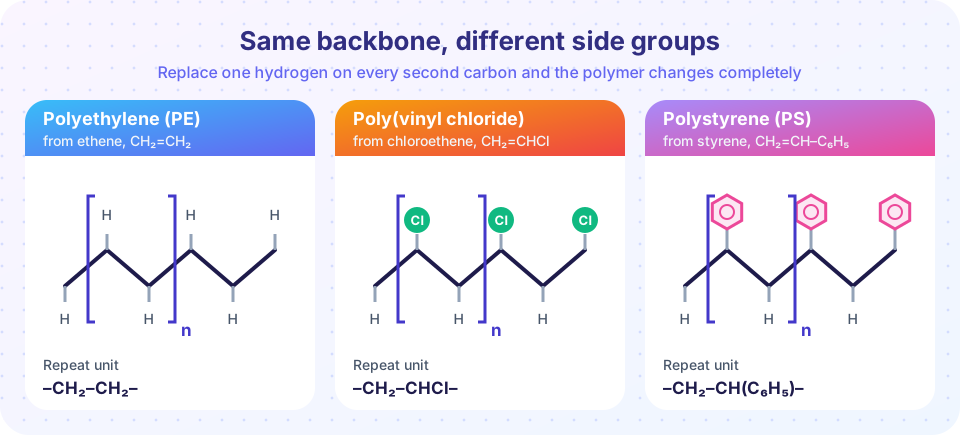
Take ethylene, CH₂=CH₂. In chain-growth polymerization the double bond opens and each molecule joins the chain, giving –CH₂–CH₂–. The repeat unit has the same atoms as the monomer, only the bonding is different. The same is true of propylene (to –CH₂–CH(CH₃)–), vinyl chloride (–CH₂–CHCl–) and styrene (–CH₂–CH(C₆H₅)–). Polymers made this way from vinyl-type monomers are called addition polymers: nothing is lost.
In a condensation polymer the repeat unit is not the monomer. Nylon 6,6 forms from two monomers, H₂N–(CH₂)₆–NH₂ and HOOC–(CH₂)₄–COOH, and each time two units link, a molecule of water is released. The repeat unit,
–NH–(CH₂)₆–NH–CO–(CH₂)₄–CO–
contains the atoms of both monomers minus the water. Its mass is therefore not the sum of the monomer masses: 116.2 + 146.1 − 2 × 18.02 = 226.3 g/mol. Polymers like PET, polycarbonates and polyamides work this way. Polymers formed by ring opening have the ring as monomer and a chain segment as repeat unit.
In a copolymer there is more than one monomer and often no single "repeat unit"; the pattern may be random. We will deal with that in the lesson on copolymers.
Reading and writing polymer names
There are two common naming systems.
Source-based names simply put poly before the monomer name: polyethylene, polystyrene, poly(vinyl chloride), poly(methyl methacrylate). Parentheses are used when the monomer name has more than one word. These are the names used in daily life.
Structure-based (IUPAC) names name the repeat unit and put poly before it. Because the repeat unit of polyethylene is a single CH₂, its structure-based name is poly(methylene). The repeat unit of PVC is –CH₂–CHCl–, which IUPAC names poly(1-chloroethane-1,2-diyl). Structure-based names are unambiguous, which matters when two different monomers could give the same polymer, but they are long, and most people use source-based names or common abbreviations (PE, PP, PS, PVC, PET, PMMA).
Abbreviations are worth learning. PE, PP, PS and PVC refer to polyethylene, polypropylene, polystyrene and poly(vinyl chloride); PET is poly(ethylene terephthalate); PA6 and PA66 are nylon 6 and nylon 6,6; PTFE is polytetrafluoroethylene.
Classifying polymers
A few classifications recur in the course, so learn them now:
- By origin: natural (cellulose, proteins, DNA, natural rubber), semi-synthetic (cellulose acetate) and synthetic (polyethylene, nylon).
- By mechanism: Carothers originally divided polymers into addition and condensation types by whether a small molecule is eliminated. Flory refined this into step-growth and chain-growth according to how chains grow. A polyurethane forms without losing any small molecule, yet it grows stepwise, which shows why the mechanism-based view is more useful. Chapter 3 treats it.
- By thermal behavior: thermoplastics soften when heated and can be reshaped; thermosets cure into networks; elastomers are lightly crosslinked and stretch and recover.
- By backbone: carbon-chain (polyethylene), heteroatom chain (polyesters, polyamides, polyethers), inorganic (silicones, with Si–O).
- By composition: homopolymers have one type of repeat unit, copolymers have two or more.
Degree of polymerization and molar mass
If a chain contains DP repeat units and each has mass M₀, the molar mass of the chain is approximately
M = DP × M₀ (+ end groups)
For long chains the end groups are negligible. Rearranged, DP = M / M₀.
Worked example 1. A sample of polyethylene has M = 280,000 g/mol. The repeat unit –CH₂–CH₂– has M₀ = 2(12.011) + 4(1.008) = 28.054 g/mol. So DP = 280,000 / 28.054 ≈ 9,980 repeat units, which means about 20,000 carbon atoms in the backbone.
Worked example 2. A poly(ethylene terephthalate) sample has M = 20,000 g/mol. The repeat unit is C₁₀H₈O₄ (M₀ = 192.17 g/mol), so DP = 20,000 / 192.17 ≈ 104.
Whether you count "monomer units" or "repeat units" matters for condensation polymers. Nylon 6,6 has one repeat unit made of two monomer residues, so its degree of polymerization in monomer units is twice the number of repeat units. Always say which you are counting.
For very short chains, end groups matter. A chain of ten ethylene units, H–(CH₂CH₂)₁₀–H, has M = 10 × 28.054 + 2 × 1.008 = 282.6 g/mol, slightly more than 10 × 28.054. Chains below a few hundred g/mol are called oligomers.
From mass to length: why chains coil
How long is a chain? In the all-trans zigzag shape of polyethylene, each C–C bond is 0.154 nm long and the bond angle is about 112 degrees, so each bond advances the chain by about 0.154 × sin(56°) ≈ 0.127 nm. A chain with 20,000 carbons would stretch to about 2,540 nm, or 2.5 micrometers. That is the contour length.
But in a melt or solution, chains do not sit stretched; bond rotation lets them wriggle into random coils. A good model for the end-to-end distance of a flexible chain is R₀ = l √(C∞ n), where n is the number of bonds, l the bond length and C∞ the characteristic ratio (about 7 for polyethylene). For 20,000 bonds that gives roughly 58 nm, about 40 times smaller than the contour length. Polymer properties depend on this: a coiled chain is entangled with its neighbors and can stretch out when pulled, which is the origin of rubber elasticity and of the toughness of plastics.
Functionality decides the architecture
A bifunctional monomer (two reactive sites, like ethylene's double bond or a diol) gives chains. A monomer with three or more reactive sites (glycerol, three –OH groups) gives branches and, with enough reaction, networks. This simple counting rule is the root of the architecture lesson that follows.
Common misconceptions
"The repeat unit is always the same as the monomer." True for addition polymers, but not for condensation polymers, where atoms are lost as water or another small molecule.
"Longer chains are always better." Properties improve with length up to a point, but very long chains make melts too viscous to process. Chapter 4 shows the trade-off.
"DP is the number of chains." DP is the length of one chain, counted in repeat units; it says nothing about how many chains the sample has.
Try it
First, write chemical formulas as text and let the program compute the repeat unit mass for several polymers, then plot them. Second, compute degree of polymerization, contour length and coil size for polyethylene samples of different molar mass, to see how strongly coiling shortens a chain.
Press Run (or Ctrl + Enter) to see the result here.
Program input · what you'd type while the program runs
Type the answers before you press Run, one per line. Each time the program reads a line (with input()), it gets the next line from this box.
Press Run (or Ctrl + Enter) to see the result here.
Program input · what you'd type while the program runs
Type the answers before you press Run, one per line. Each time the program reads a line (with input()), it gets the next line from this box.
Check your understanding
Quick check · 5 questions
of 5 answered You scored / 5 · perfect!
-
1. What is the repeat unit of polyethylene?
Polyethylene is made of –CH₂–CH₂– units, derived from ethylene (its structure-based IUPAC name uses the single –CH₂– unit). -
2. A polypropylene sample has M = 84,160 g/mol. The repeat unit mass is 42.08 g/mol. What is the DP?
DP = 84,160 / 42.08 = 2,000. -
3. Why is the repeat unit of nylon 6,6 lighter than the sum of its two monomers?
Condensation polymerization releases a small molecule (water) at each link. -
4. The contour length of a chain is
Contour length follows the backbone along its all-trans zigzag; coils are far shorter. -
5. A monomer with three reactive sites in a step-growth reaction will tend to give
Each extra reactive site is a point where the chain can branch.
Summary
- The repeat unit is the smallest group that repeats; for addition polymers it has the monomer's formula, for condensation polymers it does not.
- Polymers are named from the monomer (source-based) or from the repeat unit (structure-based, IUPAC); abbreviations such as PE, PP, PVC and PET are standard.
M = DP × M₀; for example, M = 280,000 g/mol of polyethylene means about 10,000 repeat units.- A stretched chain can be micrometers long, but a flexible chain is a coil tens of nanometers across.
Track your progress
Create a free account to tick off lessons and pick up where you left off on any device.
of Polymer and Materials Chemistry lessons completed