


















Lesson 13 of 47 · Polymerization Mechanisms
Free-radical chain polymerization
Understand initiation, propagation and termination in radical polymerization, derive the rate and chain-length equations, and meet chain transfer, inhibition and the gel effect.
Most of the plastic in the world is made by free-radical polymerization or by close relatives of it. Polystyrene cups, PVC pipes, acrylic glass (PMMA), low-density polyethylene film and the emulsions in water-based paints all begin with a molecule that falls apart into radicals. The method is popular because it is fast, tolerates water and impurities, works with many monomers and is cheap to run at scale. The kinetics are also a model of how chemists think: a few elementary steps, a steady-state assumption, and out comes a simple rate law with consequences you can test.
What you will learn
- The three stages of chain-growth: initiation, propagation and termination
- How to derive the rate of polymerization and the kinetic chain length
- How chain transfer, inhibitors and the gel effect modify the result
- Typical monomers, initiators and industrial processes
Key terms
Radical: a species with an unpaired electron, written with a dot (R•).
Initiator: a compound that decomposes to produce radicals, such as AIBN or benzoyl peroxide.
Propagation: the repeated addition of a monomer to the radical chain end.
Termination: the reaction of two radicals to end chain growth, by combination or disproportionation.
Kinetic chain length (ν): the average number of monomers added per initiating radical.
The three stages
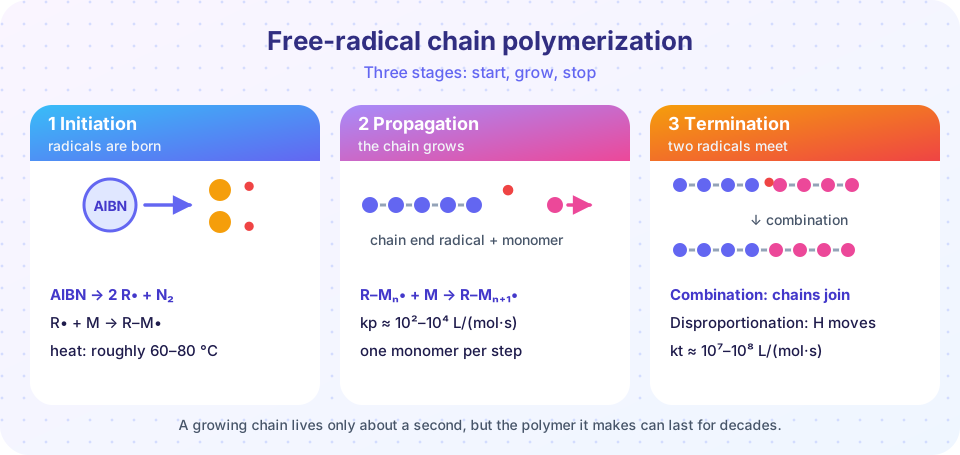
Initiation. An initiator splits into radicals under heat or light. Azobisisobutyronitrile (AIBN) is the standard laboratory example: on heating to roughly 60 to 80 °C it releases nitrogen gas and two 2-cyano-2-propyl radicals:
AIBN → 2 R• + N₂
A radical then attacks the double bond of a monomer M and forms a new radical, R• + M → R–M•. Not every radical produced starts a chain, because some recombine in the solvent cage before they escape; the fraction that does is the initiator efficiency f, typically 0.3 to 0.8.
Propagation. The chain-end radical adds monomer after monomer:
R–Mₙ• + M → R–Mₙ₊₁•
The rate constant kp is large for most monomers. As a rough guide, kp spans about 10² to 10⁴ L/(mol·s), so each chain adds hundreds or thousands of monomers within seconds. The radical usually attacks the less substituted carbon of a vinyl monomer, giving a head-to-tail arrangement and a more stable radical on the substituted carbon. Because each new radical forms from a monomer that has just been consumed, chain length grows quickly and the chains are already long when they stop.
Termination. Two growing radicals meet. In combination, the two chains join into one with double length; in disproportionation, one chain abstracts a hydrogen from the other, giving one saturated and one unsaturated chain. Polystyrene terminates mainly by combination; PMMA mostly by disproportionation. Termination rate constants are enormous (about 10⁷ to 10⁸ L/(mol·s)) but radicals are so scarce that termination is infrequent in absolute terms.
The rate law
Let [I] be the initiator concentration, [M] monomer, and [M•] the total concentration of growing radicals.
- Rate of initiation:
Ri = 2 f kd [I](two radicals per initiator molecule). - Rate of termination:
Rt = 2 kt [M•]².
After a short start-up, radicals are created and destroyed at the same rate (the steady-state assumption), Ri = Rt, so
[M•] = (f kd [I] / kt)^½.
The rate of monomer consumption is the rate of propagation, because propagation uses up so much more monomer than initiation does:
Rp = kp [M] [M•] = kp [M] (f kd [I] / kt)^½.
Two testable consequences follow. The rate is first order in monomer and half order in initiator. Doubling the initiator concentration increases the rate by only √2, because more radicals also means faster termination.
The kinetic chain length is the ratio of propagation to initiation:
ν = Rp / Ri = kp [M] / (2 (f kd kt [I])^½).
If termination is by disproportionation, Xn = ν; by combination, Xn = 2ν. Note the trade-off: more initiator gives a faster reaction but shorter chains, since ν falls as [I]^−½. A chemist who wants both speed and long chains must lower the temperature, use an initiator with the right half-life or choose a controlled method (next lesson).
Worked example. Styrene at 60 °C with 0.010 mol/L AIBN. Take kd = 1.0 × 10⁻⁵ s⁻¹, f = 0.6, kp = 340 L/(mol·s), kt = 6.0 × 10⁷ L/(mol·s) and [M] = 8.0 mol/L (illustrative literature magnitudes).
- [M•] = (0.6 × 10⁻⁵ × 0.010 / 6.0 × 10⁷)^½ = (10⁻¹⁵)^½ ≈ 3.2 × 10⁻⁸ mol/L
- Rp = 340 × 8.0 × 3.2 × 10⁻⁸ ≈ 8.6 × 10⁻⁵ mol/(L·s), about 3.9 percent of the monomer per hour
- Ri = 2 × 0.6 × 10⁻⁵ × 0.010 = 1.2 × 10⁻⁷ mol/(L·s)
- ν = 8.6 × 10⁻⁵ / 1.2 × 10⁻⁷ ≈ 720; with combination, Xn ≈ 1,400
Only about 3 × 10⁻⁸ mol/L of radicals are present at any moment, yet they build chains of more than a thousand units.
Chain transfer, inhibition and retardation
Real chains rarely reach the ideal length. In chain transfer, a growing radical abstracts an atom (often hydrogen) from a monomer, solvent, initiator, polymer chain or a deliberate chain-transfer agent such as a thiol. The radical on that chain ends, but a new radical starts elsewhere, so kinetics are unchanged and molar mass falls. The Mayo equation sums these effects:
1/Xn = 1/Xn,0 + C_M + C_S [S]/[M] + ...
where the C values are ratios of transfer to propagation rate constants. Thiols are added on purpose to cap molar mass, and in LDPE intramolecular transfer is the origin of short-chain branches. Transfer to polymer makes branching in PVAc and polyacrylates.
Inhibitors such as hydroquinone, and oxygen itself, react with radicals to give stable species that do not propagate; they cause an induction period until the inhibitor is consumed. Monomers are shipped with a small amount of inhibitor, and polymerizations are usually done under nitrogen. Retarders only slow the reaction.
The gel effect and heat
As polymerization proceeds in bulk, the mixture gets viscous. Large chain radicals move slowly, so termination (which needs two large radicals to meet) slows sharply, while small monomers still diffuse and propagate. The radical concentration climbs, the rate speeds up and more heat is released: the gel effect (Trommsdorff–Norrish effect, autoacceleration). It can also broaden the molar mass distribution and, if heat is not removed, lead to a thermal runaway. Polymerization is exothermic (about −70 to −90 kJ/mol for common vinyl monomers), so control of heat transfer is a central problem of reactor design.
Processes and examples
| Process | Medium | Features |
|---|---|---|
| Bulk | monomer only | pure polymer, hard to cool (PMMA sheets, PS) |
| Solution | solvent | easy heat removal, solvent recovery needed |
| Suspension | monomer droplets in water | beads; PVC, PS |
| Emulsion | micelles in water | high molar mass at high rate; latex paints, synthetic rubber |
| High-pressure gas | supercritical ethylene | LDPE at about 1,000 to 3,000 atm and 150 to 300 °C |
Monomers that work well include styrene, methyl methacrylate, vinyl chloride, vinyl acetate, acrylates and acrylonitrile. Radical polymerization is poor at controlling tacticity (the radical is planar), so most radical polymers are atactic, and it is limited in how well it can control length and architecture. That limitation motivates the next two lessons.
Common misconceptions
"A faster polymerization makes longer chains." In a free-radical process the opposite often holds: more initiator speeds the reaction but shortens chains.
"Radicals live for a long time." A growing chain usually lives about a second or less before termination. What lasts is the polymer.
"All of the initiator becomes polymer." Initiator efficiency is below 1, and fragments end up as end groups.
Try it
The first program applies the kinetic equations and shows how conversion rate and chain length depend on initiator concentration. The second simulates chain lengths when termination happens at random after each propagation step and compares disproportionation (Đ ≈ 2) with combination (Đ ≈ 1.5). These are simplified models with illustrative constants, not experimental results.
Press Run (or Ctrl + Enter) to see the result here.
Program input · what you'd type while the program runs
Type the answers before you press Run, one per line. Each time the program reads a line (with input()), it gets the next line from this box.
Press Run (or Ctrl + Enter) to see the result here.
Program input · what you'd type while the program runs
Type the answers before you press Run, one per line. Each time the program reads a line (with input()), it gets the next line from this box.
Check your understanding
Quick check · 5 questions
of 5 answered You scored / 5 · perfect!
-
1. In ideal free-radical polymerization, how does the polymerization rate depend on initiator concentration?
Rp = kp[M](f kd[I]/kt)^½, so the rate scales with [I]^0.5. -
2. Doubling the initiator concentration changes the kinetic chain length by a factor of
ν ∝ [I]^−½, so doubling [I] divides ν by √2. -
3. Which pair of steps ends a growing chain?
Termination occurs by combination (chains join) or disproportionation (hydrogen transfer). -
4. The gel effect speeds up bulk polymerization because
Large chain radicals diffuse slowly in viscous medium, so termination is hindered more than propagation. -
5. What is the role of a thiol chain-transfer agent?
A thiol donates a hydrogen to the growing radical, capping that chain and starting a new one.
Summary
- Free-radical chain polymerization has three stages: initiation (radicals from AIBN or peroxides), propagation (monomer addition at rate constant kp) and termination (combination or disproportionation).
- Steady state gives
Rp = kp[M](f kd[I]/kt)^½andν = kp[M]/(2(f kd kt[I])^½); Xn = ν or 2ν. - Chain transfer lowers molar mass, inhibitors delay the reaction, and the gel effect can cause runaway; products are mostly atactic with Đ about 1.5 to 3.
Track your progress
Create a free account to tick off lessons and pick up where you left off on any device.
of Polymer and Materials Chemistry lessons completed