


















Lesson 12 of 47 · Polymerization Mechanisms
Step-growth polymerization and the Carothers equation
Learn how nylon and polyester chains form stepwise, why conversion above 99 percent is needed, how stoichiometry limits chain length, and when networks gel.
Nylon stockings, polyester shirts, the PET in a soft-drink bottle and the polyurethane foam in a mattress all come from the same basic idea: take molecules with two reactive ends and let them react with each other, again and again, until the pieces are long enough to behave like a polymer. There is no special initiator and no chain that is "alive". Any two reactive ends can meet. This simplicity hides a surprise. A reaction that looks 90 percent complete still gives chains only ten units long. This lesson explains why, and gives you the equations that tell you exactly how complete a reaction must be to make a useful material.
What you will learn
- How A–A plus B–B monomers (and A–B monomers) build chains stepwise
- The Carothers equation and what it says about conversion and chain length
- How a small stoichiometric imbalance or an impurity caps the chain length
- Why polyfunctional monomers lead to gelation, and how to estimate the gel point
- Examples: nylon 6,6, PET, polyurethane, polycarbonate and phenol-formaldehyde resins
Key terms
Conversion (p): the fraction of one type of functional group that has reacted.
Carothers equation: Xn = 1/(1 − p), relating number-average degree of polymerization to conversion.
Stoichiometric ratio (r): the ratio of the amount of the group that is in shortage to the group in excess, r = NA/NB ≤ 1.
Condensation: a reaction that releases a small molecule, usually water.
Gel point: the conversion at which an infinite network first appears in a polyfunctional step-growth reaction.
The basic picture
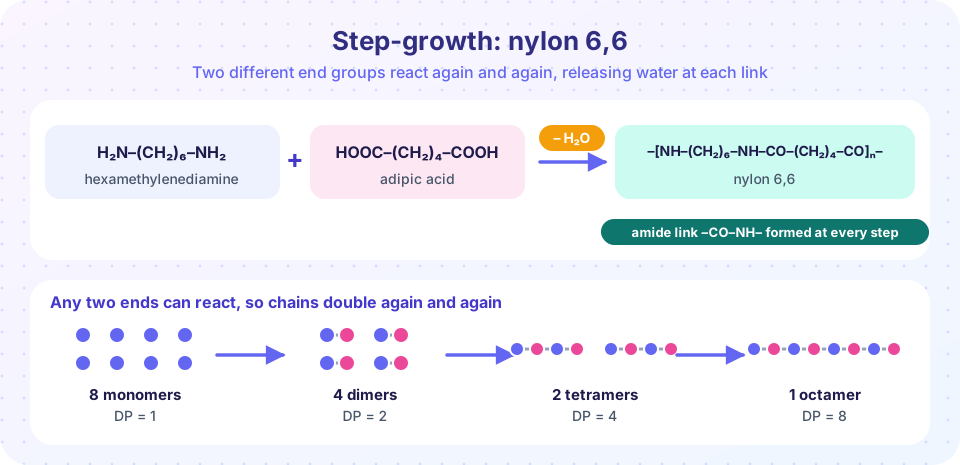
Consider the nylon 6,6 reaction. A diamine (H₂N–R–NH₂) reacts with a diacid (HOOC–R′–COOH). An amine and an acid form an amide and release water:
–NH₂ + HOOC– → –NH–CO– + H₂O
The product still has an amine at one end and an acid at the other. Both can keep reacting. A dimer can react with a monomer, with another dimer or with a long chain. All of these have the same chemistry, and the reactivity of an end does not depend on how long its chain is (Flory's equal-reactivity assumption, which holds well in practice because the reactive group is small compared with the chain). The molecule count falls steadily, but the average size grows only slowly until the very end.
If you start with N₀ monomer molecules and, after some reaction, N molecules remain, the conversion is p = (N₀ − N)/N₀, because each bond formed reduces the number of molecules by one. The average number of monomers per chain is
Xn = N₀/N = 1/(1 − p) (Carothers equation)
| Conversion p | Xn | Meaning |
|---|---|---|
| 0.50 | 2 | average chain is a dimer |
| 0.90 | 10 | still an oligomer |
| 0.95 | 20 | too short for strong fibers |
| 0.99 | 100 | useful |
| 0.999 | 1,000 | very high mass |
Because of that steep relationship, step-growth polymerizations must be driven almost to completion. A mixture that is 90 percent reacted and still makes a thick liquid is far from a finished polymer.
Why the byproduct matters
Esterification and amidation are reversible. If the water stays in the reactor, the reaction stops at an equilibrium conversion. For polyesterification the equilibrium constant is small (of the order of 1 to 10), so without removing water, p stays low. Industrial reactors run at high temperature under vacuum, or sweep with an inert gas, to remove water or other byproducts (for PET, ethylene glycol is also removed in the last stage) and drive the equilibrium to p above 0.99. Polyamidation has a much larger equilibrium constant, so it is easier, but water removal still helps. Polymerizations that form no byproduct, like polyurethane formation from isocyanates and alcohols, are not equilibrium limited.
Stoichiometry: the second limit
For an A–A + B–B reaction, chain ends can only be A or B. If there is an excess of B–B monomer, all chains eventually end in B groups, no A groups remain to react with them, and growth stops. Let r = NA/NB be the ratio of A groups to B groups, with NA ≤ NB. The Carothers equation becomes
Xn = (1 + r) / (1 + r − 2rp)
At full conversion (p = 1) this reduces to Xn = (1 + r)/(1 − r).
Worked example. Suppose one monomer is in 1 percent excess, so r = 1/1.01 = 0.990.
- At p = 1: Xn = (1 + 0.990)/(1 − 0.990) = 199.
- At p = 0.99: Xn = 1.990/(1.990 − 2 × 0.990 × 0.99) = 1.990/0.0298 ≈ 67.
A 1 percent imbalance caps the chain at about 200 units even if every possible bond forms. Hence manufacturers carefully balance monomers, often by forming a salt (hexamethylene diammonium adipate for nylon 6,6, a 1:1 crystalline salt that is purified and weighed exactly). A small amount of a monofunctional impurity such as a monoacid has the same effect, since it caps one chain end, and is sometimes added deliberately to control molar mass.
Distribution of chain lengths
Flory showed that random coupling gives the most probable distribution. The fraction of chains with x units (number distribution) is (1 − p)·p^(x−1), and Xw = (1 + p)/(1 − p). The dispersity is Đ = Xw/Xn = 1 + p, which approaches 2 at high conversion. Step-growth polymers therefore have Đ near 2, no matter how high the molar mass; the equation also tells you that linear step-growth cannot give narrow distributions.
Types and examples
- A–A + B–B: nylon 6,6 (diamine + diacid), PET (ethylene glycol + terephthalic acid, or its dimethyl ester), polyurethanes (diisocyanate + diol), polycarbonate (bisphenol A + phosgene or a carbonate), polyureas, aramids such as Kevlar (diamine + diacid chloride).
- A–B: one molecule with both functional groups, such as an amino acid (to nylon-type polyamides) or hydroxy acids (polylactic acid by condensation). Here balance is automatic.
- Polyfunctional monomers: glycerol (three –OH), a triacid, an amine with three –NH₂ groups. These create branches and networks. Examples are phenol-formaldehyde (Bakelite), melamine-formaldehyde, epoxy resins with polyamine hardeners, and alkyd paints.
PET deserves a short note. Its first stage forms bis(2-hydroxyethyl) terephthalate; melt polycondensation then builds chains, and solid-state polymerization of pellets raises the molar mass for bottle resin.
Gelation in polyfunctional systems
If some monomers have more than two functional groups, branching grows with conversion. At a critical conversion the largest molecule spans the whole sample: the viscosity diverges, and an insoluble gel forms. Carothers estimated the gel point from the average functionality f_avg (functional groups per monomer molecule):
p_c = 2 / f_avg
Worked example. Glycerol (f = 3) and phthalic anhydride (f = 2) in 2:3 molar ratio. Total groups = 2 × 3 + 3 × 2 = 12 on 5 molecules, so f_avg = 12/5 = 2.4 and p_c = 2/2.4 = 0.833. The more careful statistical theory of Flory and Stockmayer predicts gelation earlier, at about 0.707, and experiment lies close to Flory's value because the Carothers equation overlooks rings and the real spread of chain sizes. The practical lesson: stop the reaction before p_c if you want a processable liquid prepolymer, then cure it later. This is exactly how thermosets are used.
Common misconceptions
"If the reaction is 95 percent complete, you have 95 percent of the chain length." Xn = 20 at p = 0.95. Chain length depends on 1/(1 − p), not on p.
"Adding a little extra of one monomer just speeds things up." An excess caps the molar mass. Exact 1:1 stoichiometry gives the longest chains.
"Step-growth polymers can have very narrow distributions." For linear chains Đ → 2 at high conversion.
Try it
The first program plots the Carothers equation for different stoichiometric imbalances. The second is a Monte Carlo simulation of a step-growth reaction with 10,000 A–A and 10,000 B–B monomers: it reacts random pairs of ends and measures Xn and Đ at several conversions, which you can compare with the theory. The simulation is a model that applies the equal-reactivity assumption and ignores rings; it is not an experimental result, and the higher moment Đ is noisy because few long chains carry much of the weight.
Press Run (or Ctrl + Enter) to see the result here.
Program input · what you'd type while the program runs
Type the answers before you press Run, one per line. Each time the program reads a line (with input()), it gets the next line from this box.
Press Run (or Ctrl + Enter) to see the result here.
Program input · what you'd type while the program runs
Type the answers before you press Run, one per line. Each time the program reads a line (with input()), it gets the next line from this box.
Check your understanding
Quick check · 5 questions
of 5 answered You scored / 5 · perfect!
-
1. In an ideal step-growth polymerization, what is Xn at 95% conversion?
Xn = 1/(1 − 0.95) = 20. -
2. A diamine and diacid are mixed with a 2% excess of diacid (r = 0.980). What is the maximum Xn at p = 1?
Xn = (1 + r)/(1 − r) = 1.98/0.02 = 99. -
3. Why is a vacuum applied in the late stage of PET production?
Removing the small molecule shifts the reversible reaction and allows very high conversion. -
4. What is the dispersity of a linear step-growth polymer at very high conversion?
The Flory most probable distribution gives Đ = 1 + p, tending to 2. -
5. Glycerol and a diacid are mixed so that f_avg = 2.4. The Carothers estimate of the gel point is
p_c = 2/f_avg = 2/2.4 = 0.833; the Flory-Stockmayer theory predicts an earlier 0.707 for this mix.
Summary
- Step-growth polymers form by reactions between any two reactive ends; long chains appear only at very high conversion because
Xn = 1/(1 − p). - Exact stoichiometry (or the balanced salt) and removal of the byproduct are essential; with ratio r the maximum chain is
(1 + r)/(1 − r). - Linear step-growth gives Đ ≈ 2; polyfunctional monomers gel at about
2/f_avg(Carothers) or a bit earlier (Flory–Stockmayer).
Track your progress
Create a free account to tick off lessons and pick up where you left off on any device.
of Polymer and Materials Chemistry lessons completed