


















Lesson 44 of 47 · Projects and Practice
Practice Problems: Characterization to Sustainability
Thirteen practice problems with worked solutions on molar mass, DSC, XRD, TGA, gel points, rubber, fibers, composites, conductivity, hydrogels, recycling and LCA.
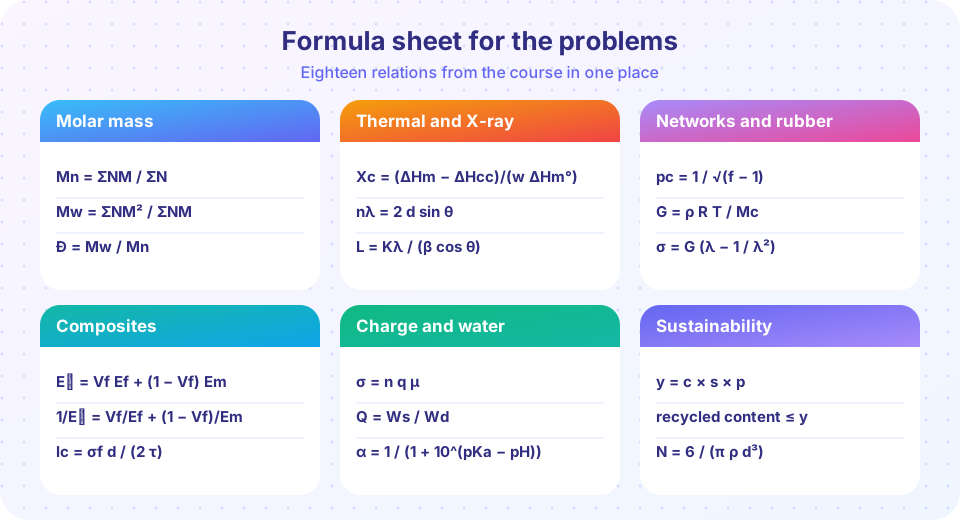
Reading about a formula and using it are two different skills. This lesson gives you thirteen problems that cover the second half of the course, from characterization through sustainability. Work each one on paper first, using the formula sheet below, then run the checker to compare your numbers, and finally read the worked solutions for the steps you got wrong.
Aim for the habit experts have: write the symbols and units, name the formula, substitute, compute, and ask whether the answer is plausible. A molar mass of 2 g/mol or a crystallinity of 140 % should set off an alarm before anyone else sees it.
What you will learn
- Apply the course's main formulas to new numbers.
- Check answers for plausibility, units and limiting cases.
- Identify which lesson to revisit for each type of problem.
Key terms
Plausibility check: a quick test (order of magnitude, limiting case, sign) that catches most arithmetic and unit errors.
Limiting case: a simple value of the inputs (such as Vf = 0 or Vf = 1) for which the answer is obvious.
Significant figures: the digits in an answer that are justified by the data.
The problems
Characterization
1. Molar mass. A sample has 200 chains of 20,000 g/mol, 100 chains of 60,000 g/mol and 20 chains of 200,000 g/mol. Find Mn, Mw and the dispersity.
2. DSC crystallinity. A polypropylene sample containing 15 % talc by weight shows a melting enthalpy of 60 J/g (per gram of sample). With ΔHm° = 207 J/g for 100 % crystalline PP and no cold crystallization, find the crystallinity of the polymer.
3. XRD. A semicrystalline polymer shows a peak at 2θ = 19.8° with Cu Kα (λ = 0.15406 nm). Find the plane spacing d.
4. TGA. A polyethylene compound leaves 18 % residue in air at 800 °C, and the filler is calcium carbonate that decomposes to CaO (56.08 g/mol) and CO₂ (from CaCO₃, 100.09 g/mol). What was the CaCO₃ content?
Families
5. Gel point. An epoxy system uses a difunctional resin (A₂) and a trifunctional hardener (B₃) in balanced amounts. Find the gel-point conversion from Flory–Stockmayer theory.
6. Rubber. A rubber has density 930 kg/m³, Mc = 8,000 g/mol between cross-links and is at 300 K. Find the modulus G and the stress at a stretch ratio of 2.5.
7. Fiber. A 40 tex nylon yarn breaks at 24 N. Its density is 1.14 g/cm³. Find its tenacity, its strength in GPa and its linear density in denier.
Functional materials
8. Composite. Glass fibers (Ef = 73 GPa) in epoxy (Em = 3 GPa) at Vf = 0.5. Find the Voigt and Reuss moduli.
9. Conductivity. A doped film has n = 5 × 10¹⁹ cm⁻³ carriers with mobility 0.5 cm²/(V s). Find its conductivity.
10. Hydrogel. A gel weighs 0.6 g dry and 12 g swollen. Find Q and the water content.
Sustainability
11. Recycling loop. Collection 0.75, sorting 0.92, process 0.88. Find the loop yield and the fraction of the original material left after four trips.
12. Microplastics. For polyethylene spheres of diameter 50 µm (ρ = 0.95 g/cm³), find the number of particles per gram and the surface area per gram.
13. Reuse break-even. A single-use container has E₁ = 0.15 kg CO₂e; a reusable one has production E_r = 0.90 kg CO₂e and w = 0.05 kg CO₂e per trip (illustrative values). How many trips are needed to break even?
Try it
Write your answers first, then run the checker. It solves every problem and prints a plausibility note next to each result.
Press Run (or Ctrl + Enter) to see the result here.
Program input · what you'd type while the program runs
Type the answers before you press Run, one per line. Each time the program reads a line (with input()), it gets the next line from this box.
A second tool for self-checking: limiting cases. A formula that gives silly answers at the extremes is being misused. Run each test, then try writing a limiting-case test for the Reuss formula yourself.
Press Run (or Ctrl + Enter) to see the console output here.
No output.
Worked solutions for the trickier ones
Problem 1. ΣN = 320, ΣNM = 200×2×10⁴ + 100×6×10⁴ + 20×2×10⁵ = 4×10⁶ + 6×10⁶ + 4×10⁶ = 1.4×10⁷. So Mn = 1.4×10⁷/320 = 43,750 g/mol. For Mw: ΣNM² = 200×4×10⁸ + 100×3.6×10⁹ + 20×4×10¹⁰ = 8×10¹⁰ + 3.6×10¹¹ + 8×10¹¹ = 1.24×10¹², so Mw = 1.24×10¹²/1.4×10⁷ = 88,571 g/mol. Dispersity = 88,571/43,750 = 2.02.
Problem 2. The measured enthalpy is per gram of sample, but only 85 % of the sample is polymer, so the enthalpy per gram of polymer is 60/0.85 = 70.6 J/g. Then Xc = 70.6/207 = 34.1 %. Forgetting the filler would give 29 %.
Problem 4. Calcium carbonate loses CO₂ and leaves CaO, which is 56.08/100.09 = 56.0 % of the CaCO₃ mass. So 18 % residue as CaO corresponds to 18/0.560 = 32.1 % CaCO₃ in the original compound.
Problem 5. For A₂ + B_f with balanced groups p_c = 1/√(f − 1). With f = 3, p_c = 1/√2 = 0.707.
Problem 8. Voigt = 0.5×73 + 0.5×3 = 38.0 GPa. Reuss: 1/E = 0.5/73 + 0.5/3 = 0.00685 + 0.16667 = 0.17352, so E = 5.76 GPa. Limiting-case check: both formulas give Em at Vf = 0 and Ef at Vf = 1.
Problem 12. Volume of one sphere = π d³/6; with d = 5×10⁻³ cm, V = 6.54×10⁻⁸ cm³, mass = 6.2×10⁻⁸ g, so about 1.6×10⁷ particles per gram. Surface area per gram = 6/(ρ d) = 1,263 cm²/g = 0.126 m²/g.
Common misconceptions
"If the calculator gives it, it must be right." Check units, order of magnitude and limiting cases every time.
"A formula applies everywhere." Each formula has assumptions: the gel-point formula assumes balanced groups and no rings; the rubber formula assumes an ideal network and moderate stretch.
"Significant figures are decoration." Reporting Mn = 43,750.0 from data accurate to two digits claims precision you do not have.
Check your understanding
Quick check · 5 questions
of 5 answered You scored / 5 · perfect!
-
1. Problem 1's dispersity is about:
Mw / Mn = 88,571 / 43,750 = 2.02. -
2. Problem 2: why divide by the polymer weight fraction?
Only the polymer fraction can be crystalline, so normalize the enthalpy to polymer mass. -
3. Problem 6: the stress at stretch 2.5 for G = 0.29 MPa is about:
σ = G (λ − 1/λ²) = 0.29 × (2.5 − 0.16) = 0.68 MPa. -
4. Problem 11: with y = 0.607, what fraction remains after four trips?
0.607⁴ = 0.136. -
5. Problem 13: if the reusable container is used 6 times in practice, it:
Per use impact is 0.90/6 + 0.05 = 0.20 kg CO₂e, above 0.15.
Summary
- Work problems in a fixed order: symbols and units, formula, substitution, calculation, plausibility check.
- Normalize to the right mass (polymer, not sample) before using enthalpies or residues.
- Limiting cases (
Vf = 0or1,p = 0) quickly reveal misused formulas. - Report answers with justified precision and keep a list of the assumptions behind each formula.
Next: Glossary
Track your progress
Create a free account to tick off lessons and pick up where you left off on any device.
of Polymer and Materials Chemistry lessons completed