


















Lesson 6 of 47 · Polymer Basics
Chapter 2 overview: polymer basics
See the big picture of chapter 2: how repeat units, degree of polymerization, molar mass averages and chain architecture describe any polymer sample.
A bottle of water contains identical molecules: every one has the same formula and the same mass. A bag of polyethylene does not. Every chain in it has the same repeat unit, but the chains differ in length, and some differ in branching too. To talk about a polymer sample at all, you need a vocabulary for what repeats, how long the chains are on average, how widely they vary and how they are shaped. That vocabulary is the subject of this chapter, and you will use it in every later chapter, from how chains are made to how plastics are recycled.
What you will learn
- The big picture of how a polymer is described: repeat unit, size, shape
- What each lesson in this chapter covers
- Why a polymer sample needs averages rather than one number
- How the three ideas combine into the descriptions used later in the course
The big picture
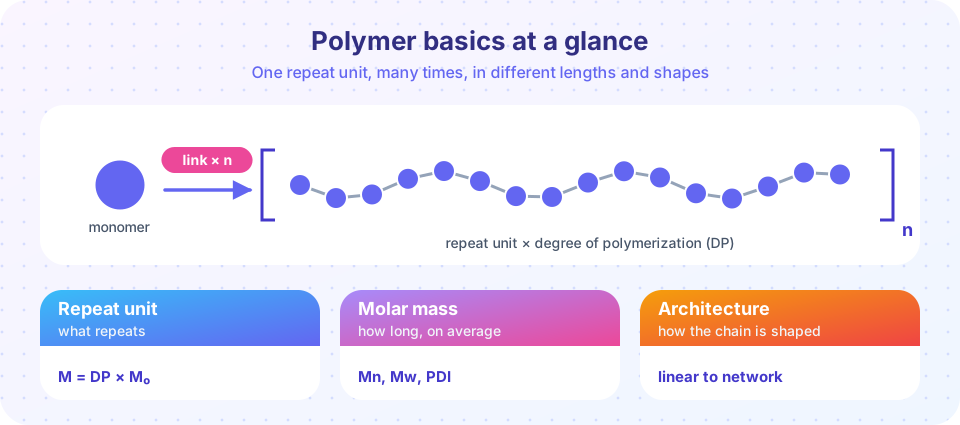
Three questions describe any polymer.
What repeats? The repeat unit is the smallest fragment that, when repeated, builds the chain. Its chemistry sets the polarity, the flexibility and the way chains interact. Changing a hydrogen to a chlorine or a benzene ring turns polyethylene into PVC or polystyrene.
How big is it? The number of repeat units in a chain is its degree of polymerization, and multiplying by the repeat unit's mass gives the molar mass. But in a real sample every chain has a different length, so we describe the size with averages and with the width of the distribution.
What shape is it? A chain can be a single line, a line with branches, a star, a comb or a network. Two different monomers can alternate, mix randomly, form long blocks or hang off the backbone as grafts. Shape and sequence change properties as strongly as chemistry does.
Describing any polymer
Why averages?
Where it leads
What each lesson covers
| Lesson | Question it answers |
|---|---|
| Monomers and repeat units | What is the repeat unit, how is it named and how many are in a chain? |
| Molar mass and its distribution | What are Mn, Mw and the dispersity, and why do they differ? |
| Architectures and copolymers | How do branching, crosslinks, sequence and tacticity change a polymer? |
| Chapter 2 review | Do I have the whole picture? |
Why this chapter matters
Two samples of "polyethylene" can behave so differently that one makes a plastic bag and the other a bulletproof vest. Both have the same repeat unit. What differs is the molar mass (the vest material has chains of several million g/mol) and the arrangement and orientation of chains. If you cannot describe those differences, you cannot compare, design or specify polymers. Throughout the course you will return to three numbers: the degree of polymerization, the molar mass averages and the dispersity.
A preview with numbers
Here is how the three questions work together on a single example. Suppose a data sheet says: "High-density polyethylene, Mn = 28,000 g/mol, Mw = 112,000 g/mol, linear." From the repeat unit, M₀ = 28.05 g/mol, you find DPn = 28,000 / 28.05 ≈ 1,000 repeat units, or about 2,000 backbone carbons. From the two averages you find a dispersity of 112,000 / 28,000 = 4, so the sample is broad: some chains are far longer than average, which is typical of a catalyst with several kinds of active site. And "linear" tells you the chains have almost no branches, so they can pack and crystallize. Three short phrases have already told you that this is a stiff, fairly dense plastic that will melt around 130 °C and flow readily enough to be molded, because the many short chains act as a lubricant.
Every lesson that follows adds precision to one of these statements. The lesson on monomers and repeat units shows how to read and count. The lesson on molar mass shows what each average means and how to compute it. The lesson on architectures shows how branching, crosslinking and sequence enter. By the end of the chapter you should be able to read a polymer data sheet the way a chemist reads a recipe.
Try it
A small calculator ties the vocabulary together: pick a polymer, choose a degree of polymerization, and read off the molar mass and the length of the chain if it were completely stretched out. The numbers use atomic masses and a C–C backbone length; the stretched length is an upper bound, since real chains coil.
Check your understanding
Quick check · 3 questions
of 3 answered You scored / 3 · perfect!
-
1. What does the degree of polymerization count?
DP is the number of repeat (or monomer) units in one chain. -
2. Why do we need averages for a polymer sample?
Chain growth is statistical, so a sample contains chains of many lengths. -
3. Which pair differs only in the side group on every other carbon?
Replacing one hydrogen of every second carbon in polyethylene with Cl gives PVC.
Summary
- Describing a polymer takes three things: the repeat unit, the size distribution and the architecture or sequence.
- Because chain growth is random, a sample needs averages (Mn, Mw) and a measure of width (the dispersity).
- Shape and sequence matter as much as chemistry, and later chapters connect all three to properties.
Track your progress
Create a free account to tick off lessons and pick up where you left off on any device.
of Polymer and Materials Chemistry lessons completed