


















Lesson 9 of 47 · Polymer Basics
Chain architecture, copolymers and tacticity
Explore linear, branched, star, comb and network polymers, the four copolymer sequences, and how tacticity changes properties, with the copolymer equation and a simulation.
Two polymers with the same repeat unit and the same molar mass can behave very differently. High-density polyethylene is used for milk jugs and pipes; low-density polyethylene is the soft film of a shopping bag. Both are made of –CH₂–CH₂–. The difference is how the chains are arranged: one is nearly linear, the other is branched. Add a second monomer and the possibilities multiply: the same two monomers can be mixed at random, alternated, arranged in long blocks or grafted. This lesson shows the main architectures and sequences, explains why they matter and lets you simulate how a copolymer's sequence emerges from the reactivities of its monomers.
What you will learn
- The main chain architectures: linear, branched, star, comb, network, dendritic and cyclic
- The four copolymer sequences and a famous example of each
- What tacticity is and why isotactic and atactic polypropylene differ so much
- How the copolymer composition equation and reactivity ratios predict sequence
Key terms
Branching: side chains attached to the main chain at intervals.
Crosslink: a covalent bond linking two different chains, turning a collection of chains into a network.
Copolymer: a polymer with two or more different repeat units.
Reactivity ratio (r₁, r₂): the ratio of the rate constant for a growing chain end adding its own kind of monomer to the rate constant for adding the other kind.
Tacticity: the stereochemical arrangement of side groups along a chain.
Architecture: beyond the straight line
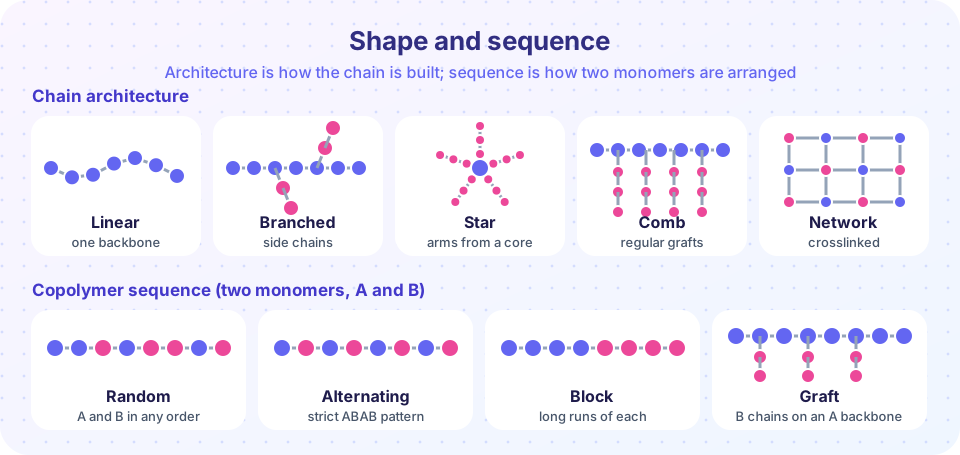
Linear polymers have a single backbone with no long side chains. Chains can pack side by side, so linear polymers crystallize easily. High-density polyethylene (HDPE, density 0.94 to 0.97 g/cm³) is nearly linear.
Branched polymers have side chains. In low-density polyethylene (LDPE, density about 0.91 to 0.94 g/cm³), made at high pressure by radical polymerization, a growing radical can abstract a hydrogen from its own chain ("backbiting") and continue from there, creating short branches, and can also form long branches. Branches prevent tight packing, so LDPE is less dense, less crystalline, softer and more transparent than HDPE. Linear low-density polyethylene (LLDPE) is made by copolymerizing ethylene with a little 1-butene or 1-hexene; the comonomer places short branches at controlled intervals, giving tough, puncture-resistant film.
Star polymers have several arms radiating from a core. They are compact, so they have lower solution and melt viscosity than a linear chain of the same mass.
Comb and bottlebrush polymers have a backbone with regularly spaced side chains. Bottlebrushes, with side chains on every unit, are stiff, tube-like molecules.
Dendrimers and hyperbranched polymers are tree-like, with branching at every unit. They have many end groups, which can be given functions such as drug binding.
Cyclic polymers have no ends; ladder polymers have a double-stranded backbone and are stiff and heat-resistant.
Network (crosslinked) polymers are chains joined into one giant molecule. A thin crosslink density gives an elastic rubber (vulcanized rubber); a high crosslink density gives a hard thermoset (epoxy, Bakelite). The point where an infinite network first appears during reaction is the gel point, and a network can swell in a solvent but not dissolve.
Branching and crosslinking arise from monomers with functionality greater than two, from chain transfer or from deliberately added crosslinkers. Because crosslinked polymers cannot flow, they cannot be melted again, which is a challenge for recycling that chapter 8 discusses.
Copolymers: two monomers, four patterns
If two monomers A and B polymerize together, the sequence along the chain can take four main forms:
- Random (statistical): A and B appear in no regular order. The proportions depend on the monomer ratio in the feed and their reactivities.
- Alternating: ABABAB. It happens when each chain end prefers the other monomer. Styrene with maleic anhydride is the classic radical example.
- Block: long runs of A followed by long runs of B. SBS, a polystyrene–polybutadiene–polystyrene triblock, is a thermoplastic elastomer: glassy polystyrene domains act as physical crosslinks that hold the rubbery polybutadiene in place, yet the material melts when heated. Block copolymers are usually made by living polymerization.
- Graft: chains of B hang off an A backbone. High-impact polystyrene (HIPS) uses polybutadiene rubber grafted with polystyrene to toughen brittle polystyrene.
ABS plastic, found in LEGO bricks and many appliance housings, combines acrylonitrile, butadiene and styrene in a two-phase structure where a rubbery phase toughens a glassy matrix.
The same two monomers in different sequences give different materials: a random copolymer of ethylene and propylene is an amorphous rubber (EPR), while a block arrangement can crystallize in each block. This is why chemists work hard to control sequence.
Tacticity: the three-dimensional arrangement
In a vinyl polymer –CH₂–CHR–, every second carbon bears a side group R. Looking at the chain in its zigzag plane, each R can point toward the viewer or away. The pattern is the tacticity.
- Isotactic: all R groups on the same side.
- Syndiotactic: R groups alternate sides.
- Atactic: random.
For polypropylene this is not a detail: isotactic PP crystallizes (melting near 165 °C) and gives the stiff, strong plastic in food containers and ropes; atactic PP is a soft, sticky, amorphous material with almost no use as a structural plastic. The catalysts of Ziegler and Natta, and later metallocenes, learned to place R groups in order (chapter 3). Tacticity also affects poly(methyl methacrylate): syndiotactic-rich PMMA has a higher glass transition than isotactic.
Two adjacent units are described as a meso (m) diad if their side groups are on the same side and a racemo (r) diad if on opposite sides. A chain of all-m is isotactic; all-r is syndiotactic. NMR spectroscopy measures the fractions of triads (mm, mr, rr), a technique you will see in chapter 5.
Predicting copolymer sequence: the Mayo–Lewis equation
How do the two monomers pick? Consider a growing chain ending in unit A. It can add A with rate constant k_AA or B with k_AB. The ratio r₁ = k_AA / k_AB is its reactivity ratio; likewise r₂ = k_BB / k_BA for a B-ended chain. If f₁ and f₂ are the mole fractions of A and B in the monomer feed, the mole fraction of A in the copolymer being formed at that instant is
F₁ = (r₁f₁² + f₁f₂) / (r₁f₁² + 2f₁f₂ + r₂f₂²).
Interpretation:
r₁ = r₂ = 1: ideal random copolymer;F₁ = f₁.r₁, r₂ < 1: each end prefers the other monomer; tendency toward alternation.r₁ = r₂ = 0: perfectly alternating (F₁ = 0.5 whatever the feed).r₁, r₂ > 1: each end prefers its own kind; blocky or even two homopolymers.r₁ r₂ = 1with unequal values: the composition drifts, but sequence is still random-like ("ideal").
Because one monomer is usually consumed faster than the other, the composition of chains drifts with conversion unless the feed is topped up. For styrene (A) and methyl methacrylate (B) in radical polymerization, r₁ ≈ 0.52 and r₂ ≈ 0.46, so the copolymer is slightly alternating and nearly random.
Common misconceptions
"A copolymer is a blend of two polymers." A blend is a physical mixture of separate chains. A copolymer has both units in the same chain.
"The copolymer composition equals the feed composition." Only for r₁ = r₂ = 1. Usually one monomer is incorporated faster, and composition drifts as it is used up.
"Branched means weaker." Branching lowers density and crystallinity, which reduces stiffness but can raise toughness, clarity and melt strength; the right architecture depends on the use.
Try it
The first program simulates a copolymer chain by letting each new unit be chosen according to the reactivity ratios, and prints the sequences and average run length for three cases. The second plots the Mayo–Lewis composition curve for different reactivity ratios.
Press Run (or Ctrl + Enter) to see the result here.
Program input · what you'd type while the program runs
Type the answers before you press Run, one per line. Each time the program reads a line (with input()), it gets the next line from this box.
Press Run (or Ctrl + Enter) to see the result here.
Program input · what you'd type while the program runs
Type the answers before you press Run, one per line. Each time the program reads a line (with input()), it gets the next line from this box.
Check your understanding
Quick check · 5 questions
of 5 answered You scored / 5 · perfect!
-
1. Why is LDPE less dense and less crystalline than HDPE?
Branches disturb the regular packing needed for crystallinity, so density drops. -
2. A polymer with long runs of A followed by long runs of B is
Block copolymers contain long sequences of each monomer; SBS is a triblock example. -
3. Isotactic polypropylene differs from atactic polypropylene because
Regular placement allows crystallization, giving a rigid plastic; atactic PP is soft and amorphous. -
4. If r₁ = r₂ = 0 the copolymer is
Each chain end can only add the other monomer, so A and B alternate. -
5. What gives a thermoplastic elastomer such as SBS its rubbery behavior and meltability?
The polystyrene blocks cluster and anchor the rubbery polybutadiene; heating melts the domains, so the material can be reprocessed.
Summary
- Architecture (linear, branched, star, comb, dendritic, network) changes packing, density, viscosity and crystallinity without changing the repeat unit.
- Copolymers can be random, alternating, block or graft; reactivity ratios r₁ and r₂ and the Mayo–Lewis equation predict composition and sequence.
- Tacticity (isotactic, syndiotactic, atactic) decides whether chains can crystallize: isotactic PP is a strong plastic, atactic PP a sticky gum.
Next: Chapter 2 review
Track your progress
Create a free account to tick off lessons and pick up where you left off on any device.
of Polymer and Materials Chemistry lessons completed