


















Lesson 34 of 47 · Advanced and Functional Materials
Conducting and Electroactive Polymers
How plastics that conduct electricity work: conjugation, doping, polarons, band gaps, PEDOT and polyaniline, OLED and solar applications, plus percolation in filled composites.
For most of the twentieth century a plastic was the thing you wrapped around a wire to stop current. Then in the 1970s three chemists, Hideki Shirakawa, Alan MacDiarmid and Alan Heeger, showed that polyacetylene treated with iodine vapor conducts electricity, many orders of magnitude better than the untreated polymer. They shared the Nobel Prize in Chemistry in 2000, and a new field began.
Conducting polymers combine the electrical behavior of semiconductors and metals with the processing of plastics: they can be printed, coated from solution and bent. This lesson explains why a polymer chain can conduct at all, what doping does, how to estimate conductivity from simple numbers and how a different route, filling a polymer with conductive particles, relies on percolation.
What you will learn
- Explain conjugation and why it is necessary but not sufficient for conduction.
- Describe doping, polarons and the role of counter-ions.
- Estimate conductivity with
σ = n q μand compare materials on a log scale. - Name the main conducting polymers and applications, and explain percolation in composites.
Key terms
Conjugation: a chain of alternating single and double bonds in which π electrons are delocalized over many atoms.
Doping: chemical or electrochemical oxidation or reduction that adds charge carriers to a polymer.
Polaron: a charge carrier together with the local distortion of the chain it causes.
Band gap (Eg): the energy needed to lift an electron from the filled valence band to the empty conduction band.
Percolation threshold: the filler fraction at which particles first form a continuous conducting path.
Conjugation: the highway
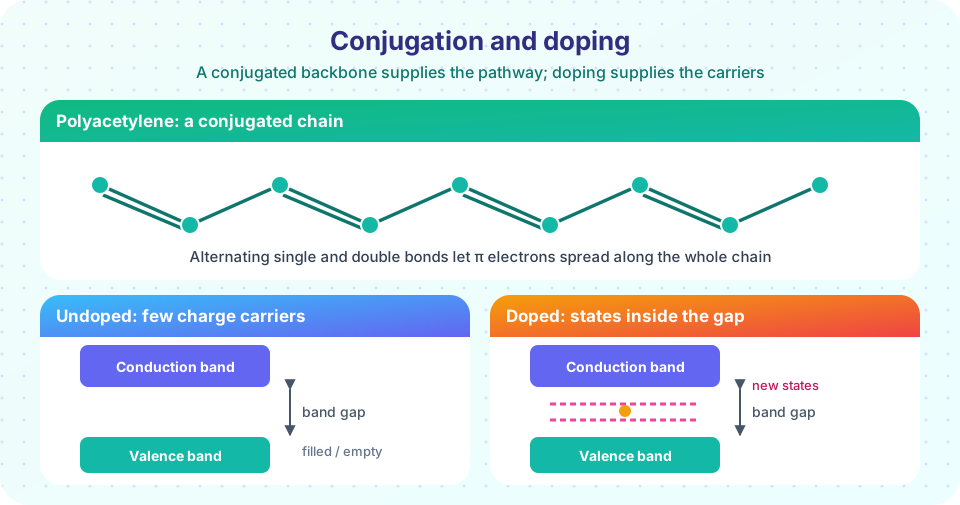
In ordinary polyethylene every carbon uses all four electrons in single σ bonds. The electrons are locked in place, and the gap to empty states is huge, so it is an excellent insulator. In polyacetylene, –(CH=CH)ₙ–, each carbon contributes one extra electron in a p orbital perpendicular to the chain. Neighboring p orbitals overlap and form a π system that spreads along the backbone, as in the figure above. This is conjugation.
Because of the overlap, orbitals merge into bands. A long conjugated chain has a filled valence band, an empty conduction band and a band gap between them. As the conjugated length grows the gap narrows, and the polymer begins to absorb visible light. The gap also sets the color: a photon of energy E has wavelength λ(nm) ≈ 1240 / E(eV), so a gap of 2.0 eV absorbs around 620 nm (orange-red light), which is why a thin film of P3HT looks deep purple.
But conjugation alone gives only a semiconductor with few carriers. Undoped polymers conduct poorly because almost no electrons occupy the conduction band, a situation the picture shows on the left.
Doping: adding carriers
Doping changes the number of charges on the chain. In p-type doping an oxidant (iodine, FeCl₃, or an electrochemical potential) removes electrons. The removed electron leaves a positive charge on the chain, which attracts and distorts the lattice around it, forming a polaron, a charge-plus-distortion quasi-particle with energy levels inside the gap (right panel). At higher doping two charges combine into a bipolaron. Because oxidation makes the chain positive, a negative counter-ion (anion) must sit nearby, and when the doping level is changed electrochemically, ions move in and out of the film, which changes color and volume. That is the basis of electrochromic windows and polymer actuators ("artificial muscles").
Doped polymers conduct by electrons moving along chains and hopping between chains. Order matters: tightly packed, aligned chains conduct better. Conductivity of a doped polymer can reach hundreds to thousands of siemens per centimeter in good samples, still lower than copper (about 6 × 10⁵ S/cm) but far above the 10⁻¹⁵ S/cm of an insulating plastic.
Estimating conductivity
Electrical conductivity depends on the density n of carriers, their charge q (the elementary charge, 1.602 × 10⁻¹⁹ C) and their mobility μ:
σ = n q μ
Worked example. Suppose a doped film has n = 10²⁰ cm⁻³ carriers with a mobility of 1 cm²/(V s):
σ = 1e20 × 1.602e-19 × 1 = 16 S/cm
Doping to higher carrier density, or improving chain alignment and mobility, raises σ directly. Mobilities in conducting polymers are modest, from 10⁻⁵ up to a few cm²/(V s), compared with several hundred in silicon, so large conductivity requires heavy doping.
The main conducting polymers
| Polymer | Key points | Uses |
|---|---|---|
| Polyacetylene | The first discovered; unstable in air | Historic; research |
| Polyaniline (PANI) | Conductivity switched by pH and oxidation; cheap | Anticorrosion coatings, sensors |
| Polypyrrole (PPy) | Easily made electrochemically; biocompatible | Sensors, actuators, tissue scaffolds |
| Polythiophenes (P3HT) | Soluble with side chains; semiconducting | Organic transistors, solar cells |
| PEDOT:PSS | Dispersion in water; transparent, stable, up to hundreds of S/cm after treatment | Antistatic films, touchscreens, capacitors |
| PPV derivatives | Light-emitting | First polymer LEDs |
Applications cluster around three properties: they are conductors you can print (antistatic packaging, transparent electrodes), semiconductors that emit or absorb light (OLED displays and organic solar cells), and materials that respond to charge (sensors, electrochromic films, actuators). In an OLED, injected electrons and holes meet in a thin emissive layer and recombine to produce light; the gap sets the color.
Separate from electronic conduction, ionic conducting polymers such as poly(ethylene oxide) with dissolved lithium salts transport ions, not electrons, and are studied as solid electrolytes for batteries.
Another route: conductive composites and percolation
Instead of making the chain conductive, you can fill an insulating polymer with conductive particles (carbon black, carbon nanotubes, metal flakes). At low loading the particles are isolated islands, and the composite insulates. Past a critical fraction the particles touch and form a continuous path: the conductivity jumps by many orders of magnitude over a narrow range. This is percolation.
For randomly placed spheres in three dimensions the threshold is about 16 % by volume; for long thin fillers such as nanotubes it can be below 1 %, because rods touch far more easily. A lattice model gives a sharp picture: on a square grid where each site is conducting with probability p, a spanning cluster first appears around p ≈ 0.593. This is the reason conductive carbon-filled plastics are used for antistatic packaging, EMI shielding and flexible heaters.
Common misconceptions
"Plastics are insulators by nature." Most are, but conjugated polymers are semiconductors and doped ones conduct. The conductivity comes from electronic structure, not from the word plastic.
"Doping means adding impurities by accident." In conducting polymers doping is a deliberate, often reversible, redox reaction that changes the charge on the chain.
"A conductive filler works linearly: twice the filler, twice the conductivity." Conductivity changes abruptly near the percolation threshold and then rises slowly.
Try it
First, compute conductivities from carrier density and mobility and place them against typical materials on a log scale. The ranges for each class are approximate.
Press Run (or Ctrl + Enter) to see the result here.
Program input · what you'd type while the program runs
Type the answers before you press Run, one per line. Each time the program reads a line (with input()), it gets the next line from this box.
Second, a percolation experiment on a square grid. Each site is conducting with probability p. The chart estimates how often a conducting path connects the top edge to the bottom edge.
Press Run (or Ctrl + Enter) to see the result here.
Program input · what you'd type while the program runs
Type the answers before you press Run, one per line. Each time the program reads a line (with input()), it gets the next line from this box.
Third, the color a polymer absorbs for a given band gap, using λ = hc/E.
Press Run (or Ctrl + Enter) to see the console output here.
No output.
Check your understanding
Quick check · 5 questions
of 5 answered You scored / 5 · perfect!
-
1. Why is polyethylene an insulator while polyacetylene can conduct after doping?
Conjugation delocalizes π electrons along the chain; doping then adds charge carriers. -
2. What is a polaron?
A charge on a conjugated chain distorts its surroundings; the combined object has energy levels inside the band gap. -
3. A doped film has n = 10²⁰ cm⁻³ and μ = 1 cm²/(V s). Its conductivity is about:
σ = n q μ = 1e20 × 1.602e-19 × 1 ≈ 16 S/cm. -
4. A conductive-filler composite stays insulating at low loading and then suddenly conducts. This is called:
At the percolation threshold the filler forms a continuous network of contacts. -
5. Which polymer dispersion is widely used as a transparent antistatic and electrode material?
PEDOT:PSS forms transparent, conductive, water-processable films.
Summary
- Conjugation lets π electrons delocalize; undoped conjugated polymers are semiconductors with a band gap.
- Doping (usually oxidation) creates polarons and bipolarons and raises conductivity by many orders of magnitude; counter-ions balance the charge.
- Conductivity follows
σ = n q μ; typical polymer mobilities are low, so high doping is needed. - Key materials: PANI, PPy, polythiophenes, PEDOT:PSS, PPV. Uses include OLEDs, solar cells, sensors and antistatic coatings.
- Filled composites conduct through percolation: a sharp jump near a critical filler fraction (about 0.593 for a square lattice; lower for rods).
Track your progress
Create a free account to tick off lessons and pick up where you left off on any device.
of Polymer and Materials Chemistry lessons completed