


















Lesson 45 of 47 · Projects and Practice
Glossary of Polymer and Materials Chemistry
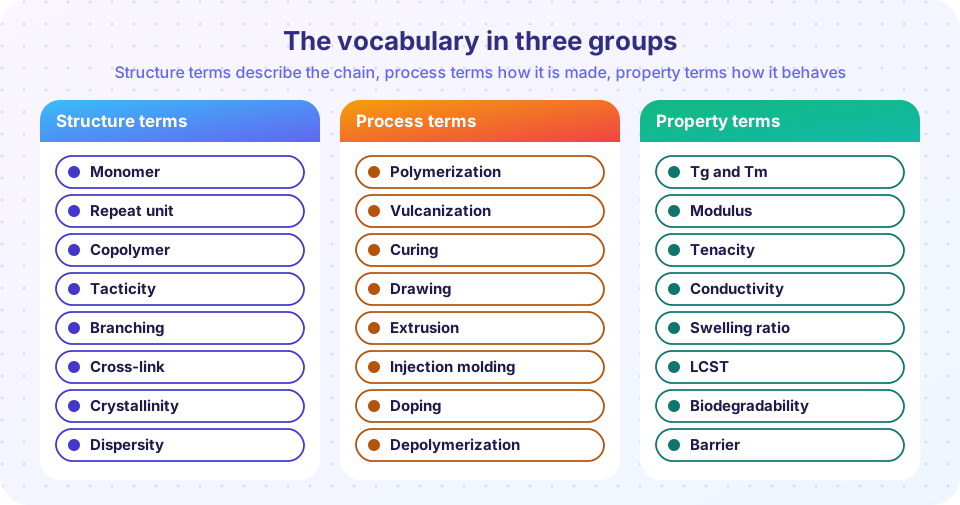
A glossary of about sixty key terms in polymer and materials chemistry, grouped by structure, processing, properties, characterization, materials and sustainability.
Every field has its own shorthand, and polymer science has plenty of it: abbreviations, Greek letters and words that mean something specific. This glossary collects about sixty terms from the whole course, grouped so related ideas sit together. Use it when a word in a lesson or a data sheet is unfamiliar, and use the flashcards below to turn recognition into recall.
Definitions here are short on purpose. Where a term has a formula, the formula is given so you can connect the word to a calculation.
What you will learn
- Recall the precise meaning of the main terms of the course.
- Recognize common abbreviations and symbols.
- Connect each term to the lesson topic where it matters.
Key terms
Terminology: the shared vocabulary that lets chemists and engineers describe the same material in the same way.
Abbreviation: a short form such as PET, Tg or DSC, standard in data sheets and papers.
Symbol: a letter or Greek letter standing for a quantity, such as Mn, σ or Đ.
Structure
| Term | Meaning |
|---|---|
| Monomer | A small molecule that can link with others to form a polymer |
| Repeat unit | The smallest group of atoms that repeats along a chain |
| Degree of polymerization (Xn) | Average number of repeat units per chain, Mn / M0 |
| Homopolymer | Polymer made from one kind of monomer |
| Copolymer | Polymer made from two or more kinds of monomer (random, alternating, block, graft) |
| Tacticity | Stereochemical arrangement of side groups: isotactic, syndiotactic, atactic |
| Branching | Side chains growing from the backbone, which lowers packing |
| Cross-link | A covalent bridge between chains that forms a network |
| Conjugation | Alternating single and double bonds with delocalized π electrons |
| Crystallinity (Xc) | Mass fraction of a polymer that is crystalline |
| Amorphous | Without long-range order |
| Spherulite | A spherical crystalline superstructure built from radiating lamellae |
| Lamella | A thin folded-chain crystal plate, typically about 10 nm thick |
| Dispersity (Đ) | Mw / Mn, the breadth of the molar-mass distribution |
| Mn, Mw, Mz | Number-, weight- and z-average molar mass; Mn ≤ Mw ≤ Mz |
Processing
| Term | Meaning |
|---|---|
| Polymerization | A reaction linking monomers into chains |
| Polycondensation | Step-growth polymerization that releases a small molecule |
| Vulcanization | Cross-linking rubber, traditionally with sulfur |
| Curing | Cross-linking a thermoset resin into a network |
| Gel point | Conversion at which a network first spans the sample |
| Extrusion | Forcing a melt through a die to make a profile, film or pellets |
| Injection molding | Forcing a melt into a mold to make a solid part |
| Blow molding | Inflating a hot hollow tube inside a mold |
| Spinning | Extruding filaments through a spinneret; melt, dry, wet or gel |
| Drawing | Stretching a filament to align chains and raise strength |
| Annealing | Holding below Tm to let crystals perfect or stresses relax |
| Doping | Adding charge carriers to a conjugated polymer by oxidation or reduction |
| Sol-gel | Making an inorganic network from liquid precursors by hydrolysis and condensation |
| Compounding | Mixing a polymer with additives and fillers |
Properties
| Term | Meaning |
|---|---|
| Glass transition (Tg) | Temperature range where an amorphous polymer changes from glassy to rubbery |
| Melting temperature (Tm) | Temperature at which crystals melt |
| Young's modulus (E) | Stiffness: stress divided by strain in the elastic region |
| Yield | The point where deformation becomes permanent |
| Tenacity | Breaking force per unit linear density of a fiber (N/tex) |
| Tex, denier | Mass in grams of 1,000 m and 9,000 m of fiber |
| Creep | Slow deformation under constant load |
| Impact strength | Energy absorbed before fracture at high rate |
| Anisotropy | Direction-dependent properties |
| Conductivity (σ) | Ability to carry current, σ = n q μ |
| Swelling ratio (Q) | Swollen mass divided by dry mass |
| LCST | Lower critical solution temperature: above it, a polymer separates from water |
| Permeability | Rate at which gas or vapor passes through a film |
| Plasticizer | Small molecule that softens a polymer by lowering Tg |
Characterization
| Term | Meaning |
|---|---|
| GPC / SEC | Gel permeation (size-exclusion) chromatography: sorts chains by coil size |
| DSC | Differential scanning calorimetry: heat flow versus temperature |
| TGA | Thermogravimetric analysis: mass versus temperature |
| DMA | Dynamic mechanical analysis: modulus and tan δ versus temperature |
| FTIR | Fourier-transform infrared spectroscopy: bond vibrations |
| NMR | Nuclear magnetic resonance: nuclear environments and composition |
| XRD / SAXS | X-ray diffraction / small-angle X-ray scattering |
| SEM / TEM | Scanning / transmission electron microscopy |
| AFM | Atomic force microscopy: surface topography with a sharp tip |
| Bragg's law | n λ = 2 d sin θ |
| Wavenumber | Waves per centimeter (cm⁻¹), the IR x-axis |
| Chemical shift (δ) | NMR peak position in ppm |
Materials and sustainability
| Term | Meaning |
|---|---|
| Thermoplastic | Polymer that softens on heating and can be reshaped |
| Thermoset | Cross-linked polymer that cannot be re-melted |
| Elastomer | Polymer that stretches several times its length and recovers |
| Composite | Material of two or more phases, such as fiber in a matrix |
| Matrix | The continuous phase that binds the reinforcement |
| Laminate | A stack of plies with chosen fiber orientations |
| Hydrogel | Cross-linked hydrophilic network swollen with water |
| Polaron | A charge carrier plus the local chain distortion it causes |
| Percolation | Sudden appearance of a connected path at a critical filler fraction |
| Bio-based | Made from renewable biological carbon |
| Biodegradable | Broken down by microorganisms under stated conditions |
| Compostable | Biodegradable within a set time in a defined composting system |
| Mechanical recycling | Melting and reforming plastic without changing its chemistry |
| Chemical recycling | Depolymerizing plastic to monomers or feedstocks |
| Downcycling | Reuse in a lower-value application |
| LCA | Life cycle assessment of impacts across a product's life |
| Functional unit | The service compared in an LCA |
| Microplastic | A plastic particle from about 1 µm to 5 mm |
Common misconceptions
"Plastic" and "polymer" are synonyms. Polymers include rubbers, fibers, proteins, cellulose and DNA; plastics are the group of moldable synthetic polymers.
"Tg and Tm are the same thing." Tg is a change in mobility in amorphous regions; Tm is the melting of crystals.
"Biodegradable, compostable and bio-based mean the same." Three different properties, with different tests and different meanings.
Try it
First, a flashcard deck. Click the card to reveal the definition, then choose the next term at random.
Second, a searchable lookup in the console. Change the query to find every term that mentions a word.
Press Run (or Ctrl + Enter) to see the console output here.
No output.
Check your understanding
Quick check · 4 questions
of 4 answered You scored / 4 · perfect!
-
1. Which term describes the average number of repeat units per chain?
Xn = Mn / M0 counts repeat units per chain on average. -
2. A functional unit in LCA is:
It sets the common basis so different products are compared fairly. -
3. Which pair of terms are NOT synonyms?
Bio-based describes the source of the carbon; biodegradable describes end-of-life behavior. -
4. What does LCST stand for?
Above the LCST a polymer such as PNIPAM separates from water.
Summary
- The vocabulary falls into structure, processing, properties, characterization and materials or sustainability terms.
- Many terms are paired with a formula (
Xn,Đ,σ = n q μ, Bragg's law): learn them together. - Keep similar-sounding terms apart: Tg versus Tm, bio-based versus biodegradable, thermoplastic versus thermoset.
Next: Cheat sheet
Track your progress
Create a free account to tick off lessons and pick up where you left off on any device.
of Polymer and Materials Chemistry lessons completed